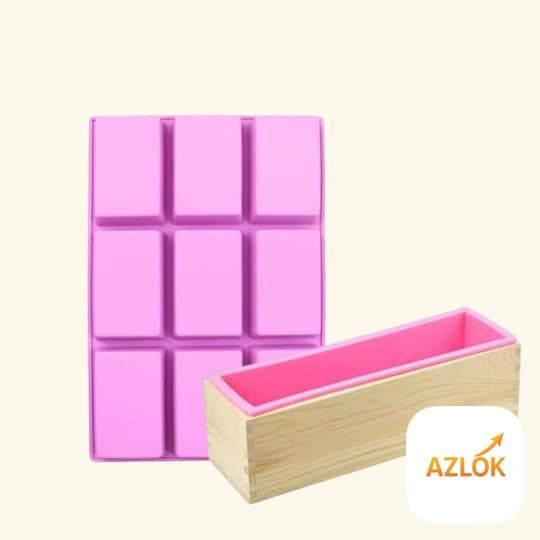

The Azlok 9 Cavity Rectangle Shape Soap Mold + Wooden Soap Mold combo gives you two tools in one pack: a flexible silicone tray that pops out nine ready-to-use rectangular bars, and a wooden loaf mold for pouring a single big block you can slice yourself. The silicone mold suits melt-and-pour and small batches, while the wooden mold is better for cold-process soap that needs firm sides and gentle insulation during curing.
What You Get and When to Use Each
Soap makers often ask which mold to reach for. The short answer: pick based on your method and how many bars you want in one go.
- 9-cavity silicone rectangle mold — Ideal for melt-and-pour glycerine soap, small test batches, and gifting. Each cavity releases a neat, uniform bar with clean edges. No cutting needed.
- Wooden loaf mold — Suited to cold-process and hot-process soap. You pour one large batch, let it set, unmould, and cut into bars of your preferred thickness. The wood holds warmth, which helps the saponification process along.
Having both means you can experiment with different recipes without buying separately. This is why makers often keep a combo like Azlok's in their kit.
How to Use the Silicone Mold
- Melt your soap base (glycerine, goat milk, or shea) gently in a double boiler or microwave in short bursts.
- Stir in colour, fragrance or essential oil once slightly cooled, so the scent doesn't burn off.
- Pour into the nine cavities. Spray the tops lightly with rubbing alcohol to remove bubbles.
- Let it set at room temperature for a few hours, or refrigerate for faster release.
- Flex the mold and push each bar out from the base. Silicone releases without greasing.
How to Use the Wooden Loaf Mold
For cold-process soap, line the wooden mold with baking paper or a silicone liner first — raw soap batter is caustic and will stain bare wood. Pour your traced batter in, tap to settle, cover, and insulate with a towel. After 24 to 48 hours, lift the block out using the liner, then cut into bars with a knife or wire cutter. Cure the bars on a rack for four to six weeks before use.
Tips and Safety Notes
- Wear protection when handling lye. Cold-process soap uses sodium hydroxide, which is corrosive. Use gloves, goggles and work in a ventilated area.
- Always line the wooden mold. It protects the wood and makes unmoulding far easier.
- Don't overheat fragrance oils. Add them at the right temperature to keep the scent strong.
- Let bars fully cure. Under-cured cold-process soap is soft and harsh on skin.
- Patch-test finished soap if you're using new essential oils, especially for sensitive skin.
Buying and Storage
This combo comes in Pack of 1, Pack of 5 and Pack of 10, so hobbyists and small businesses can scale up as needed. If you sell at local markets or run soap-making workshops, the larger packs let you produce several batches at once.
Store silicone molds flat, away from sharp objects and direct sunlight, so they keep their shape. Wipe them clean with warm soapy water and dry fully. For the wooden mold, keep it dry and away from damp to prevent warping, and never machine-wash it. With basic care, both molds last through many batches.
FAQ
Can I use the silicone mold for cold-process soap?
Yes, but individual silicone cavities can be tricky for the high-heat, thick batter of cold process. Many makers prefer the wooden loaf mold for cold process and reserve the silicone tray for melt-and-pour or lighter recipes.
Do I need to grease the silicone mold?
No. Silicone is naturally non-stick, so bars release once fully set. Chilling briefly can make removal even easier.
How many bars does this combo make?
The silicone tray produces nine rectangular bars per pour. The wooden loaf mold gives one large block that you can slice into as many bars as you like, depending on thickness.
Why should I line the wooden mold?
Raw soap batter can stain and damage bare wood, and lining makes it much easier to lift out the hardened block. Use baking paper or a fitted silicone liner every time.
Are these molds reusable?
Yes. Both are designed for repeated use. Clean them after each batch, dry thoroughly, and store properly to extend their life.