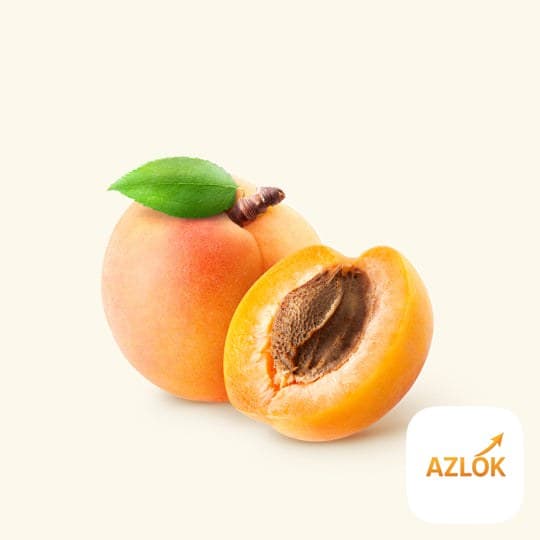

Apricot Liquid Extract is a herbal cosmetic ingredient made from the fruits and seeds of the apricot plant (Prunus Armeniaca), used at 1–2% in DIY skincare, soap and hair formulations. It comes in a water-soluble version (extracted in vegetable glycerine, alcohol-free) and an oil-soluble version (extracted in soy oil), so you can pick whichever suits your recipe base.
What is Apricot Liquid Extract?
This is a solvent-extracted botanical extract, not a pressed oil. The label term for it is Prunus Armeniaca Extract, and it also goes by names like Armenian Plum, Damasco and Abricot. Azlok's extract carries a 4:1 herb-to-extract ratio, which means 4 kg of raw apricot material is concentrated down to yield 1 kg of finished extract. It is a liquid, essentially odourless and tasteless, and is kept stable with a small amount of BHT as a preservative note.
A couple of practical points worth knowing before you buy:
- Water-soluble — extracted in vegetable palm glycerin/glycerol, alcohol-free. Best for water-based products.
- Oil-soluble — extracted using soy oil. Best for oil and butter-based products.
- It is described as free from gluten, artificial colour, heavy metals and fertilisers.
Where you can use it
Because it blends easily and has no strong smell of its own, apricot extract is a flexible add-in for personal care projects. Common applications include:
- Soap making (cold process and melt-and-pour)
- Shampoos and hair conditioners
- Face wash, cleansers and toners
- Lotions, creams and body butters
- Serums and facial oils
- General DIY personal care for face, hair, skin and body
The neutral odour is genuinely useful here — it lets your fragrance or essential oil blend come through without competing notes.
How to use it correctly
The recommended dosage is 1–2% of your total formulation. For a 100 gm batch of cream, that works out to roughly 1–2 gm of extract. A few tips to get it right:
- Match the extract to your base. Use the water-soluble (glycerin) version in water-phase products and the oil-soluble (soy oil) version in oil-phase products, so it mixes in cleanly.
- Add it during the cool-down phase, once your batch has dropped below about 40°C, rather than during high heat.
- Stir gently but thoroughly until fully incorporated.
- Keep a written note of the percentage you used so you can repeat a batch you like.
If you are formulating a leave-on product, remember that this extract is one ingredient in a system — you will still need a proper broad-spectrum preservative for any water-containing recipe.
Safety and honest notes
This is a cosmetic-grade ingredient meant for external use in formulations, not a food or supplement. A few sensible precautions:
- Keep it away from the reach of children.
- Avoid direct contact with the eyes; rinse with clean water if contact happens.
- Do the industry-standard patch test on your finished product before wider use, especially on facial skin.
- The oil-soluble version is extracted using soy oil, so keep that in mind if you or your customers have soy sensitivities.
- Stick to the 1–2% guidance rather than assuming more is better.
For business buyers, Azlok can provide COA and MSDS documents for both the water-soluble and oil-soluble grades on request.
Buying and storage
Azlok offers Apricot Liquid Extract starting at ₹319, with pack sizes from 100 GM up to bulk 25 KG drums — handy whether you are testing a single serum recipe or running small-batch production. It is made in India and has a shelf life of around 2 years.
Store it in a cool, dry place, tightly closed and away from direct sunlight and heat. Keeping the cap sealed between uses helps protect the extract and extend its usable life. Always check that you are ordering the right solubility (water or oil) for the products you plan to make.
FAQ
Is Apricot Liquid Extract the same as apricot oil?
No. Apricot oil is pressed from the kernel, while this is a concentrated 4:1 liquid extract made using a glycerine or soy-oil solvent. They are used differently in formulations.
How much apricot extract should I add to a recipe?
Use 1–2% of your total batch weight. For 100 gm of product, that is about 1–2 gm of extract, added during the cool-down phase.
Which version should I choose — water-soluble or oil-soluble?
Pick water-soluble (glycerin-based) for water-based products like toners, face washes and shampoos, and oil-soluble (soy-oil based) for oil, butter and balm formulations.
Does it have a strong smell?
No. The extract is described as odourless and tasteless, so it will not interfere with your chosen fragrance or essential oil blend.
Can I eat it or use it internally?
No. This is a cosmetic ingredient for external use in personal care formulations only. Do not ingest it, and keep it away from children.