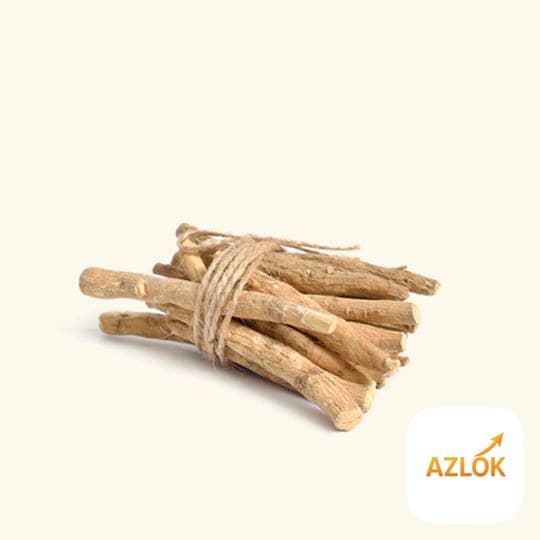

Ashwagandha Liquid Extract is a concentrated herbal extract of Withania somnifera used mainly as a functional ingredient in DIY personal care — soaps, shampoos, creams, lotions, serums and face washes. Azlok's version is a 4:1 extract (four kilograms of herb yield one kilogram of extract) and is available in both water-soluble (glycerine-based, alcohol-free) and oil-soluble (soy oil) forms, so you can match it to whatever base you are formulating.
What is Ashwagandha Liquid Extract?
Ashwagandha is one of India's most familiar herbs, often called Indian Ginseng or White Berry. The name comes from 'ashwa' (horse), a nod to the smell of the fresh root. In traditional practice the root has long been associated with calming and restorative uses. This product, however, is a cosmetic-grade liquid extract meant for external formulations rather than a supplement to be swallowed.
- Botanical name: Withania somnifera
- CAS number: 90147-43-6
- Odour and taste: Practically odourless and tasteless
- Strength: 4:1 herb-to-extract ratio
- Physical form: Liquid
- Free from: Gluten, artificial colour, heavy metals and fertilizers
Common uses in DIY personal care
Because the extract is nearly colourless, odourless and available in water- or oil-soluble grades, it slots neatly into a wide range of homemade and small-batch products:
- Face washes, serums and toners
- Creams, lotions and body butters
- Cold-process and melt-and-pour soaps
- Shampoos and hair conditioners
- Scalp and body oils (using the oil-soluble grade)
The water-soluble version blends into aqueous phases and glycerine-rich formulas, while the oil-soluble version is ideal for anhydrous products like balms, serums and hair oils.
How to use it in a formulation
The recommended usage rate is 1–2% of your total formula. That means for a 100 g batch of cream you would add roughly 1–2 g of extract. A few practical pointers:
- Match the grade to your base. Use the glycerine-based water-soluble extract for water-based products and the soy-oil grade for oil-based ones.
- Add it in the right phase. Water-soluble extracts go into the water phase; oil-soluble extracts go into the oil phase before emulsifying.
- Add at cool-down where possible. To protect delicate actives, stir it in once your mixture has cooled below 40°C, unless your recipe requires otherwise.
- Keep good notes. Record the percentage you used so you can reproduce a batch you like.
Safety notes
This is a cosmetic raw material, not a food or medicine. Please keep these points in mind:
- External use only. Do not ingest the cosmetic extract.
- Patch test any new formulation on a small area of skin before wider use.
- The product contains BHT as a preservative note and the oil-soluble grade uses soy oil — relevant if you or your customers have soy sensitivities.
- Not to be used during pregnancy. Consult a physician before use if you are nursing or taking any medication.
- No herb-drug interactions are documented, but caution should still be observed with external applications.
- Keep out of reach of children.
Buying and storage tips
Azlok offers Ashwagandha Liquid Extract from a 100 g bottle right up to 25 kg, so hobbyists and small businesses can both find a suitable pack size. The 100 g size starts at around ₹329, which makes it easy to trial before committing to bulk.
- Store in a cool, dry place away from direct sunlight.
- Shelf life is about 2 years when stored properly.
- Keep the cap tightly closed to avoid contamination.
- If you need documentation, COA and MSDS sheets are available for both the water-soluble and oil-soluble grades — useful for anyone selling finished products.
FAQ
Can I drink Ashwagandha Liquid Extract?
No. This is a cosmetic-grade extract intended for external formulations such as creams, soaps and serums. It is not a dietary supplement and should not be ingested.
How much should I add to my recipe?
The recommended usage is 1–2% of the total weight of your formulation. For a 100 g batch, that is roughly 1–2 g of extract.
What is the difference between the water-soluble and oil-soluble versions?
The water-soluble grade is extracted using vegetable glycerine and is alcohol-free, so it mixes into water-based products. The oil-soluble grade uses soy oil and is meant for oil-based products like balms and hair oils.
Does it have a strong smell or colour?
No. The extract is practically odourless and tasteless, and it is free from artificial colour, which is why it works well in a variety of cosmetics without affecting fragrance or shade.
Is it safe during pregnancy?
It is not recommended for use during pregnancy. If you are nursing or taking any medication, please consult a physician before use.