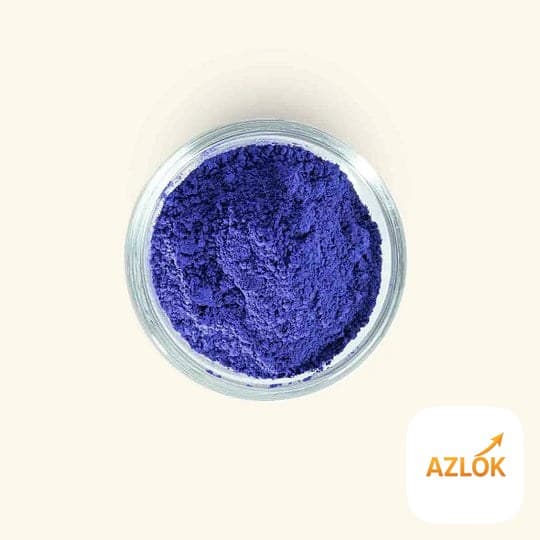

Azlok Blue Soap Color is a pigment-rich, mica-enriched powder that gives handmade soap a clean, even blue — anything from a soft baby blue to a deep Prussian tone, depending on how much you use. Add a small amount, disperse it well, and it colours your batch without streaks or clumps.
What is Blue Soap Color used for?
This is a colorant, not a fragrance or an additive with any cleansing role. Its job is simple: to tint your product a reliable blue. Makers reach for it in a few common ways.
- Cold process soap: the classic use, where the colour needs to survive the saponification (curing) process and stay true.
- Melt-and-pour soap: stir into a melted base for quick, small-batch colouring.
- Cosmetics and DIY bath products: bath bombs, salts and similar projects where a splash of blue makes the difference.
- Custom shades: blend with other pigments to build teals, purples, greys or muted denim tones.
How to use it in soap
A little goes a long way, so start conservatively and build up. The most common mistake is dumping dry powder straight into the batter, which leaves speckles.
- Pre-disperse the powder. Mix roughly one teaspoon of colour into one tablespoon of a light carrier — distilled water, or a light oil like sweet almond or your soaping oil. Stir into a smooth slurry with no lumps.
- Add gradually. For cold process, stir the slurry into your batter at thin trace. For melt-and-pour, add to the melted base a few drops at a time.
- Judge the depth. Start with about half a teaspoon of dispersed colour per 500 g of oils or base, then add more for a deeper blue.
- Blend for custom tones. Combine with a touch of pink or red for lavender-purple, or with a little black or grey for a moody slate.
Because the exact shade depends on your recipe, oils and any fragrance you add, it's worth doing a small test batch before committing to a large one.
Tips and safety notes
Pigment powders are messy by nature. A few habits keep your workspace — and your soap — clean.
- Wear a dust mask when scooping dry powder so you don't inhale fine particles, and work away from draughts.
- Pre-disperse every time. It is the single biggest factor in getting an even colour.
- Keep the powder off skin and clothes; it stains. Gloves and an apron help.
- Store the container tightly closed so it doesn't pick up moisture or clump.
- This is a colorant for external DIY products only. Do not ingest it, and keep it out of reach of children.
- If you are making leave-on cosmetics, always patch-test your finished product and follow safe usage rates for your formulation.
Buying and storage
Azlok Blue Soap Color comes in 50 g, 100 g, 500 g and 1 kg packs, priced from ₹349, so you can pick a small pouch for testing or a larger size once you know your recipe. For most hobby makers a 50 g or 100 g pack lasts a long time, since dosing is measured in teaspoons.
Store it in a cool, dry place away from direct sunlight and humidity. Kept sealed, the powder has a shelf life of around two years. If it clumps a little over time, that is usually just moisture — breaking it up and pre-dispersing in liquid restores it. The powder is made in India and available on azlok.com alongside other candle and soap colours if you want to build a palette.
FAQ
How much Blue Soap Color do I need per batch?
Start with about half a teaspoon of pre-dispersed colour per 500 g of oils, then add more to deepen the shade. Because it is pigment-rich, small increases make a big difference.
Will the blue fade during cold process saponification?
Mica-based pigments like this are chosen for soap because they hold up well through the process. For the truest result, pre-disperse the powder and test a small batch, since your oils and fragrance can slightly shift the final tone.
Can I mix it with other colours?
Yes. Blending with red or pink gives purples, and adding grey or black creates muted slate tones. Mix your dispersions first, then combine, so you can control the shade.
Is it safe for bath bombs and cosmetics?
It is suitable for external DIY bath and cosmetic products when used at sensible rates. Do not ingest it, avoid inhaling the dry powder, and patch-test finished leave-on products.
Does the powder have a scent?
The listing describes a fresh aroma, but it is primarily a colorant. Add your own fragrance or essential oils to scent the finished product.