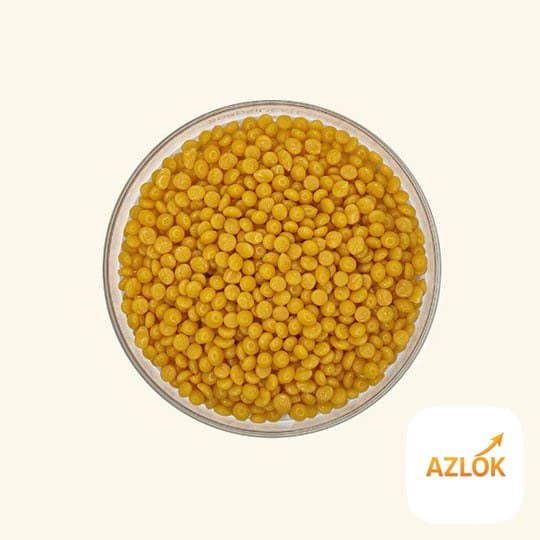

Candelilla wax is a plant-based, vegan wax made from the coating on the leaves of the Candelilla shrub, and it is the go-to swap for beeswax in lip balms, lotion bars and salves. It comes as yellowish-brown beads, melts between roughly 144 and 147 °F, and gives products firmness and a smooth glide without any animal-derived ingredients. If you make cosmetics at home or run a small skincare label, it is one of the most useful hardening waxes to keep on the shelf.
What is Candelilla wax?
Candelilla wax (INCI name Candelilla Cera, CAS 8006-44-8) is harvested from the wax that naturally coats the leaves of Euphorbia Candelilla shrubs. Because it comes entirely from plants, it is suitable for vegan and vegetarian formulations. It helps lock moisture into the skin, adds structure to balms and bars, and gives a pleasant, non-greasy finish. Azlok stocks it in sizes from 100 gm up to 25 kg, so it works for both first-time hobbyists and bulk buyers.
Common uses
- Lip balms and lip butters — the classic use. Candelilla sets a balm firmly and gives a clean glide.
- Lotion bars and body butters — hardens the bar so it holds shape at room temperature.
- Salves and balms — thickens oil-based blends into a spreadable consistency.
- Solid perfumes and creams — provides body and structure.
- Candle making — sometimes added to raise firmness and melting point in blends.
How to use it
Candelilla is harder and more brittle than beeswax, so you generally need less of it. As a rough rule, use about half to two-thirds the amount you would use for beeswax.
- Weigh your ingredients. Formulating by weight is far more reliable than by volume.
- Melt gently. Use a double boiler or a heatproof bowl over simmering water. Melt the wax with your carrier oils and butters until fully liquid.
- Test the set. Before pouring the full batch, chill a small spoonful. Too hard? Add more oil. Too soft? Add a pinch more wax.
- Add heat-sensitive extras last. Stir in essential oils or fragrance oils once the mix is off the heat and slightly cooled, then pour into tubes, tins or moulds.
A simple starter lip balm ratio is roughly 20% Candelilla wax, 40% carrier oil (like almond or jojoba) and 40% butter (such as shea or cocoa), adjusted to your preferred firmness.
Tips and safety notes
- Candelilla is firmer than beeswax, so start with a smaller quantity and increase only if you need a stiffer set.
- Melt on low, steady heat. Never leave melting wax unattended, and keep water away from hot oil.
- Do a small patch test of any finished skincare product before wider use, especially if you have sensitive skin.
- This is a cosmetic raw material — not for eating on its own. Keep out of reach of children.
- The natural yellow tint can lightly colour very pale balms. This is normal and does not affect performance.
Buying and storage
Choose your pack size by how often you make products: 100 gm is ideal for trying a recipe or two, while 5 kg and above suit small businesses producing in batches. Store Candelilla wax in a cool, dry place away from direct sunlight and heat. Kept sealed and dry, it has a shelf life of around two years. Azlok's Candelilla wax starts at ₹249, and buying larger packs usually brings the per-kilo cost down if you make regularly.
FAQ
Is Candelilla wax vegan?
Yes. It is derived entirely from the leaves of the Candelilla shrub, with no animal-derived ingredients, which makes it a popular vegan substitute for beeswax.
Can I replace beeswax with Candelilla wax one-to-one?
Not exactly. Candelilla is harder and more brittle, so you typically need only about half to two-thirds of the beeswax amount. Test a small batch and adjust the wax-to-oil ratio to get the firmness you want.
What is the melting point of Candelilla wax?
It melts at roughly 144 to 147 °F. A gentle double boiler is the easiest way to melt it evenly without scorching.
How long does Candelilla wax last?
About two years when stored in a cool, dry place away from sunlight and heat. Keep the pack sealed to avoid moisture and dust.
Is Candelilla wax safe for lip balms?
Yes, it is widely used in lip balms and cosmetics. As with any skincare item, patch-test your finished product and keep it clean during preparation.