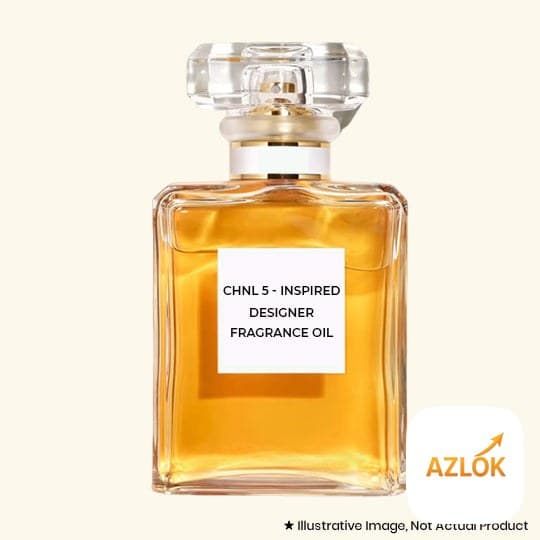

Azlok's Chnl 5 - Inspired Designer Fragrance Oil is a floral perfume oil that recreates the character of the classic Chanel No. 5 style scent, made for DIY perfume, candle and soap projects. It is a pale yellow oil with a soft, powdery floral aroma, and it works across perfumes, attars, candles, melt-and-pour soaps, lotions and diffusers. Starting price is ₹599, and it comes in 50 gm, 100 gm and 500 gm sizes.
This is an inspired-by fragrance, created through chemical analysis and replication. Azlok is not affiliated with the trademark owner; the brand name is used only as a reference point so you know what the scent smells like.
What it smells like
Expect a refined, timeless floral. There's a soft powdery quality with rich flower notes layered together, the kind of scent that reads as elegant rather than sweet or fruity. It suits people who like classic, understated perfumes. Because the profile is versatile, it blends well into wax, soap and body-care bases without turning harsh.
Common uses
- Perfumes and attars: dilute in a perfumer's alcohol or a carrier oil to make your own signature scent.
- Candles: add to soy, coconut or paraffin wax for a scented burn.
- Melt-and-pour soaps and body washes: a little goes a long way in cleansing bases.
- Lotions and creams: lightly fragrance leave-on products (patch-test first).
- Room fresheners and reed diffusers: mix with a diffuser base for a lasting home scent.
The oil is phthalate-free, paraben-free and SLS/SLES-free, which many small-batch makers prefer for cleaner-label products.
How to use it: dosing basics
Fragrance oils are strong, so measure by weight rather than guessing. As a general starting point:
- Candles: around 6–10% of the total wax weight, staying within your wax's recommended maximum load.
- Melt-and-pour soap: roughly 1–3% of the base weight.
- Perfume: about 15–25% fragrance oil in perfumer's alcohol for an eau-de-parfum style strength; go lighter for body mists.
- Diffusers: 20–30% oil in a suitable diffuser base.
Always make a small test batch first. Cure candles for a few days to a week before judging the scent throw, and let perfume blends rest so the notes settle.
Safety and skin use
Treat this as a concentrated ingredient, not a ready-to-wear perfume. A few honest reminders:
- Never apply the neat oil directly to skin. Dilute it in a carrier or alcohol and do a patch test on your inner arm before wider use.
- Do not ingest, and keep it away from eyes, children and pets.
- Work in a ventilated space and wipe up spills; the oil can affect some plastics and finished surfaces.
- Follow the usage rate for the specific product type you are making, especially for anything that stays on skin.
Buying and storage tips
Pick your size based on the project. The 50 gm bottle is ideal for testing a recipe or making a small batch of candles or soap. The 100 gm suits regular hobbyists, while the 500 gm makes sense for small businesses running repeat production. Buying larger usually brings down the per-gram cost.
Store the oil in a cool, dry place away from direct sunlight and heat, with the cap tightly closed to slow evaporation and oxidation. Kept well, it has a shelf life of about two years. If the colour or smell changes noticeably, it's past its best.
FAQ
Is this real Chanel No. 5 perfume?
No. It is an independently made fragrance oil inspired by that scent profile, produced through chemical analysis. Azlok is not affiliated with any trademark owner, and the brand name is used only for reference.
Can I wear it directly as a perfume?
Not in its neat form. It is a concentrated fragrance oil meant to be diluted in perfumer's alcohol or a carrier oil before use on skin. Always patch-test the finished dilution.
Is it suitable for candles and soap?
Yes. It works in candles, melt-and-pour soaps, body washes, lotions, diffusers and room fresheners. Use the recommended percentage for each product type for best results.
How long does it last?
About two years when stored in a cool, dry place away from light and heat, with the bottle kept tightly sealed.
Which size should I buy?
Choose 50 gm for testing, 100 gm for regular hobby use, and 500 gm for small-scale production where you need a lower cost per gram.