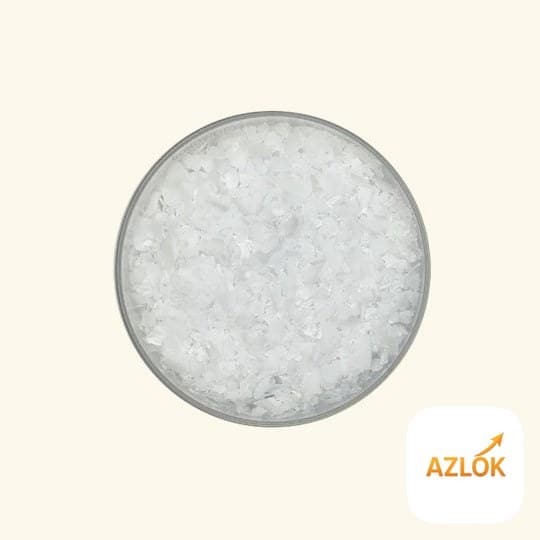

Emulsifying wax is the ingredient that lets you blend oil and water into a smooth, stable cream or lotion that will not separate. Add it to your oil phase, heat both phases, combine and stir, and you get a uniform emulsion instead of an oily mess floating on water. Azlok's emulsifying wax is a plant-based blend of fatty alcohols and Polysorbate 60, sold as easy-to-melt flakes.
What emulsifying wax actually does
Oil and water do not mix on their own. In any moisturiser, serum or body butter, an emulsifier is what holds those two phases together permanently. This wax acts as a binding agent, a mild thickener and a stabiliser all at once, which is why it appears in so many beauty formulas.
Its INCI name is Cetyl Stearyl Alcohol and Polysorbate 60, and it carries CAS number 8014-38-8. It is made from vegetable fats, so the base is fatty acids and natural oils. Melting point is around 62°C and the flakes are pale yellow.
Where you can use it
- Lotions and body milks — light, pourable emulsions.
- Face and hand creams — thicker, richer textures.
- Hair conditioners and masks — smooth, spreadable consistency.
- Cleansing balms and lotions — that rinse away cleanly.
- Sunscreen and cosmetic bases — as a stable carrier for actives.
How to use it in a basic lotion
A standard oil-in-water emulsion uses roughly 3% to 8% emulsifying wax of the total recipe weight. More wax gives a thicker, creamier result. A simple starter formula by weight:
- Water phase: around 70% distilled water, heated to about 70°C.
- Oil phase: around 20% carrier oil plus 6% emulsifying wax, heated separately to about 70°C until fully melted.
- Pour the water phase into the oil phase slowly while stirring or blending continuously.
- Keep mixing as it cools and thickens.
- Once it drops below 40°C, add your preservative, fragrance and any heat-sensitive actives.
Always weigh ingredients on a scale rather than measuring by volume. Consistency in cosmetics depends on accurate ratios.
Safety and formulating tips
- Use a preservative. Any product containing water can grow mould and bacteria within days. A broad-spectrum preservative is not optional for creams and lotions.
- Heat both phases to a similar temperature before combining, or the emulsion may break.
- Patch-test your finished product on your inner arm before regular use, especially with added essential oils or actives.
- Keep melting temperatures moderate. Overheating oils can degrade them; a water bath gives you gentle, even heat.
- This is a cosmetic raw material, not a food ingredient. Do not ingest it, and keep it away from children.
- Work in a clean space and sanitise your tools and containers to extend the shelf life of what you make.
Buying and storage
Azlok sells emulsifying wax in packs from 100 g right up to 25 kg, so a hobbyist making a few jars and a small skincare brand doing production runs are both covered. Pricing starts at around Rs 199, and the flake form makes it easy to weigh out and melt.
Store the wax in a cool, dry place away from direct sunlight and moisture. Kept properly, it has a shelf life of about two years. Reseal the pack tightly after each use, since flakes can clump if exposed to humidity. Buying a larger pack works out cheaper per gram if you formulate regularly, but only go big once you are confident in your recipes.
FAQ
Is emulsifying wax the same as beeswax?
No. Beeswax is a thickener but a weak emulsifier and needs borax to work. Emulsifying wax is a dedicated emulsifier that reliably binds oil and water on its own, giving a smoother, more stable result.
How much emulsifying wax do I need in a lotion?
Typically 3% to 8% of the total weight of your recipe. Around 4–5% suits a light lotion, while 6–8% gives a thicker cream.
Is Azlok's emulsifying wax vegan?
It is made from plant-based vegetable fats rather than animal sources, so it suits plant-based formulations. Check the current specification if certification matters for your brand.
Do I still need a preservative if I use emulsifying wax?
Yes. Emulsifying wax stabilises the mix but does not stop microbial growth. Any water-containing product needs a proper broad-spectrum preservative.
Can I use it for hair conditioner?
Yes. It works well in rinse-off and leave-in conditioners, giving a smooth, spreadable texture that coats the hair evenly.