Fenugreek Liquid Extract: A DIY Maker's Guide to Methi in Skincare and Haircare

Fenugreek Liquid Extract is a concentrated form of methi seed made for cosmetic use, added at just 1–2% to soaps, shampoos, creams, serums and hair oils. Azlok's version is a 4:1 extract (four kilograms of seed yield one kilogram of extract), tasteless and virtually odourless, and comes in both water-soluble and oil-soluble forms so you can slot it into almost any formulation.
What is Fenugreek Liquid Extract?
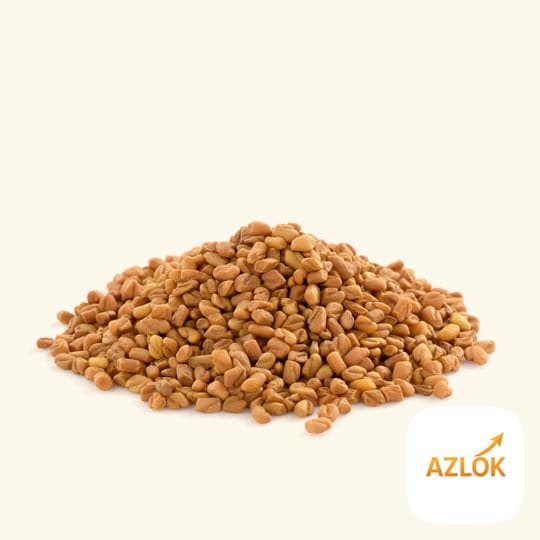
Fenugreek, known across India as methi, comes from the plant Trigonella foenum-graecum. It is one of the oldest cultivated herbs, with references reaching back to ancient Egypt, and its Latin-derived English name literally means "Greek hay". While the plant is native to the Mediterranean, India grows and eats it in enormous quantities.
This product takes raw fenugreek seeds and concentrates their soluble compounds into a liquid. The water-soluble version is alcohol-free and extracted using vegetable glycerin (palm or vegetable glycerol). The oil-soluble version uses soy oil as the carrier. BHT is added in small amounts as a preservative to keep the extract stable.
Where to use it
Because it is nearly odourless and colourless, fenugreek extract blends in without changing the smell or feel of your finished product. Common applications include:
- Hair care: shampoos, conditioners, hair serums and body/hair oils where methi is a traditional favourite.
- Skin care: face creams, lotions, serums and face washes.
- Cleansers: cold-process and melt-and-pour soap, along with liquid body washes.
Match the extract type to your base. Use the water-soluble (glycerin) version in water-based products like toners, gels, shampoos and lotions. Use the oil-soluble (soy oil) version in oil serums, balms and the oil phase of creams.
How to use it in formulations
The recommended dose is 1–2% of your total formula. In practice that is roughly 1–2 grams per 100 grams of product.
- Decide whether your product is mainly water-based or oil-based, and pick the matching extract.
- Add the extract to the cool-down phase of a cream or lotion, or to the water/oil phase as appropriate, rather than boiling it.
- Stir gently and thoroughly so it disperses evenly.
- Always weigh with a small scale for accuracy at these low percentages.
Because it is tasteless and unscented, it will not interfere with any fragrance or essential oil you have chosen for the batch.
Safety and honest notes
This extract is made for external, cosmetic use. A few sensible points:
- Patch test any new formulation on your inner arm before wider use.
- Stick to the 1–2% guideline; more is not better and can affect texture.
- The manufacturer notes no known herb–drug interactions, but caution is advised with external applications. Do not treat this as a medicine or a cure for any condition.
- Keep away from children and store safely.
- The product is stated to be free from gluten, artificial colour, heavy metals and fertilizers. Always check the accompanying COA and MSDS for your specific batch.
Buying and storage
Azlok offers Fenugreek Liquid Extract from a 100 gm bottle up to bulk 25 kg packs, so it suits both hobby makers and small businesses scaling up. Pricing starts at ₹349, and packaging is arranged as per requirement.
The extract has a shelf life of around 2 years when stored well. Keep it in a cool, dry place, tightly closed and out of direct sunlight. Use clean, dry utensils each time to avoid contamination, and label your bottle with the opening date so you can track freshness.
FAQ
What is the difference between the water-soluble and oil-soluble versions?
The water-soluble version is extracted with vegetable glycerin and is alcohol-free, making it ideal for water-based products like shampoos, toners and lotions. The oil-soluble version uses soy oil and suits oil serums, balms and the oil phase of creams.
How much fenugreek extract should I add?
Use 1–2% of the total weight of your formulation, which is about 1–2 grams per 100 grams of product. Weigh it for accuracy.
Does it smell or taste of methi?
No. This extract is described as tasteless and odourless, so it will not affect the scent or flavour profile of your product. It is intended for external cosmetic use, not eating.
What does the 4:1 strength mean?
A 4:1 ratio means four kilograms of raw fenugreek seeds are concentrated to produce one kilogram of extract, giving you a more potent liquid than the raw herb.
How long does it last and how should I store it?
It has a shelf life of about two years. Store it in a cool, dry place away from sunlight, keep the cap tightly closed, and use clean, dry tools to prevent contamination.