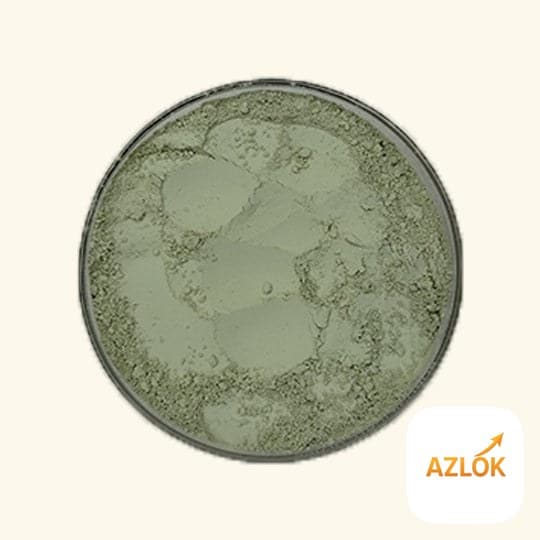

French Green Clay Powder is a natural mineral clay used mainly as a face and body mask to draw out excess oil, unclog pores and gently cleanse the skin. You mix a small amount with water (or another liquid), apply it as a thin layer, let it dry partly, and rinse off. It suits oily, combination, dry and acne-prone skin when used the right way.
What French Green Clay Powder Is
French Green Clay gets its colour from natural plant matter and mineral oxides, so the shade ranges from light to dark green. Azlok's version is a fine powder meant for external use in skin care, face masks, cosmetics and hair products. It is paraben free and free from artificial colour. Because it is highly absorbent, it works by pulling oil, sweat and surface impurities away from the skin as the mask dries.
Main Uses
- Face mask: the most popular use, especially for oily and acne-prone skin, to reduce shine and clean out congested pores.
- Spot treatment: a small dab on an active breakout area.
- Body and scalp: as a clarifying mask for oily areas or an occasional scalp treatment before shampoo.
- DIY cosmetics: a natural ingredient in homemade masks, cleansing bars and hair products.
How to Make a Basic Face Mask
- Take about one to two teaspoons of French Green Clay Powder in a non-metal bowl.
- Add filtered water a little at a time and stir into a smooth, spreadable paste. For dry skin, use rose water or add a few drops of a carrier oil.
- Apply an even, thin layer over clean skin, avoiding the eye area.
- Leave it on for 10 to 15 minutes. Do not let it dry rock-hard, as that can feel tight and drying.
- Rinse with lukewarm water using gentle circular motions, then pat dry and follow with a moisturiser.
Use it once or twice a week for oily skin and once a week or less for dry or sensitive skin. Mixing in a bit of honey or yoghurt makes a gentler, more hydrating mask.
Tips and Safety Notes
- External use only. Do not eat the clay and avoid direct contact with your eyes.
- Patch test first. Apply a little on your inner forearm and wait 24 hours before using it on your face, especially if your skin is sensitive.
- Avoid metal tools. Use a wooden, plastic or ceramic spoon and a glass or plastic bowl to keep the clay's properties intact.
- Do not over-dry. Rinse before the mask cracks to prevent tightness, and always moisturise afterwards.
- Keep away from children. Store the powder out of their reach.
- This is a cosmetic ingredient, not a medicine. If you have persistent acne or a skin condition, see a dermatologist.
Buying and Storage
Azlok sells French Green Clay Powder starting at ₹129, with pack sizes from 100 gm up to 25 kg, so it works for a single home user as well as small soap and cosmetic businesses. The product is made in India and has a shelf life of about two years.
To keep it fresh, store the powder in an airtight container in a cool, dry place away from direct sunlight and moisture. Always use a clean, dry spoon so no water gets into the main jar, since damp clay can clump and spoil faster. If you are buying larger packs, transfer smaller amounts into a working jar and keep the bulk sealed.
FAQ
Is French Green Clay good for oily and acne-prone skin?
Yes. It is absorbent and helps draw out excess oil and unclog pores, which is why it is a common choice for oily and acne-prone skin. Use it once or twice a week and always moisturise after rinsing.
Can dry or sensitive skin use it?
Yes, but less often and with care. Mix it with rose water, yoghurt or a little carrier oil instead of plain water, keep the mask on for a shorter time, and rinse before it fully dries.
How often should I use a green clay mask?
Once or twice a week is enough for most people with oily skin, and once a week or less for dry or sensitive skin. Over-use can leave skin feeling tight.
Can I use French Green Clay Powder on my hair?
Yes. Made into a paste, it can be used as an occasional clarifying scalp mask before shampooing, particularly if your scalp gets oily. Rinse thoroughly and condition afterwards.
Is it safe to leave the mask on until it fully dries?
It is better not to. Letting the clay harden completely can feel tight and dry, especially for sensitive skin. Rinse while the mask is still slightly damp for a more comfortable result.