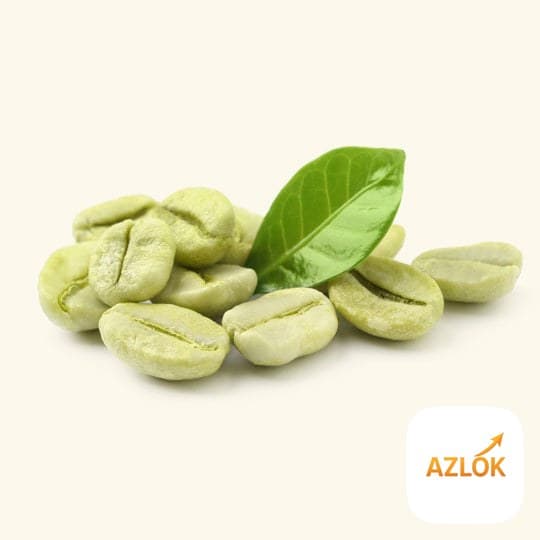

Green Coffee Liquid Extract is a cosmetic-grade herbal extract made from raw, unroasted Arabica coffee beans (Coffea Arabica), used mainly in skincare, hair and formulation work at around 1–2% of a recipe. It is not a food or drink ingredient and should not be swallowed. Azlok offers it in both water-soluble and oil-soluble versions so you can match it to the base of whatever you are making.
What is Green Coffee Liquid Extract?
Unlike the roasted beans you brew each morning, green coffee beans are fresh and unroasted, which keeps more of their naturally occurring plant compounds intact. This extract is drawn from those raw beans and supplied as a liquid. It is tasteless and has no odour, which makes it easy to blend without changing the smell of your product.
A few specifications worth knowing before you buy:
- Botanical name: Coffea Arabica (also called Arabica green coffee beans)
- Strength: 4:1 herb-to-extract ratio — 4 kg of raw herb yields 1 kg of extract
- Water-soluble version: alcohol-free, extracted using vegetable palm glycerin (vegetable glycerol)
- Oil-soluble version: extracted using soy oil as the solvent
- Preservative: BHT (butylated hydroxytoluene)
- Free from: gluten, artificial colour, heavy metals and fertilisers
Common uses in formulations
Because it is odourless, tasteless and available in two solubilities, this extract slots easily into a range of homemade and small-batch cosmetic products. Makers typically reach for it in:
- Face serums and gels — the water-soluble (glycerin) type suits water-based recipes
- Creams and lotions — pick the version that matches your continuous phase
- Under-eye and firming formulations where a plant-derived extract is wanted
- Body butters and balms — the oil-soluble (soy oil) type blends into oil bases
- Hair oils, masks and scalp products
- Cold-process and melt-and-pour soaps as a botanical additive
How to use it
The recommended usage rate is 1–2% of the total formulation. For a 100 g batch, that means roughly 1–2 g of extract. Start at the lower end and adjust as you test.
- Choose the right version. Use the water-soluble extract for water- and gel-based products, and the oil-soluble extract for oils, butters and anhydrous balms.
- Add it in the correct phase. Water-soluble goes into your water phase; oil-soluble goes into your oil phase.
- Add at cool-down where possible to protect the plant compounds from prolonged high heat.
- Use a proper preservative in any product that contains water — an extract is not a substitute for a broad-spectrum preservative.
- Patch-test the finished product on a small area of skin before wider use.
Safety notes
This is a cosmetic raw material, not a supplement or a beverage. Keep these points in mind:
- Do not ingest it. It is meant for external, topical formulations only.
- Avoid direct contact with the eyes; rinse with plenty of water if contact occurs.
- Keep it well away from children.
- The oil-soluble version is extracted using soy oil — take note if you formulate for people with soy sensitivities.
- Always do a small patch test with any new ingredient and observe for 24 hours.
- Follow the COA and MSDS provided for the exact grade (water-soluble or oil-soluble) you order.
Buying and storage
Azlok stocks Green Coffee Liquid Extract from 100 g right up to 25 kg, so hobbyists can start small and small businesses can scale their orders. Pricing starts at ₹299, and packaging is arranged as per requirement. It is made in India.
To keep it in good condition:
- Store in a cool, dry place, away from direct sunlight and heat.
- Keep the container tightly closed to limit air exposure.
- Shelf life is 2 years when stored correctly.
- Label your decanted batches with the date and the solubility type to avoid mix-ups.
FAQ
Can I drink Green Coffee Liquid Extract?
No. This is a cosmetic-grade extract intended for topical formulations. It is not a food or supplement and should not be consumed.
What is the difference between the water-soluble and oil-soluble versions?
The water-soluble version is alcohol-free and extracted using vegetable glycerin, so it blends into water- and gel-based products. The oil-soluble version uses soy oil and suits oils, butters and balms. Choose the one that matches your base.
How much should I add to my product?
The recommended usage rate is 1–2% of the total formulation. For a 100 g batch that is about 1–2 g. Start low and adjust after testing.
Does this extract preserve my product?
No. It contains BHT to protect the extract itself, but any product that contains water still needs its own broad-spectrum preservative.
What does the 4:1 ratio mean?
It describes the concentration: 4 kg of raw green coffee herb is used to produce 1 kg of extract, so it is a fairly concentrated liquid.