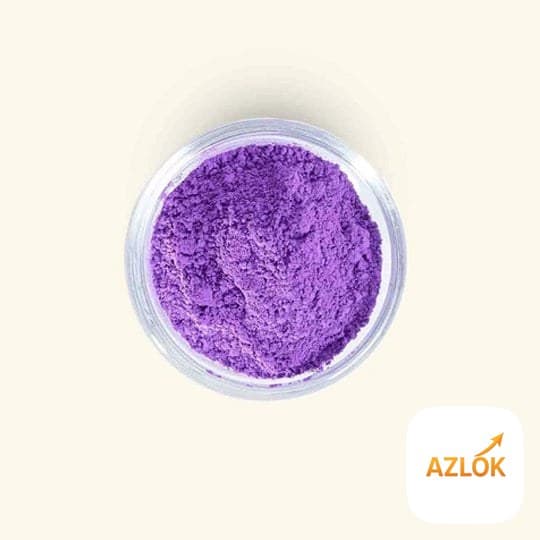

Matte Violet Pigment Powder is a dry, vibrant violet colourant used to tint handmade soaps, candles, nail paints, eye shadows, lip gloss and craft projects. It is a finely milled oxide-style powder that gives a soft, matte finish, and when a little is stirred into plain water at room temperature it disperses into a pale lavender shade rather than a deep violet.
What is Matte Violet Pigment Powder?
This is a powdered violet pigment designed for makers and hobbyists. It comes in a smooth, matte form that blends into both oil-based and wax-based recipes. Azlok stocks it in a wide range of packs, from a small 15 Gm jar for testing colours right up to bulk 25 KG sacks for small businesses, so you can buy exactly what your batch size needs.
Common uses
Because it is a versatile colourant, this pigment works across many craft and cosmetic projects:
- Soap making: tint cold-process and melt-and-pour bases in lavender to plum shades.
- Candle making: colour wax for decorative pillars, containers and tea lights.
- Nail paints and gels: add a matte violet tone to clear bases.
- Eye shadow and lip gloss: use in mineral makeup and gloss bases where cosmetic-grade colour is called for.
- Art and resin work: stir into resin, paint and other craft mediums for a solid matte finish.
How to use it
A little pigment goes a long way, so always start small and build up. General approach:
- Pre-disperse first. Mix the powder with a small amount of a compatible carrier — glycerin or a light oil for soap and cosmetics, or a spoon of melted wax for candles — to form a smooth slurry. This avoids speckles and clumps.
- Add gradually. Stir the slurry into your main batch bit by bit until you reach the shade you want.
- Test on a small batch. Colours can shift depending on your base, so make a sample before committing a full recipe.
Remember that the pigment shows differently depending on your medium. Suspended in plain water it reads as a pale lavender, but concentrated in an opaque soap or wax base it appears far richer.
Tips and safety notes
- Wear a mask when handling. Fine powders can float in the air; mix in a well-ventilated space and avoid inhaling the dust.
- Patch-test cosmetics. If you are making a leave-on product like lip gloss or eye shadow, test on a small area of skin first and only use the pigment in products where such colourants are appropriate.
- Do not ingest. This is a colourant, not a food ingredient.
- Keep away from children and pets.
- Mind staining. Concentrated pigment can stain skin, clothing and surfaces, so protect your work area and wear gloves.
- Add slowly. It is easier to deepen a colour than to lighten an over-tinted batch.
Buying and storage
Choose your pack size to match how often you make. A 15 Gm or 100 Gm pack is ideal for hobby batches and colour trials, while the 500 Gm to 25 KG options suit soap and candle sellers producing regularly. The powder has a shelf life of around two years when looked after.
- Store in a cool, dry place away from direct sunlight and moisture.
- Keep the container tightly closed so the powder does not absorb damp or clump.
- Use a clean, dry spoon each time to avoid contaminating the jar.
- Ask for the COA and MSDS if you need documentation for a small business.
FAQ
How much pigment should I use in a batch?
Start with a very small pinch per batch, pre-dispersed in carrier oil, glycerin or melted wax, then add more gradually until you reach the shade you want. Exact quantity depends on your base and how deep you want the colour.
Why does the powder look pale in water but deep in soap?
When suspended in plain water at room temperature the pigment diffuses into a light lavender tone. In an opaque, concentrated medium like soap or wax, the same pigment appears much richer and more saturated.
Can I use it in lip gloss and eye shadow?
It is marketed for cosmetic uses including eye shadow and lip gloss. Always patch-test the finished product, use it only where such colourants are appropriate, and never ingest the raw powder.
How long does it last?
The shelf life is about two years when stored in a cool, dry place in a tightly sealed container away from moisture and sunlight.
Which pack size should I buy?
For trials and hobby projects, the 15 Gm or 100 Gm packs are convenient. For regular soap or candle production, the larger 500 Gm to 25 KG packs work out more economical.