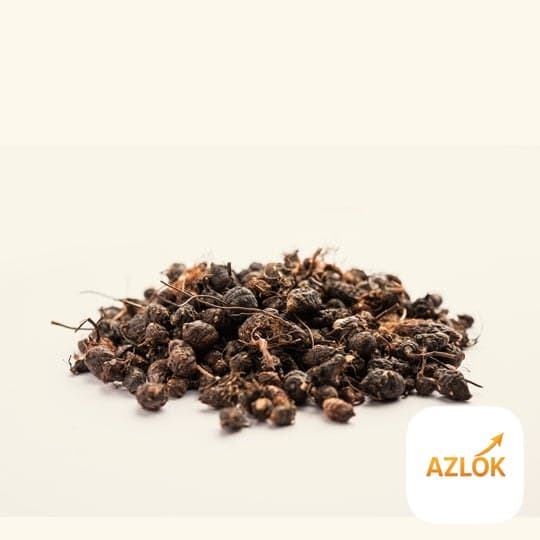

Nagarmotha liquid extract is a cosmetic-grade herbal extract made from the roots (rhizomes) of the nut grass plant, Cyperus rotundus. It is designed to be blended into DIY personal care formulations at around 1–2%, and Azlok offers it in both water-soluble (glycerine-based) and oil-soluble (soy oil) versions so you can match it to your recipe.
Nagarmotha, also called Motha or Nut Grass, is a perennial herb long valued in Ayurvedic tradition. While the wider aromatic industry prizes it for perfumery, this particular extract is prepared as a nearly odourless, tasteless liquid meant for skin, hair and body care projects rather than eating.
What is Nagarmotha liquid extract?
This is a 4:1 strength extract, which means 4 kg of the raw herb is concentrated down to yield 1 kg of extract. Two versions are commonly used:
- Water-soluble (alcohol-free): extracted using vegetable palm glycerin (glycerol), ideal for water-based products.
- Oil-soluble: extracted using soy oil, suited to oil and butter-based products.
Both are liquids, gluten-free, and free from artificial colour, heavy metals and fertilisers. BHT (butylated hydroxytoluene) is included as a preservative note to protect the extract.
Where you can use it
Because it is neutral in odour and taste, Nagarmotha extract slips easily into a wide range of formulations without upsetting your fragrance or texture:
- Cold-process and melt-and-pour soaps
- Shampoos and hair rinses
- Face washes and cleansing gels
- Lotions, creams and body butters
- Serums and face oils
- General DIY personal care for face, hair, skin and body
How to use it in your formulations
The recommended dosage is 1–2% of your total formulation. Getting this right is mostly about matching the extract type to your base:
- Pick the right version. Use the water-soluble (glycerine) extract for toners, face washes, shampoos and lotion water phases. Use the oil-soluble (soy) extract for face oils, balms, and the oil phase of creams.
- Weigh, don't guess. For a 100 g batch, 1–2% is just 1–2 g. A small kitchen scale gives far more consistent results than counting drops.
- Add at the right stage. Add water-soluble extract to the cooled water phase; add oil-soluble extract to the oil phase. For melt-and-pour soap, stir it in once the base has melted and slightly cooled.
- Blend thoroughly so it disperses evenly, then continue with your usual preservative and pH checks for leave-on or water-containing products.
Safety and honest notes
This extract is meant for external, cosmetic use. Please keep a few points in mind:
- Do not ingest. Despite being tasteless, it is not sold as a food or supplement.
- Patch-test any new formulation on your inner arm before using it on the face.
- Avoid direct contact with the eyes, and rinse well if contact happens.
- No herb–drug interactions are known, but caution is still advised with external applications, especially on sensitive or broken skin.
- Keep out of reach of children.
- Note that the oil-soluble version uses soy oil, which matters if you or your customers have a soy sensitivity.
Buying and storage tips
Azlok stocks Nagarmotha liquid extract from 100 gm right up to 25 kg, so it suits both hobbyists making a single batch and small businesses formulating at scale. Pricing starts at ₹399, and packaging is arranged as per requirement.
- Buy the size you'll actually use within the shelf life rather than over-ordering.
- Shelf life is 2 years; store in a cool, dry place away from direct sunlight and heat.
- Keep the cap tightly closed to reduce air exposure.
- Ask for the relevant COA and MSDS (available separately for the oil-soluble and water-soluble grades) if you are formulating commercially.
FAQ
Should I choose the water-soluble or oil-soluble version?
Match it to your base. Use the glycerine-based water-soluble extract for water-based products like toners, face washes and shampoos, and the soy oil-based version for oils, balms and the oil phase of creams.
How much Nagarmotha extract should I add?
Use 1–2% of the total weight of your formulation. For a 100 g batch that is just 1–2 g, best measured on a scale.
Does it have a strong smell?
No. This extract is described as tasteless and virtually odourless, so it blends into recipes without changing your chosen fragrance.
Can I take it internally?
No. It is a cosmetic-grade extract for external use in personal care products and should not be ingested.
How long does it last and how should I store it?
It has a shelf life of about 2 years. Store it in a cool, dry place, away from heat and sunlight, with the container kept tightly closed.