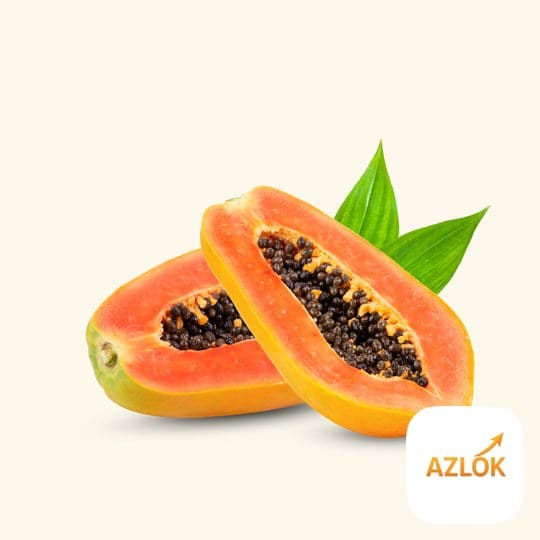

Papaya Fruit Extract is a liquid herbal extract made from the pulp of the papaya fruit (Carica papaya), used in small amounts (usually 1–2%) in soaps, creams, face washes, serums and hair care to add papaya's natural goodness to your formulations. Azlok offers it in both water-soluble and oil-soluble versions so you can slot it into almost any DIY recipe.
What is Papaya Fruit Extract?
Papaya, also called papaw or pawpaw, is a tropical fruit grown widely across India. Its ripe pulp is soft, sweet and yellowish-orange, and it naturally contains an enzyme called papain. This extract concentrates the fruit's beneficial matter into a convenient liquid form for cosmetic use. It is tasteless and has no odour, which makes it easy to work into scented or unscented products without changing the smell.
A few useful specifics from the product itself:
- INCI name: Carica Papaya
- Raw material: Pulp of the papaya fruit
- Strength: 4:1 herb-to-extract ratio (4 kg of herb yields 1 kg of extract)
- Water-soluble version: alcohol-free, extracted using vegetable glycerin
- Oil-soluble version: extracted using soy oil
- Free from: gluten, artificial colour, heavy metals and fertilizers
Common uses in DIY personal care
Because it is available as both water-soluble and oil-soluble, this extract is flexible across product types. Typical applications include:
- Soap making (melt-and-pour and cold process)
- Shampoos and hair rinses
- Face washes and cleansing gels
- Lotions, body creams and moisturisers
- Facial serums and masks
- General cosmetic and DIY personal care for face, hair, skin and body
Choose the water-soluble version for water-based products like toners, gels, face washes and shampoos. Pick the oil-soluble version when you are working with balms, facial oils, oil serums or anhydrous (waterless) blends.
How to use it in your formulations
The recommended usage level is 1–2% of your total formula. That means for every 100 g of product, you would add roughly 1–2 g of extract. A little goes a long way, so there is no need to overdose it.
- Weigh your extract on a small scale rather than guessing by drops.
- Add the water-soluble type to the water phase of your recipe, and the oil-soluble type to the oil phase.
- Stir in at the cool-down stage where possible, so you are not exposing it to unnecessary heat.
- Always include a suitable broad-spectrum preservative if your product contains water, since water-based cosmetics can grow microbes.
- Make small test batches first and note down your percentages so you can repeat what works.
Safety and honest notes
This is a cosmetic ingredient meant for external use, not for eating. A few sensible precautions:
- Avoid direct contact with the eyes; rinse well with water if it gets in.
- Do a patch test on your inner arm before using a new formulation on your face.
- Keep it away from children.
- No herb–drug interactions are known, but caution should still be observed with external applications, especially on sensitive or broken skin.
- The extract contains BHT (butylated hydroxytoluene) as a preservative note; check your product's COA and MSDS if you need full documentation for your business.
Buying and storage tips
Azlok stocks Papaya Fruit Extract from 100 g jars right up to 25 kg for small businesses, with pricing starting at ₹299. Hobbyists usually do well with the 100 g or 500 g size, while soap and cosmetic makers running regular batches may prefer the larger packs.
The extract has a shelf life of about 2 years. Store it in a cool, dry place away from direct sunlight, and keep the container tightly closed between uses. Decide in advance whether you need the water-soluble (glycerin-based) or oil-soluble (soy oil-based) version, as they are not interchangeable in a recipe.
FAQ
How much Papaya Fruit Extract should I add to a cream or face wash?
The recommended level is 1–2% of the total formula, so about 1–2 g per 100 g of finished product. Start on the lower side and adjust as needed.
Should I choose the water-soluble or oil-soluble version?
Use the water-soluble (glycerin-extracted, alcohol-free) version for water-based products like toners, gels, shampoos and face washes. Use the oil-soluble (soy oil-extracted) version for balms, facial oils and other oil-based blends.
Does the extract have a strong papaya smell or taste?
No. It is described as tasteless with no odour, so it blends into scented or unscented products without altering the fragrance.
Can I eat or drink this extract?
No. It is intended for external cosmetic use only. Keep it away from children and avoid contact with the eyes.
How long does it last and how should I store it?
It has a shelf life of around 2 years. Keep it in a cool, dry place away from sunlight, tightly sealed when not in use.