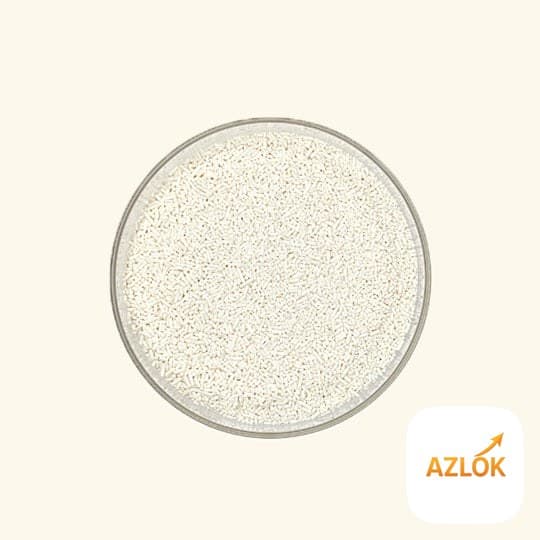

Potassium sorbate is a mild, food- and cosmetic-grade preservative that stops bacteria, yeast and mould from growing in water-based formulations, helping your creams, lotions and shampoos last longer. It is water-soluble, works best in slightly acidic products, and is often chosen as a gentler, paraben-free alternative in homemade and small-batch skincare.
What is potassium sorbate?
Potassium sorbate (INCI name: Potassium Sorbate, also known as E202) is the potassium salt of sorbic acid. Chemically it is C6H7KO2 with a molecular weight of around 150.22 g/mol and CAS number 24634-61-5. Azlok's potassium sorbate comes as a white to off-white powder at roughly 99% purity, made in India by neutralising sorbic acid with potassium hydroxide.
Because it dissolves easily in water, it slots neatly into most water-containing cosmetic recipes without needing solvents or heat. It has a characteristic mild odour and is supplied as a free-flowing powder that is simple to weigh and mix.
Common uses in cosmetics and body care
You will find potassium sorbate in a wide range of formulations where water is present, since water invites microbial growth. Typical applications include:
- Face and body creams, lotions and moisturisers
- Shampoos, conditioners and other hair care products
- Sunscreens and makeup products
- Toners, mists, gels and serums
- Liquid soaps and cleansers
It mainly guards against yeast and mould, and offers some protection against bacteria. Many formulators pair it with another preservative or an antioxidant to broaden coverage across the full range of microbes.
How to use potassium sorbate
Potassium sorbate is most effective in acidic formulations, generally below pH 6, because the active sorbic acid form works best at lower pH. The powder itself is alkaline (around pH 8.78 in solution), so you should always check and adjust your finished product's pH.
- Dissolve it: Add the powder to the water phase of your formula and stir until fully dissolved. A common starting range is 0.1% to 0.5% of the total recipe weight.
- Check the pH: Use pH strips or a meter. If your product is too alkaline, the preservative loses effectiveness, so adjust with a suitable acid (such as citric acid) to bring it down.
- Add at the right stage: Since it is heat-sensitive at very high temperatures, add it during the cool-down phase, once your mixture has come below about 40°C.
- Test your batch: For anything you plan to sell or store for long periods, consider proper preservative efficacy testing.
Safety and handling notes
This is an industrial-grade cosmetic raw material meant strictly for external use in properly formulated products. Keep these points in mind:
- External use only. Do not ingest the raw powder or use it outside its intended cosmetic purpose.
- Handle the powder carefully. Avoid inhaling dust; weigh it in a well-ventilated area and wash your hands after use.
- Patch-test finished products. Even mild preservatives can cause sensitivity in some people, so test a small amount on your skin before regular use.
- Respect the dosage. More is not better; stick to recommended percentages for safe, effective preservation.
- Keep away from children and store it clearly labelled.
Always refer to the product's COA and MSDS for full specifications and handling guidance.
Buying and storage tips
Azlok offers potassium sorbate in packs from 100 grams up to 25 kilograms, so hobbyists making small batches and small businesses running production runs can both find a suitable size. Prices start at ₹199, which makes it an economical addition to a DIY ingredient shelf.
Store the powder in a cool, dry place, tightly sealed and away from direct sunlight and moisture. Kept properly, it has a shelf life of around 24 months. Because it is hygroscopic, always close the pack well to stop it from absorbing moisture and clumping.
FAQ
Is potassium sorbate a good alternative to parabens?
Yes. It is often used as a paraben-free preservative option in water-based cosmetics. It mainly protects against yeast and mould, so many formulators combine it with a second preservative for broader antibacterial coverage.
How much potassium sorbate should I add to a formulation?
A typical usage range is 0.1% to 0.5% of the total product weight. Always confirm the correct level and pH range for your specific recipe and preservative system.
Why does pH matter with potassium sorbate?
It converts to active sorbic acid in acidic conditions, which is what actually preserves the product. It works best below about pH 6, so you should adjust and check your finished product's pH.
Can I use potassium sorbate in anhydrous products like oils or balms?
It is designed for water-containing formulations. Purely oil-based products without water generally do not need a water-phase preservative, though good manufacturing hygiene still matters.
Is potassium sorbate safe for skin?
Used at recommended levels in properly formulated, external-use products, it is considered a mild preservative. Do not ingest the raw powder, and patch-test your finished product first.