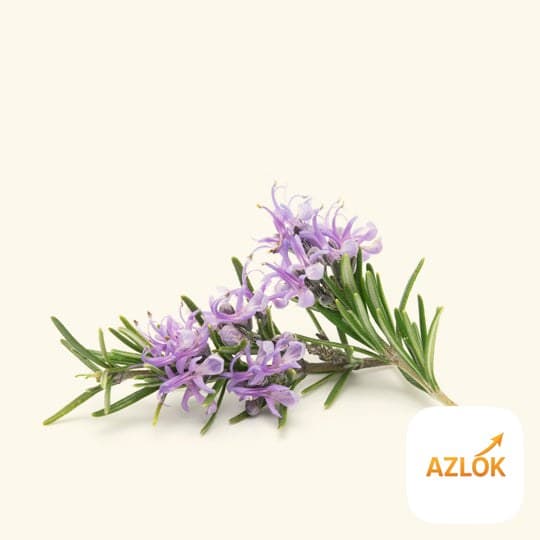

Rosemary essential oil is a steam-distilled oil from the leaves and flowering tops of the Rosmarinus officinalis herb, most commonly used to support scalp circulation and healthier-looking hair. To use it, dilute a few drops in a carrier oil like coconut or jojoba, massage into the scalp, and leave for 20-30 minutes before washing. It should never be applied neat or swallowed.
What is rosemary essential oil?
This is a concentrated aromatic oil obtained by steam distillation of the rosemary plant. It is a clear, colourless liquid with a strong, fresh, herbaceous smell. Its main plant-derived compounds and antioxidants are why it has a long history in hair and skin routines. Azlok offers it in sizes from 100 GM up to 25 KG, so it suits both home users and small businesses making their own oils, soaps and hair blends.
A quick look at the specifications: botanical name Rosmarinus officinalis, CAS# 8000-25-7, FEMA# 2992, specific gravity around 0.923, and a shelf life of about two years. It is soluble in alcohol and blends smoothly with carrier oils.
Common uses
- Scalp and hair care: Massaged in diluted form, it is traditionally used to support blood flow to the scalp and a healthier environment for hair.
- Hair oil and mask blends: A few drops added to your regular hair oil or a DIY mask.
- Aromatherapy: A couple of drops in a diffuser for a clean, invigorating aroma many people find refreshing while studying or working.
- DIY products: Soaps, beard oils, room sprays and candles where a strong herbal note is wanted.
How to use it safely
Rosemary oil is potent, so dilution matters. Follow these simple ratios and steps:
- For a scalp massage: Add 3-5 drops of rosemary oil to one tablespoon of a carrier oil such as coconut, almond or jojoba.
- Patch test first: Apply a little diluted oil to your inner forearm and wait 24 hours to check for irritation.
- Massage and rest: Work into the scalp for a few minutes, leave for 20-30 minutes, then shampoo out.
- For a diffuser: Use 2-4 drops in water as per your device instructions.
Safety notes
- Do not apply undiluted oil directly to skin, and do not ingest it.
- Always patch-test before regular use.
- Pregnant or breastfeeding women, people with epilepsy or high blood pressure, and those on medication should consult a doctor first.
- Keep away from children and pets, and avoid contact with eyes.
- The flash point is around 47°C, so store away from open flames and direct heat.
Blending ideas
Rosemary has a bold aroma, so it pairs well with softer or brighter notes. It blends nicely with lavender for a calming hair oil, lemon and wild orange for a fresh, uplifting diffuser mix, and jasmine for a more floral, layered scent. Start with more of the milder oil and add rosemary sparingly until you like the balance.
Buying and storage tips
Look for oil labelled with the botanical name Rosmarinus officinalis, an extraction method (steam distillation), and available COA/MSDS documentation, which Azlok provides. A genuine oil is colourless to pale, has a strong characteristic herbal smell, and pours as a thin liquid.
- Store in a tightly closed, dark glass bottle away from sunlight and heat.
- Keep the cap sealed to slow oxidation and preserve aroma.
- Use within the two-year shelf life for best results.
- Buy a size that matches how quickly you will use it; smaller packs stay fresher for occasional home users.
FAQ
Does rosemary oil really help hair growth?
Rosemary oil is traditionally used to support scalp circulation and hair health, and many people include it in their routine for this reason. Results vary from person to person, and it is best treated as part of overall hair care rather than a guaranteed cure.
Can I apply rosemary essential oil directly to my scalp?
No. Always dilute it in a carrier oil, usually 3-5 drops per tablespoon. Neat application can irritate the skin.
How often should I use it?
Two to three times a week as a diluted scalp massage is a common approach. Start slowly and see how your scalp responds.
What does rosemary oil blend well with?
It works well with lavender, lemon, wild orange and jasmine oils. Use rosemary in smaller amounts because its aroma is strong.
How should I store it?
Keep it in a sealed dark glass bottle, away from heat, flame and direct sunlight, and use it within about two years.