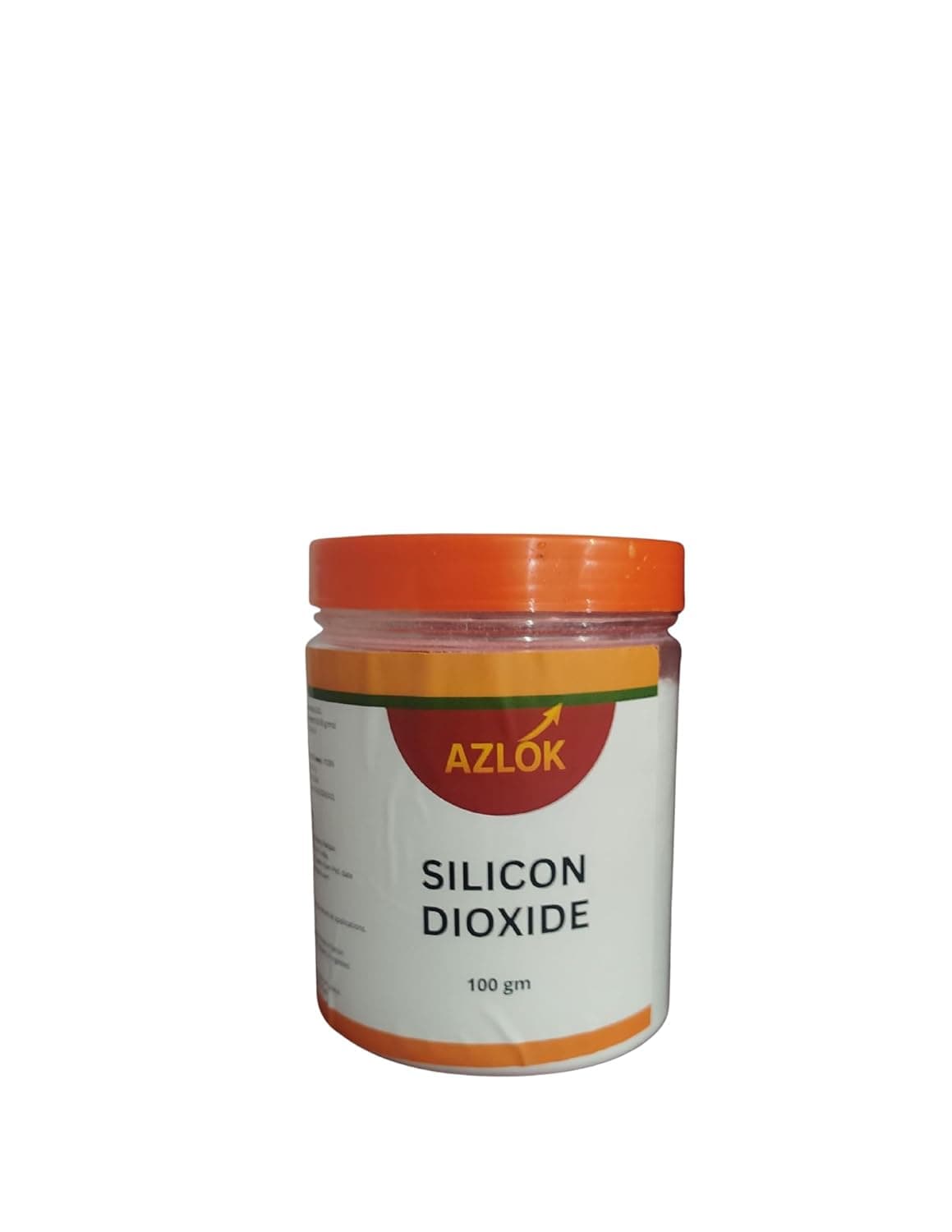
Silicon Dioxide Powder — The Silent Workhorse Behind More Industrial Processes Than You'd Expect
Silicon dioxide has a visibility problem. It doesn't have a dramatic story. It doesn't promise transformation. It doesn't carry a glamorous application. And yet — take it out of the equation and a remarkable number of industrial processes start breaking down in quiet, frustrating ways. Powder formulations clump. Paint surfaces lose their consistency. Rubber compounds underperform. Laboratory separations become unreliable.
This is what silicon dioxide does: it keeps things working the way they're supposed to. It is one of the most abundant compounds on Earth — the primary constituent of sand, quartz, and most mineral-based rock — and in its engineered powder form, it becomes a precision functional material with a role in industries spanning manufacturing floors, research laboratories, and formulation workbenches.
The Azlok Silicon Dioxide Powder 100g pack brings this versatility to the scale that matters for controlled technical applications, lab-scale research, and specialised utility use.
What Is Silicon Dioxide Powder?
Silicon dioxide — chemical formula SiO₂, commonly called silica — is an inorganic compound formed from silicon and oxygen. In nature it occurs in crystalline forms (quartz being the most familiar) and in amorphous forms found in certain clays and biological organisms. The engineered powder used in industrial and utility applications is almost always the amorphous form, produced via controlled manufacturing processes that deliver consistent particle size, surface area, and chemical behaviour.
Two principal types dominate industrial use — fumed silica and precipitated silica — and while both share the same chemical composition, their manufacturing routes give them distinctly different physical characteristics and performance profiles.
Silicon dioxide is insoluble in water and virtually all organic solvents. It is chemically inert across a wide range of conditions. These properties, combined with its unusually high surface area and particle uniformity, make it one of the most broadly applicable functional materials in industrial chemistry.
Fumed Silica vs Precipitated Silica — Understanding the Difference
Both are SiO₂. Both appear as white powders. But they behave very differently in formulation environments, and choosing the wrong type will undercut your application.
Fumed Silica (Pyrogenic):
Produced via high-temperature flame hydrolysis
Non-porous primary particles; forms loose aggregates
Very high BET surface area (50–600 m²/g)
Very low bulk density (0.05–0.15 g/mL)
Best for: thickening, rheology control, rubber reinforcement, coatings
Precipitated Silica:
Produced via wet chemical precipitation from sodium silicate
Porous, denser aggregates
Moderate surface area (30–250 m²/g)
Higher bulk density (0.15–0.40 g/mL)
Best for: anti-caking, flow aid, filler, tyre compounding
Note: For specific surface area, particle size distribution, and type classification details relevant to your application, contact Azlok at [email protected] or call 8800412138 before ordering.
Where Silicon Dioxide Powder Actually Gets Used
This is the section most product pages gloss over — and the one that matters most for anyone making a purchase decision. Silicon dioxide's utility spans a wide range of applications, each relying on a distinct aspect of the material's physical properties.
Anti-Caking & Flow Agent — In any powder formulation, SiO₂ coats the surfaces of larger particles, preventing moisture absorption and the physical contact that causes clumping. The result is a consistently free-flowing powder that measures and dispenses accurately. Even very small additions (1,000–5,000 ppm) can dramatically improve flowability.
Coatings, Paints & Varnishes — Silicon dioxide serves as a matting agent (reducing surface gloss) and a rheological additive in industrial paints and coatings. It improves anti-settling performance, scratch resistance, and film thickness uniformity — particularly valuable in powder coatings where consistent flow is critical during electrostatic application.
Rubber Compounding — As a reinforcing filler in silicone rubbers and synthetic elastomers, SiO₂ improves tensile strength, tear resistance, and abrasion performance. It is a standard ingredient in tyre compounds, shoe soles, gaskets, and sealing compounds. In modern tyre applications, silica has largely replaced carbon black because it delivers comparable reinforcement with lower rolling resistance.
Laboratory Applications — Silica powder is the standard stationary phase in thin-layer chromatography (TLC) and column chromatography — foundational separation techniques in organic chemistry and analytical labs. The consistency of particle size distribution directly determines the quality and reproducibility of separations.
Desiccant & Moisture Control — The same moisture-absorbing chemistry that makes SiO₂ useful as an anti-caking agent makes it the basis of silica gel desiccants, protecting electronics, pharmaceuticals, and precision components from humidity damage during storage and transit.
Industrial Manufacturing — Silicon dioxide finds roles in the production of impermeable films, epoxy and resin thickeners, fire extinguishing powders, dry toner formulations, soil conditioners, and dental formulation fillers. Its chemical inertness means it rarely interferes with the active components it's paired with.
How Silicon Dioxide Works — The Four Key Mechanisms
1. Surface Absorption SiO₂ particles have abundant surface hydroxyl groups that attract and hold moisture molecules. This is the basis of its desiccant and anti-caking functions — by absorbing trace moisture, it prevents the liquid bridges that cause powder agglomeration.
2. Physical Spacing Fine SiO₂ particles interpose themselves between larger compound particles, maintaining physical separation and preventing contact-induced caking.
3. Network Formation & Thickening At higher concentrations in liquid systems (paints, resins, adhesives), SiO₂ particles form a three-dimensional hydrogen-bonded network that increases viscosity and creates thixotropic behaviour — thick at rest, fluid under shear.
4. Reinforcement In rubber and polymer matrices, the high surface area of SiO₂ creates extensive interfacial contact with polymer chains. This physical entanglement transfers mechanical stress efficiently, improving strength and wear resistance.
Silicon Dioxide in Industrial Coatings — A Closer Look
In an industrial paint or varnish, SiO₂ can serve multiple simultaneous functions:
As a matting agent: Fine silica particles scatter light at the coating surface, reducing specular reflection and delivering a consistent matte or satin finish. The degree of matting is controlled by particle size distribution and loading level.
As an anti-settling agent: SiO₂'s thickening effect in the liquid phase helps prevent pigment particles from settling to the bottom during storage, improving shelf stability and application consistency.
In powder coatings: Silicon dioxide is added to improve fluidization and transfer efficiency during electrostatic application — poor powder flow directly causes uneven film thickness and product rejection.
Safe Handling — What You Need to Know
⚠️ Important: This product requires appropriate PPE during handling. The primary concern with amorphous SiO₂ powder is inhalation of fine particulates. While amorphous silica carries significantly lower respiratory risk than crystalline forms, no fine powder should be inhaled routinely.
Respiratory protection: Wear a dust mask (minimum FFP1, preferably FFP2) or a respirator rated for fine particulates whenever measuring, transferring, or working with the powder in any open environment.
Eye protection: Safety goggles or glasses with side shields when handling SiO₂ powder.
Hand protection: Chemical-resistant or nitrile gloves. Prolonged skin contact can cause drying and mild irritation.
Ventilation: Work in a well-ventilated area or under local exhaust ventilation. Add powder slowly and avoid pouring from heights to minimise dust generation.
Storage: Store in a sealed container in a cool, dry location. SiO₂ is hygroscopic and will absorb moisture from humid air, causing caking. Keep away from children.
Not for consumption: This product is Industrial & Utility Grade. It is not intended for direct food use, direct cosmetic application, or any form of ingestion.
Why the 100g Pack Makes Sense for India's Technical Users
India's manufacturing and research landscape is genuinely diverse — large industrial operations coexist with small-batch manufacturers, indie formulators, independent researchers, and educational institutions. All have legitimate needs for quality industrial chemicals, but in quantities that make industrial bulk purchasing impractical.
The Azlok 100g pack addresses this gap directly. it provides enough material for meaningful R&D work, small-batch formulation trials, or specialised utility tasks without the storage burden, regulatory complexity, or cost of industrial quantities.
For a research chemist testing a new coating formulation, a small-scale rubber compounder benchmarking a new recipe, or a technical institution running laboratory demonstrations — this is exactly the right scale.
Frequently Asked Questions
What industrial applications is this product suited for? Anti-caking and flow agent in powder formulations, matting agent and rheological additive in industrial coatings and paints, reinforcing filler in rubber and polymer compounding, desiccant in packaging environments, and stationary phase in laboratory chromatography.
Is this product food grade? No. This product is labelled Industrial and Utility Grade. It is not intended for direct human consumption. For food additive applications requiring E551 (food-grade silicon dioxide), source a product with appropriate food-grade certification.
What is the difference between silicon dioxide and silica gel? Silica gel is a porous granular form of SiO₂ produced from sodium silicate, primarily used as a desiccant. Silicon dioxide powder is a fine amorphous powder with different physical characteristics suited to anti-caking, rheological, and formulation applications. Both share the chemical formula SiO₂.
Can it be used in epoxy and resin formulations? Yes. Fine SiO₂ powder is widely used as a thickening and anti-sag additive in epoxy resins, polyester compounds, and adhesives, creating thixotropic structure and improving the mechanical properties of the cured system.
What PPE is required when handling this powder? Dust mask or respirator (FFP2 recommended), safety goggles, and nitrile or chemical-resistant gloves. Work in a well-ventilated area and minimise airborne dust generation.
Where can I buy it and what does it cost? Available at azlok.com for ₹190.00 plus GST. Standard export packaging, 7–10 day lead time.
The Bottom Line
Silicon dioxide doesn't ask to be noticed. It works in the background — preventing clumps in powder blends, controlling gloss in industrial coatings, reinforcing rubber in a gasket, separating compounds on a chromatography plate. It's the kind of material that earns its place not through novelty but through consistent, dependable performance across an extraordinary range of applications.
For researchers, formulators, small-scale manufacturers, and technical users in India who need reliable access to industrial-grade inorganic materials without bulk order commitments, Azlok Silicon Dioxide Powder 100g delivers exactly that: a controlled, well-packaged, consistently processed material at a price point that makes meaningful technical work possible at any scale.