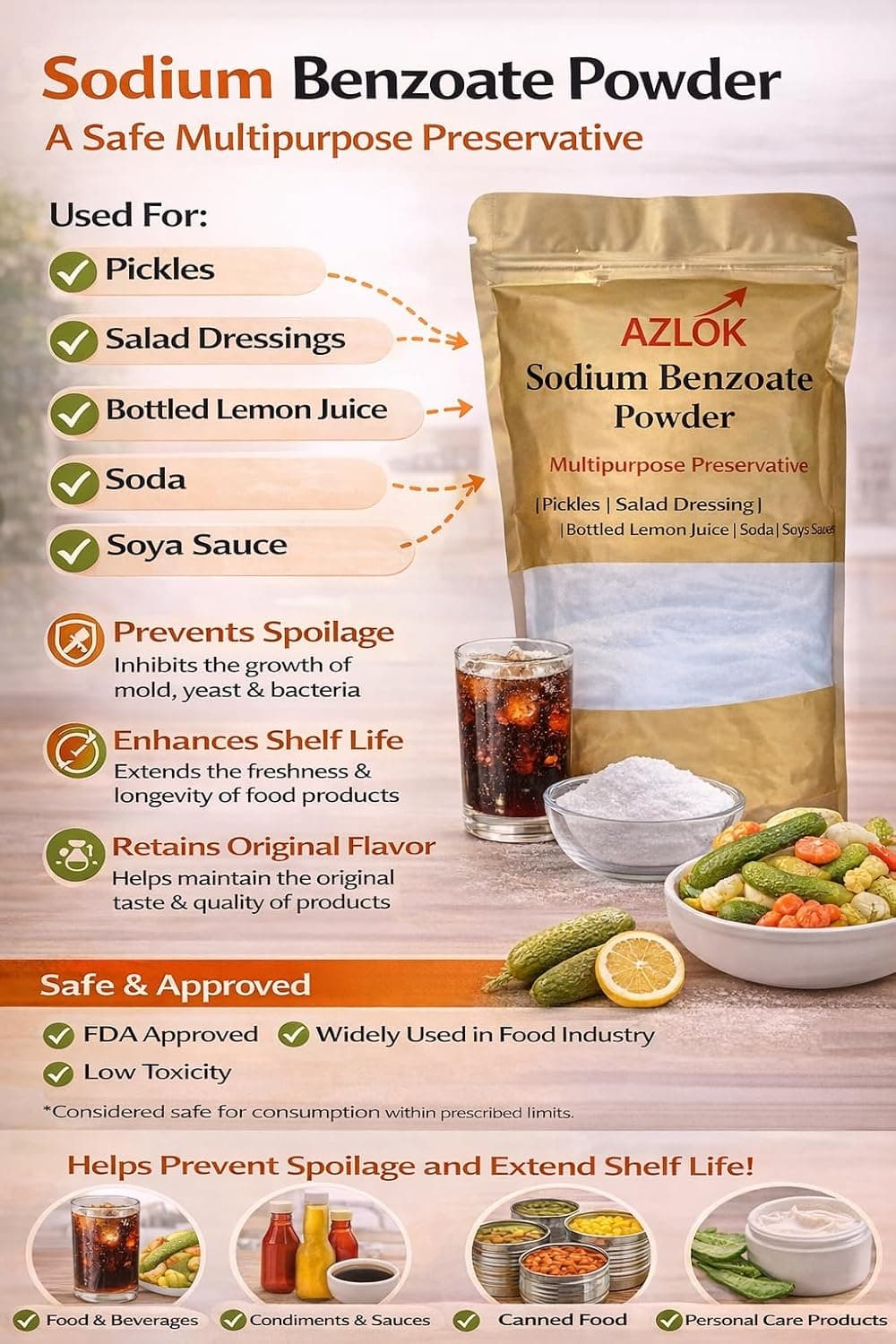
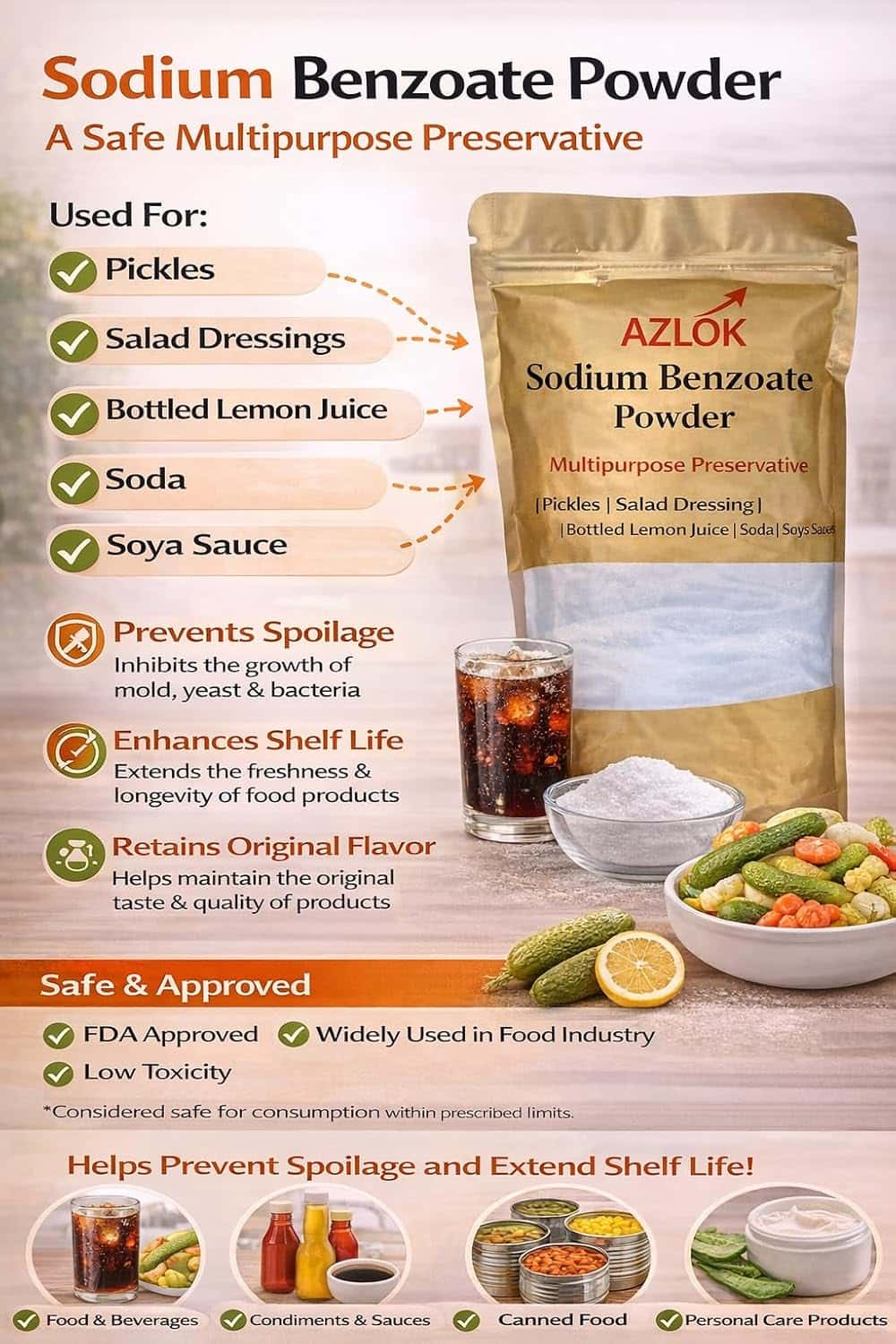
Sodium benzoate is a food-grade preservative that helps stop the growth of yeasts, moulds and some bacteria in acidic foods and drinks, extending their shelf life. It works best in products with a low pH, such as fruit juices, pickles, sauces and soft drinks, and it must be used in small, measured amounts according to regulatory limits. Azlok Sodium Benzoate Powder (100 g) comes in a fine, easy-to-disperse form suited to small-scale and limited-quantity formulation work.
What sodium benzoate does
Sodium benzoate is the sodium salt of benzoic acid. In an acidic environment, a portion of it converts to benzoic acid, which is the active form that inhibits spoilage organisms. This is why it is only effective in foods and beverages that are naturally acidic or acidified. In neutral or alkaline products it does very little, so it is rarely the right choice there.
Because the fine powder dissolves and disperses well, it blends evenly into liquid and semi-liquid formulations without leaving gritty specks.
Common uses
- Beverages: fruit-based drinks, squashes, cordials and carbonated soft drinks.
- Sauces and condiments: ketchup, chilli sauce, salad dressings and similar acidic mixtures.
- Pickles and preserves: products already relying on vinegar or citric acid.
- Jams and fruit fillings: where acidity is on the higher side.
It is also used in various technical and cosmetic formulations, though those applications follow their own separate standards.
How to use it correctly
Sodium benzoate is added in very small proportions. Most food regulations set an upper limit that is a fraction of a percent of the finished product, so this is not an ingredient you measure by the spoonful.
- Check your product's pH. Aim for an acidic base (generally below pH 4.5) for the preservative to work.
- Weigh accurately. Use a precise scale and follow the permitted dosage for your specific product category and your country's food rules.
- Dissolve first. Pre-dissolve the powder in a little of the water or liquid phase, then stir it thoroughly into the whole batch for even distribution.
- Add late in the process where possible, so it is not degraded by prolonged high heat.
When in doubt about legal limits, consult FSSAI guidance or a qualified food technologist. Dosage rules exist for a reason, and staying within them is part of making a safe product.
Safety notes
This product is intended for appropriate food processing and technical use only. Please keep these points in mind:
- Do not consume the raw powder. It is a concentrated additive, not a food on its own.
- Measure, don't guess. Over-use can affect taste and is not permitted under food rules.
- Keep away from children and pets.
- Handle in a clean, dust-free way and avoid inhaling airborne powder; work in a well-ventilated space.
- Some people prefer to limit benzoate intake, so label your finished products honestly.
Buying and storage tips
The 100 g pack is a sensible size for home experimenters, hobby food makers and small batches, where a larger tub would sit unused and slowly lose quality. Look for food-grade material with consistent purity, which is how Azlok processes this powder, and packaging that guards against moisture and contamination.
- Store in a cool, dry place away from direct sunlight.
- Keep the pack tightly sealed; sodium benzoate can absorb moisture and clump if left open.
- Use a clean, dry spoon each time to avoid introducing water or contaminants.
- Note the manufacturing details on the pack and use within a reasonable period.
FAQ
Is sodium benzoate safe in food?
Yes, when used within the permitted limits for the specific food category. It is a widely approved preservative for acidic foods and drinks. The powder should never be eaten on its own or used above recommended dosage levels.
How much sodium benzoate should I add?
Only a small fraction of a percent of the finished product, within the maximum limit set by food regulations for that item. Always weigh it precisely and follow FSSAI or equivalent guidance rather than adding by eye.
Does sodium benzoate work in all foods?
No. It is effective mainly in acidic products with a low pH, such as juices, pickles and sauces. In neutral or alkaline foods it offers little protection, so a different preservation approach is usually needed.
How do I dissolve the powder evenly?
Pre-dissolve it in a small quantity of the water or liquid phase, then mix that solution thoroughly into the full batch. The fine powder form disperses easily and helps you avoid uneven pockets.
How should I store the 100 g pack?
Keep it sealed in a cool, dry place away from sunlight and moisture, and use a clean dry spoon. Proper storage keeps the powder free-flowing and preserves its quality over time.