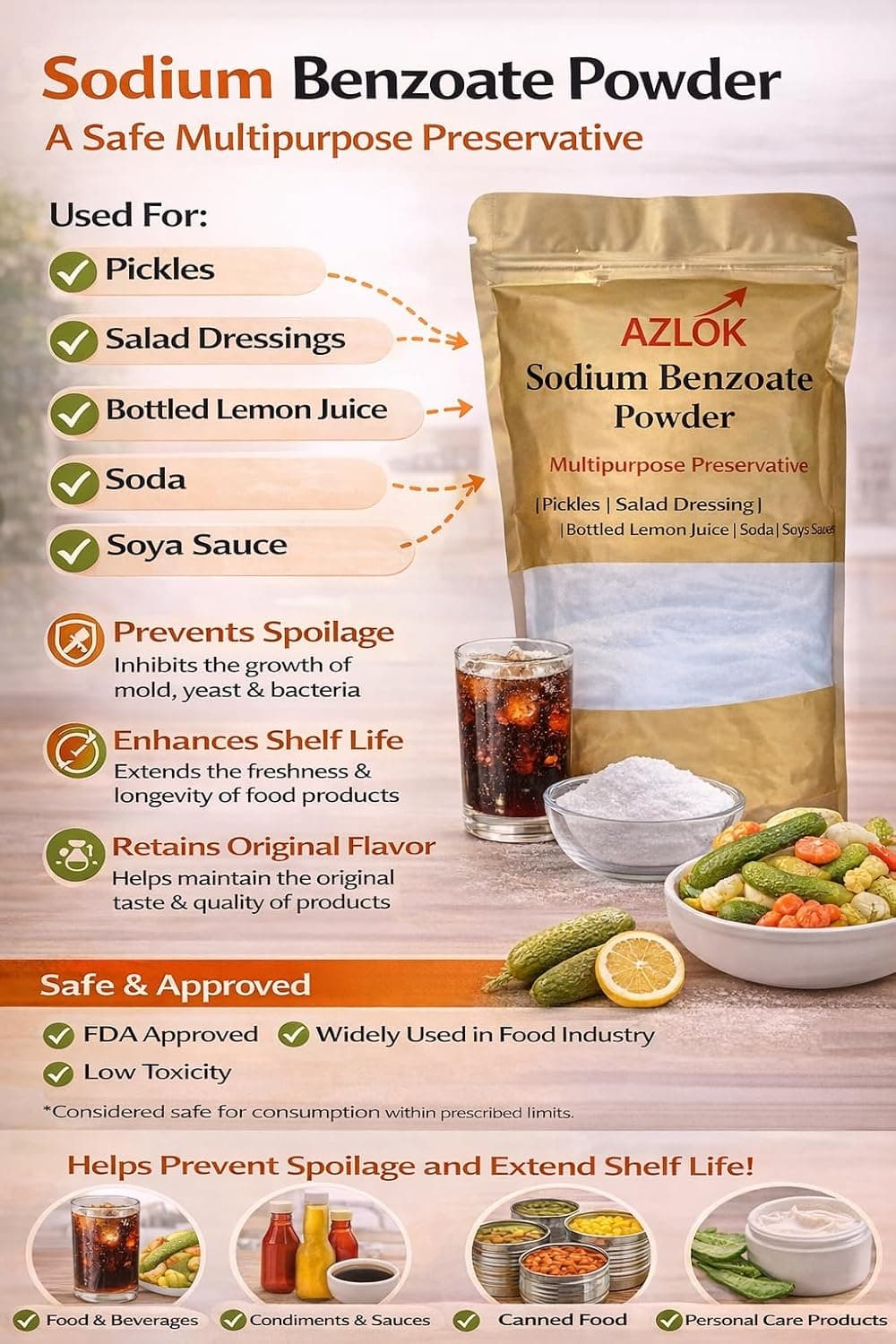
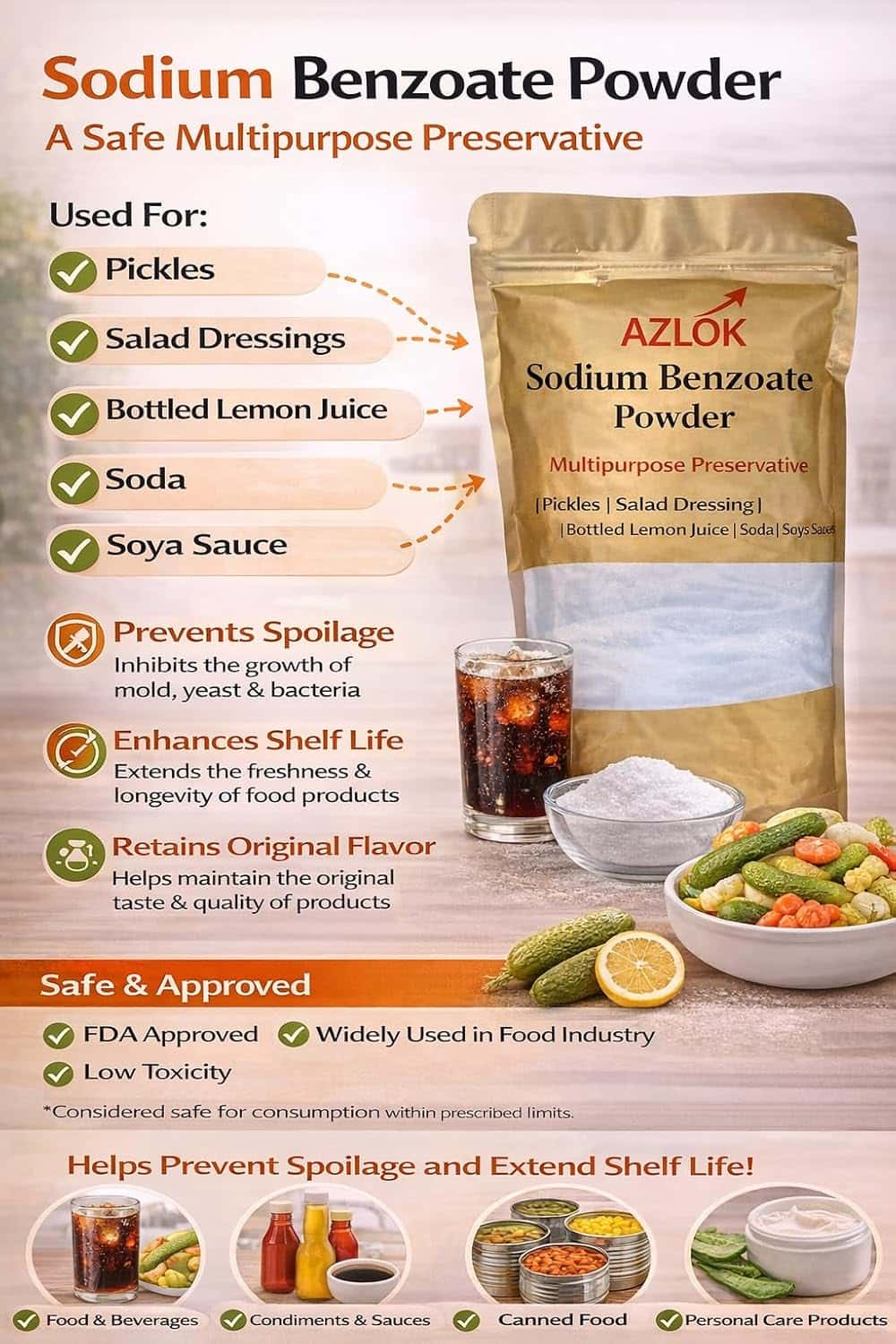
Sodium benzoate is a food-grade preservative used in small quantities to slow the growth of yeasts, moulds and some bacteria, especially in acidic foods and drinks. Azlok Sodium Benzoate Powder 200 g is a fine, easily dispersible powder meant for controlled food processing and technical use — not for eating on its own. Used at approved levels, it helps keep products like squashes, sauces and pickled preparations stable for longer.
What sodium benzoate actually does
Sodium benzoate is the sodium salt of benzoic acid. It only becomes effective in an acidic environment, which is why it works best in products with a pH below about 4.5. In these conditions it converts to its active form and holds back the microbes that cause spoilage and fermentation. In a neutral or alkaline product it does very little, so pH matters more than dose.
Because it is a fine powder, it dissolves and disperses well when added to water-based mixtures, giving uniform protection through the batch rather than settling unevenly.
Common uses
- Fruit squashes and cordials — a classic use in Indian kitchens and small units for concentrated drinks that sit on the shelf.
- Sauces and ketchups — tomato and chilli-based products that are already acidic.
- Pickles and acidic condiments — as part of a preservation system alongside salt, acid and oil.
- Carbonated and fruit beverages — where a low pH supports its activity.
- Jams and fruit fillings — in formulations that meet regulatory limits.
It is also used in some non-food technical formulations, but the guidance here focuses on food-grade preparation.
How to use it
- Check the pH first. Sodium benzoate needs an acidic product. If your recipe is not tart enough, it will not preserve well.
- Weigh, don't guess. Use a fine kitchen scale. Regulatory limits in India (FSSAI) specify maximum permitted levels for each food category, generally a fraction of a gram per litre or kilogram. Always follow the limit set for your specific product.
- Dissolve before adding. Stir the measured powder into a little warm water or the liquid phase of your recipe until fully dissolved, then blend it evenly into the whole batch.
- Add near the end. Incorporate it after cooking or when the mixture has cooled somewhat, so it mixes uniformly.
Do not exceed recommended dosage in the belief that more means safer. Overuse can affect taste, giving a faintly bitter or chemical note, and may breach food safety limits.
Safety notes
- This is a processing ingredient, not for direct consumption in raw form. Never eat the powder by itself.
- Always work to the permitted limits laid down by food regulations for your product category.
- Handle in a clean, dry area. Avoid inhaling the fine powder; measure it in a still spot rather than in a draught.
- Keep away from children and pets, and store separately from other kitchen powders to avoid mix-ups.
- If you or your customers have known sensitivities, factor that into your labelling and use.
- Some people prefer to avoid benzoate combined with high levels of vitamin C in soft drinks; keep this in mind when formulating beverages.
Buying and storage tips
The 200 g pack is a sensible size for home cooks, hobby makers and small-batch producers who don't want a large sack sitting around losing quality. Because it goes in at low doses, this quantity lasts a long time for occasional use.
- Store in a cool, dry place, away from moisture and direct sunlight.
- Keep the pack tightly closed after each use; the powder can absorb moisture and clump if left open.
- Use a clean, dry spoon every time to avoid introducing contamination.
- Label your container clearly if you decant it.
Azlok processes this powder for consistent purity and packs it to protect against moisture during storage and transport, so it stays free-flowing and reliable through its shelf life.
FAQ
Is sodium benzoate safe in food?
Yes, when used within the maximum limits set by food safety regulations such as FSSAI. It is a widely permitted preservative for specific food categories. Problems arise only from overuse or misuse, so always follow recommended dosage.
Why does it work better in acidic foods?
Sodium benzoate needs a low pH (roughly below 4.5) to convert into its active preservative form. In neutral or alkaline products it is largely ineffective, which is why it is used in squashes, sauces and pickled items rather than milk-based foods.
How much should I add?
Use only the maximum permitted level for your particular product, which is a small fraction of a gram per litre or kilogram. Weigh it precisely with a fine scale and dissolve it first. Do not exceed the limit.
Can I eat the powder directly?
No. It is an ingredient for controlled food processing, not for direct consumption in raw form. It must be dispersed at approved levels into a suitable acidic formulation.
How long does the 200 g pack last?
Because the dose per batch is very small, a 200 g pack typically lasts a long time for home or small-scale use. Kept dry and sealed, it retains its quality well over its shelf life.