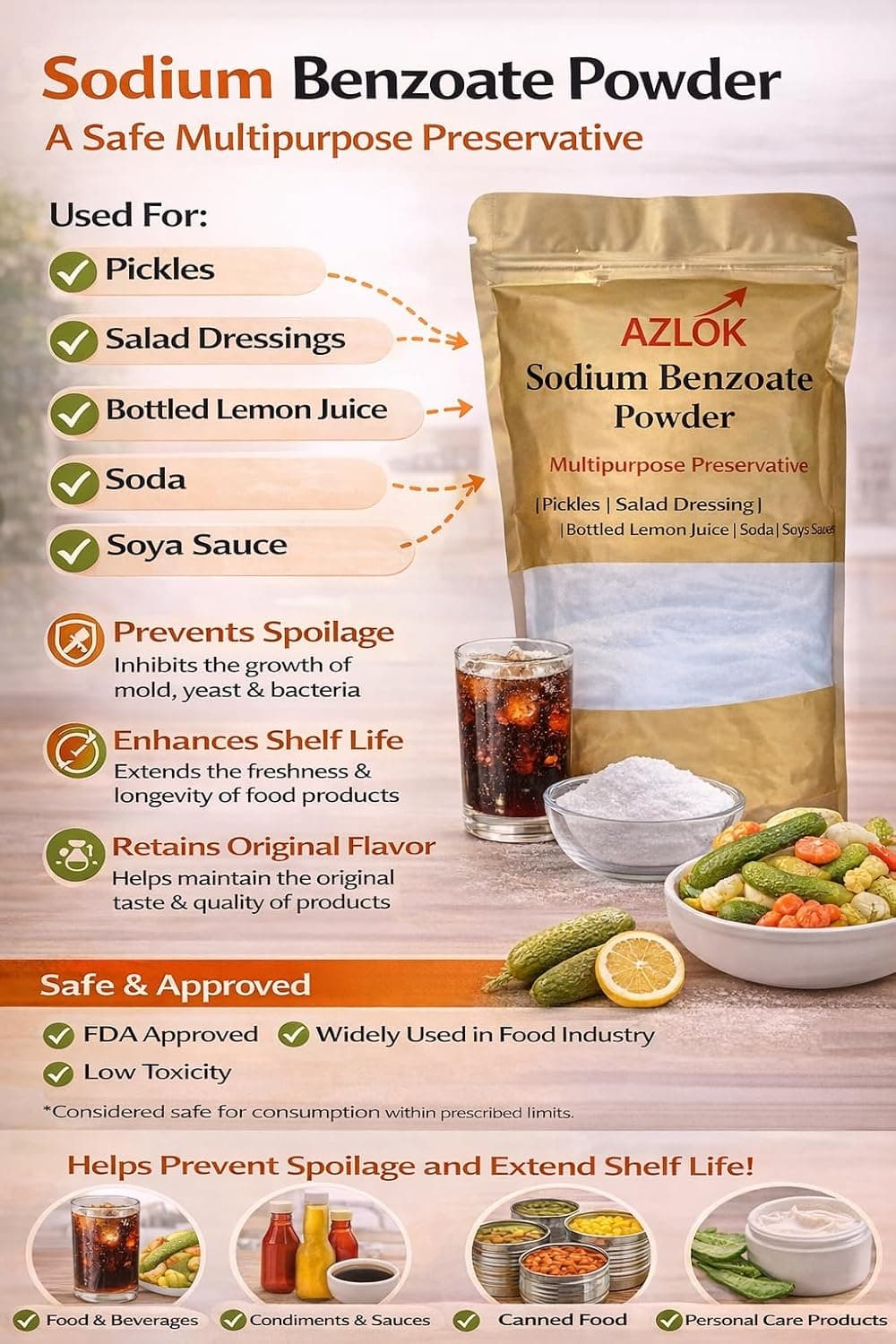
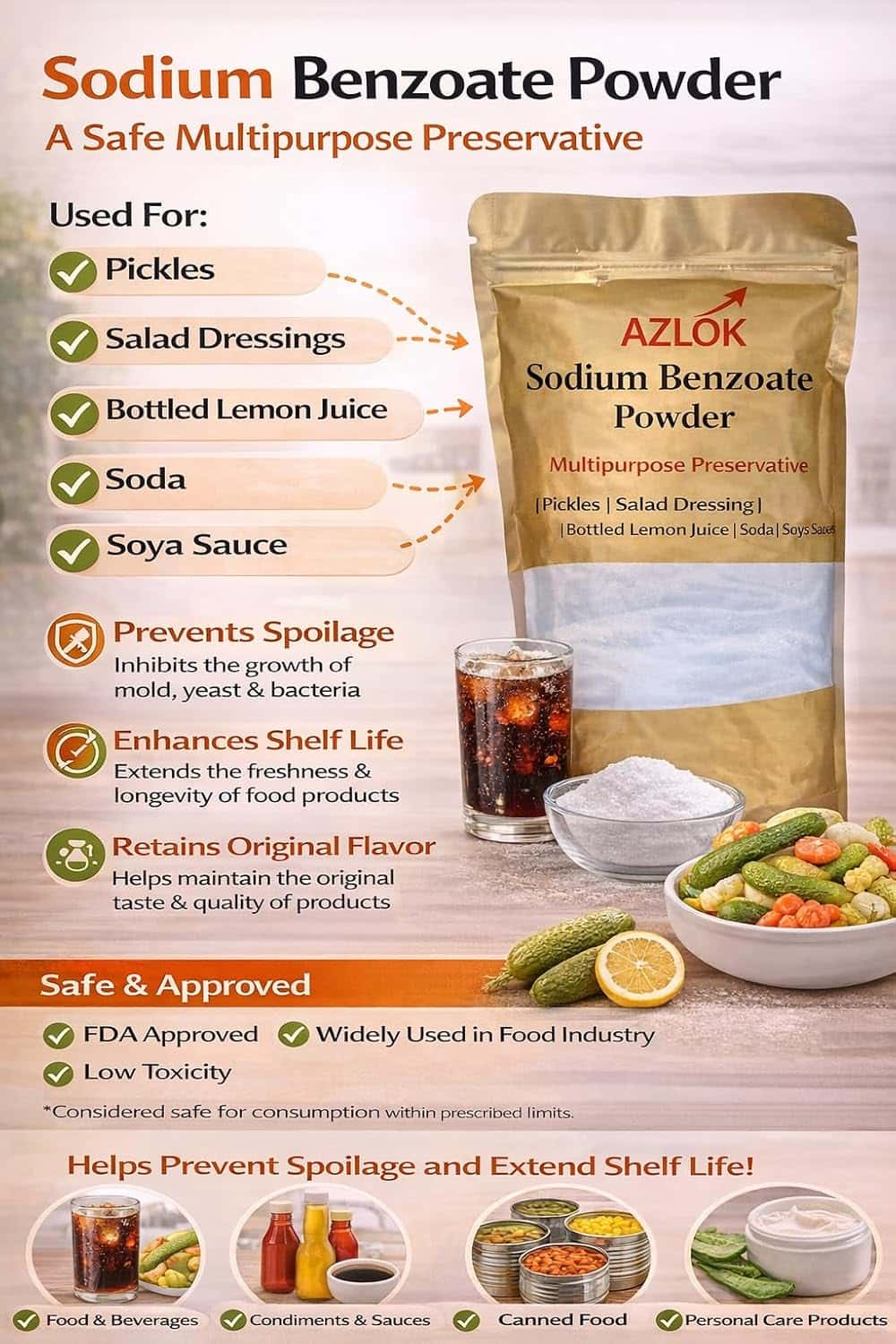
Sodium benzoate is a food-grade preservative that slows the growth of yeasts, moulds and some bacteria, and it works best in acidic products like sauces, soft drinks, pickles and fruit preparations. Azlok Sodium Benzoate Powder 800 g comes as a fine, easy-to-disperse powder meant for controlled food processing and technical use, applied strictly at recommended dosage levels rather than eaten on its own.
What is sodium benzoate?
Sodium benzoate is the sodium salt of benzoic acid. In an acidic environment it converts partly to benzoic acid, which is the active form that keeps spoilage organisms in check. This is why it is so effective in low-pH foods and drinks and much less useful in neutral or alkaline products. If your recipe is naturally acidic \u2014 think citrus squashes, tomato-based sauces, vinegar pickles or fruit syrups \u2014 sodium benzoate is a well-suited choice.
Common uses
Small food businesses and careful home makers use sodium benzoate to support shelf life in the kinds of products where microbial spoilage is a real risk. Typical applications include:
- Fruit squashes, cordials and soft drink concentrates
- Tomato ketchup, chilli sauces and similar acidic condiments
- Vinegar-based pickles and chutneys
- Jams, fruit fillings and syrups (when the pH is low enough)
- Some cosmetic and technical formulations that call for a preservative
The fine powder form dissolves and disperses evenly, which matters when you are trying to get a consistent, low dose spread through an entire batch.
How to use it correctly
Getting the dosage right is the whole game. Too little does nothing useful; too much affects taste and crosses regulatory limits.
- Check your product's acidity. Sodium benzoate performs well below roughly pH 4.5. In less acidic foods its effectiveness drops sharply.
- Weigh, don't guess. Use a fine digital scale. Preservatives are dosed in small percentages of the total batch weight, so eyeballing is a mistake.
- Dissolve first. Stir the measured powder into a little water or the liquid phase of your recipe until fully dissolved, then mix it uniformly into the full batch.
- Follow the applicable food standards. Permitted maximum levels are set by regulation (in India, by the FSSAI) and vary by food category. Always work within those limits.
If you run a food business, treat the legal maximum as a ceiling, not a target, and keep records of your dosage per batch.
Safety notes
Sodium benzoate is widely used in the food industry, but it is a processing ingredient, not something to consume raw.
- Do not ingest the neat powder. It is intended for use diluted within a finished formulation only.
- Avoid inhaling the fine dust. Weigh it in a still area and consider a mask if you handle it often.
- Keep away from children and pets.
- A known interaction: benzoates combined with vitamin C (ascorbic acid) under certain conditions of heat and light can form trace benzene. Store finished acidic drinks cool and away from direct sunlight, and keep dosages within limits.
- Some people are sensitive to benzoates. If you sell food, label ingredients honestly.
Buying and storage tips
Buy food-grade material from a reliable supplier and confirm it is intended for food processing use. The 800 g pack from Azlok is a sensible size for small-scale makers \u2014 enough for many batches without leaving a large quantity sitting around for years.
- Store in a cool, dry place, tightly closed, away from moisture.
- Keep the powder away from strong-smelling substances, as fine powders can pick up odours.
- Use a clean, dry scoop each time to avoid contamination.
- Note the batch and keep the packaging sealed between uses \u2014 Azlok's pack is designed to guard against moisture and contamination during storage.
FAQ
Is sodium benzoate safe to use in home cooking?
It is safe when used as a preservative within recommended limits in acidic foods, and only in a finished, diluted formulation. It is not meant to be eaten in raw powder form. Follow FSSAI dosage guidance for your product category.
Why does it work better in acidic foods?
Sodium benzoate becomes active benzoic acid at low pH, roughly below 4.5. In neutral or alkaline foods it converts poorly and offers little protection, so it is a poor fit for those products.
How much sodium benzoate should I add?
Only a small fraction of the batch weight, set by the maximum permitted level for that specific food category under applicable regulations. Weigh it precisely with a fine scale and dissolve it before mixing in. Never exceed the legal limit.
Can I mix it with vitamin C?
Be cautious. Benzoates with ascorbic acid can, under heat and light, form trace benzene. If both are present, keep the product cool, away from sunlight, and within recommended dosages.
How long does the powder keep?
Stored cool, dry and sealed, it stays stable for a long time. Moisture is its main enemy, so close the pack tightly after each use and use a dry scoop.