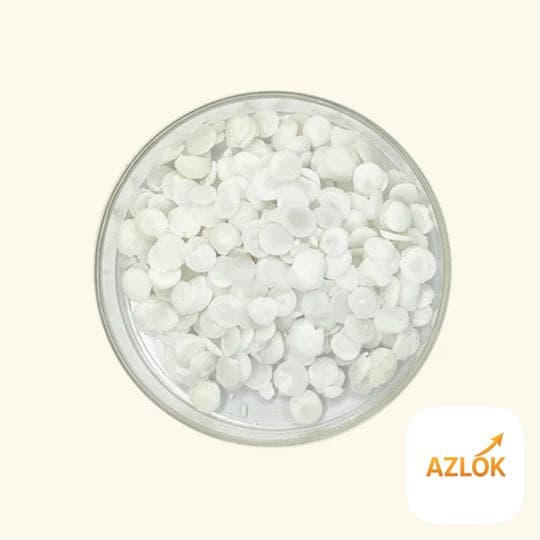

Sodium hydroxide pellets, commonly called caustic soda or lye, are a pure alkali (NaOH) used mainly to saponify oils in soap making and to adjust the pH of cosmetic formulations. Azlok supplies them as clean white 99% technical-grade pellets, which dissolve easily and are convenient to weigh for home and small-batch production.
What sodium hydroxide is used for
This is one of the most widely used raw materials in the personal-care and cleaning world. It is a strong base, so a little goes a long way. The main uses are:
- Cold-process and hot-process soap: NaOH reacts with fats and oils (saponification) to form hard bar soap. Without lye, there is no real soap.
- pH balancing: It acts as a buffering agent to lift or adjust the pH of exfoliants, creams and other formulations to the target range.
- Cleaners and drain care: It helps break down grease, fats and organic build-up.
Note that finished, well-made soap contains no free lye once curing is complete. The caustic soda is fully consumed in the reaction.
How to use it in soap making
Accuracy and caution matter more than anything here. Always use a run-through lye calculator for your specific oils before you begin.
- Weigh everything. Measure your oils, water and lye by weight using a digital scale, never by volume.
- Add lye to water, never water to lye. Slowly sprinkle the pellets into cold water while stirring. The mixture will heat rapidly and release fumes.
- Let the solution cool to around 40-50°C, and bring your oils to a similar temperature.
- Combine and blend the lye solution into the oils until you reach trace, then add fragrance, colour and pour into moulds.
- Cure the bars for four to six weeks in a well-ventilated spot before use.
Safety notes you should not skip
Caustic soda is corrosive. Treat it with respect and it is perfectly manageable at home.
- Always wear chemical-resistant gloves and eye protection, and cover your arms.
- Work in a well-ventilated area. The fumes when mixing with water can sting; avoid breathing them in.
- Add lye to water, not the reverse — doing it the wrong way can cause a violent, spitting reaction.
- Keep vinegar or plenty of running water nearby to flush accidental splashes.
- Keep it well away from children, pets, food and aluminium (it reacts with aluminium).
- Never taste or swallow it, and do not apply raw pellets or lye solution to skin.
Buying and storage tips
Azlok offers these pellets in 500 g, 1 kg, 5 kg, 10 kg, 20 kg and 25 kg packs, starting at ₹349, so you can buy a small trial quantity or stock up for regular production. A few pointers:
- Buy for your batch size. Beginners are usually better off with 500 g or 1 kg to learn on before committing to bulk.
- Store airtight. NaOH is hygroscopic — it pulls moisture from the air and clumps or turns to slush if left open. Keep the container tightly sealed.
- Keep it dry and cool, away from acids and from any damp. Shelf life is around two years when stored properly.
- Label clearly and store out of reach of children and away from your kitchen ingredients.
Ask for the COA and MSDS if you need documentation for a small business or larger order.
FAQ
Is sodium hydroxide the same as caustic soda and lye?
Yes. Sodium hydroxide, caustic soda and lye are common names for the same compound, NaOH. Azlok supplies it as white pellets at 99% purity.
Can I make soap without lye?
No. Genuine soap is made by reacting an alkali like sodium hydroxide with oils and fats. "Melt-and-pour" bases already contain saponified soap, but that base was itself made using lye.
Why must I add lye to water and not water to lye?
Mixing releases a lot of heat quickly. Adding pellets to water lets the heat disperse safely. Pouring water onto lye can cause the mixture to boil up suddenly and splash.
Is finished soap safe if it is made with caustic soda?
Yes, when the recipe is correct and the bars are properly cured. During saponification the lye is fully consumed, leaving no free caustic soda in a well-formulated, cured bar.
How should I store the pellets after opening?
Keep them in a tightly sealed, moisture-proof container in a cool, dry place away from acids, children and pets. This prevents clumping and preserves the roughly two-year shelf life.