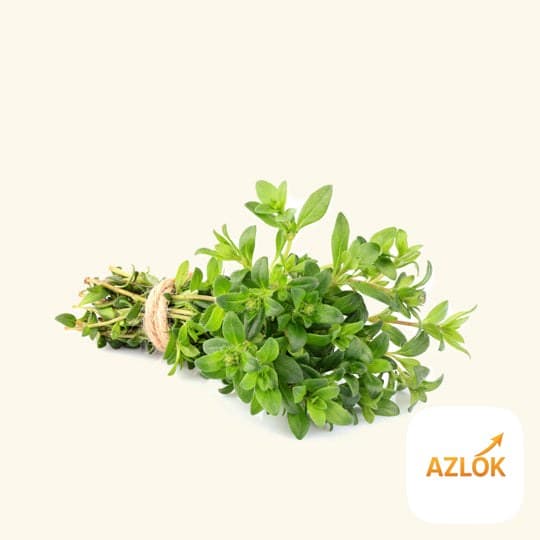

Thyme Essential Oil is a steam-distilled oil from the thyme plant (Thymus vulgaris) known for its warm, herbal-spicy aroma and its cleansing, clarifying properties in cosmetics and personal care. It is most often used, well diluted, in skincare, haircare, soaps and diffuser blends — never neat on the skin and never taken internally.
What is Thyme Essential Oil?
This is a concentrated aromatic oil obtained from the fragrant leaves and flowering tops of thyme through steam distillation. Azlok's Thyme Essential Oil is produced in India and carries the botanical name Thymus vulgaris (CAS No. 8007-46-3). It is a thin liquid, colourless to pale yellow, with a floral and spicy odour. Because it is soluble in alcohol and fixed oils rather than water, it blends easily into carrier oils and formulations.
Common uses
Thyme oil is a popular ingredient wherever a purifying, revitalising note is wanted. Typical applications include:
- Skincare formulations — added in small amounts to face and body products for its clarifying reputation.
- Haircare and scalp blends — mixed into oils, shampoos or serums to leave the scalp feeling clean and refreshed.
- Soap and candle making — for a herbaceous, spicy fragrance.
- Room and linen sprays — a few drops in an alcohol-and-water base for a fresh, herbal scent.
- Diffuser blends — pairs well with rosemary, lavender, lemon and eucalyptus for a bracing, garden-fresh aroma.
How to use it
Thyme is a strong, potent oil, so a little goes a long way. Keep these basics in mind:
- Always dilute. For skin, use a low concentration — generally no more than 0.5–1% in a carrier oil such as coconut, jojoba or sweet almond. That works out to roughly 1–2 drops per 10 ml of carrier.
- Patch test first. Apply a small diluted amount to the inner forearm and wait 24 hours before wider use.
- For scalp oils, add a few drops to a base oil, massage lightly, and rinse out after a while rather than leaving it on long-term.
- For diffusing, add 2–4 drops to your diffuser's water as directed by the device.
- In soap and candles, follow your recipe's recommended fragrance load and test small batches first.
Safety notes
Thyme oil is powerful, and honesty matters more than hype here.
- It is for external and aromatic use only. Do not ingest.
- Never apply undiluted oil directly to skin — it can cause irritation or sensitisation.
- Keep well away from children and pets, and out of reach and sight.
- Avoid contact with eyes and mucous membranes. If contact occurs, rinse with a carrier oil, then water.
- Diffuse in a ventilated room and do not run a diffuser continuously.
- Pregnant or breastfeeding women and anyone with a health condition should consult a qualified practitioner before use.
- The flash point is around 60°C, so store it away from heat and open flames.
This oil is a cosmetic and aromatherapy ingredient, not a medicine. It is not a cure for any condition.
Buying and storage tips
Azlok offers Thyme Essential Oil starting at ₹299, with pack sizes ranging from 100 GM up to bulk 25 KG options — handy whether you are testing a recipe at home or formulating for a small business. It has a shelf life of about two years when stored well.
- Keep it in a tightly closed, dark glass bottle away from direct sunlight.
- Store in a cool, dry place; heat and air speed up oxidation.
- Buy a size that suits your usage — smaller packs for occasional DIY, larger for regular production.
- Ask for the COA and MSDS if you are formulating commercially, so you have the batch specifications on file.
FAQ
Can I apply Thyme Essential Oil directly to my skin?
No. It should always be diluted in a carrier oil to a low concentration (around 0.5–1%) and patch-tested first, as neat application can irritate the skin.
Is Thyme Essential Oil safe to swallow?
No. It is intended for external and aromatic use only and should never be ingested.
What does it smell like?
It has a warm, herbal, floral-spicy aroma that blends nicely with rosemary, lavender, lemon and eucalyptus.
What can I make with it?
It is commonly used in diluted skincare and haircare blends, soaps, candles, room sprays and diffuser mixes.
How should I store it and how long does it last?
Keep it in a sealed dark glass bottle away from heat and sunlight. Stored properly, it has a shelf life of about two years.