
Why Azlok Sodium Benzoate Powder Belongs in Every Kitchen That Takes Freshness Seriously
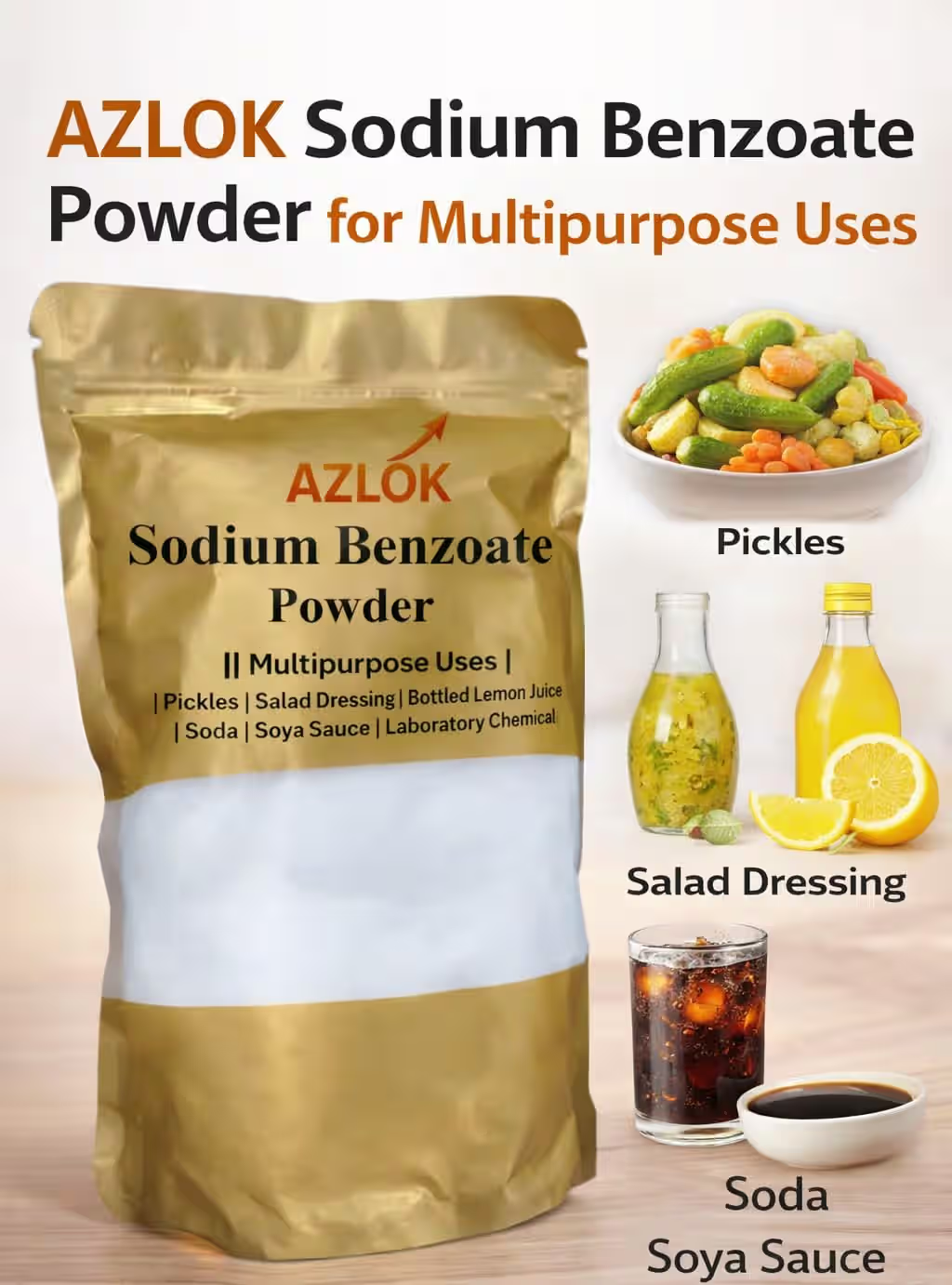
A no-nonsense guide to one of India's most trusted food-grade preservatives — what it does, how to use it correctly, and why the 100g pack from Azlok is worth every rupee.
Walk into any Indian kitchen that makes pickles from scratch, or any small-batch juice brand that worries about shelf stability, and you'll find someone asking the same two questions: "How do I keep this fresh without refrigeration?" and "Which preservative can I actually trust?"
Sodium benzoate has been answering both questions for over a century — and with good reason. It works. It's affordable. It's globally regulated. And when you're buying it in India, having a reliable, clearly labelled, food-grade source matters more than most people realise.
That's exactly what Azlok Sodium Benzoate Powder in its compact 100g pack offers: a measured, high-purity, food-grade supply that makes sense for home cooks, food hobbyists, and small-scale producers alike.
What Exactly Is Sodium Benzoate?
Sodium benzoate (chemical formula: C₆H₅COONa) is the sodium salt of benzoic acid. It appears as a fine white crystalline powder that dissolves readily in water, has no noticeable smell, and leaves almost no flavour trace when used at the right concentration. Globally, it carries the food additive code E211 — the same number you'll spot on the back of countless soft drink bottles, pickle jars, and sauce packets.
Its preservation mechanism is elegantly simple: in an acidic environment (pH below 4.5), sodium benzoate converts to benzoic acid, which disrupts the energy metabolism of bacteria, yeast, and mould — essentially starving them before they can multiply. This makes it particularly effective in the vinegary, citrusy, or fermented foods that define so much of Indian cuisine.
Sodium benzoate was the very first preservative permitted by the US FDA for use in foods — and more than a century later, it remains one of the most widely used across the world.
Azlok Sodium Benzoate Powder — At a Glance
Brand: Azlok
Pack Size: 100 g
Grade: Food Grade
E Number / INS Code: E211 / INS 211
Appearance: White crystalline powder
Solubility: Highly soluble in water
Regulatory Status (India): FSSAI Permitted Class II Preservative
Best pH Range: Below 4.5 (acidic foods)
Recommended Dosage: 0.05% – 0.1% of finished product weight
Where It Works Best — Real-World Applications
The 100g pack isn't a bulk industrial quantity — it's calibrated for meaningful, practical use. Here's where sodium benzoate genuinely earns its place:
Homemade Pickles & Achar — Whether it's mango, lime, or mixed vegetable pickle, sodium benzoate prevents yeast and mould growth in the brine, keeping the pickle shelf-stable for months without refrigeration.
Fruit Juices & Sherbets — Freshly prepared citrus juices, aam panna, and sherbets are highly perishable. A small, measured addition extends their usable life significantly — both for home stocks and small-batch commercial sales.
Sauces, Chutneys & Condiments — Tomato sauce, tamarind chutney, green chutney, and ketchup all benefit from sodium benzoate's ability to inhibit the microbial activity that causes souring, colour change, and off-odours.
Salad Dressings & Vinaigrettes — Vinegar-based dressings already have mild preservative action, but sodium benzoate strengthens that significantly — especially in warmer Indian climates where spoilage accelerates.
Soy Sauce & Fermented Condiments — Homemade or small-batch soy sauce relies on sodium benzoate to control secondary fermentation once the bottle is opened.
Carbonated Beverages & Soda Mixes — Sodium benzoate remains a standard ingredient in carbonated soft drink manufacturing, preventing microbial degradation of flavour concentrates.
Bottled Lemon Juice & Concentrate — Lemon juice's natural acidity makes it an ideal medium for sodium benzoate to work at full effectiveness, extending both taste quality and food safety.
Getting the Dosage Right
This is where most home users stumble. Too little and it doesn't preserve effectively. Too much and you're outside regulatory guidelines. The good news is the safe and effective window is very easy to work with.
Standard Reference: 0.1% concentration (maximum recommended by FSSAI)
1 litre of juice / beverage → 1 gram of sodium benzoate
1 kg of pickle or sauce → 0.5g – 1g dissolved in the brine/liquid portion
500 ml salad dressing → 0.5g dissolved in the vinegar/water phase first
1 kg jam or fruit preserve → 0.5g – 1g added during the cooking phase
Pro tip: Always dissolve sodium benzoate in a small amount of warm water before adding it to the main batch. This ensures even distribution throughout the product. Use a precision kitchen scale — not volume spoons — for accuracy.
Why "Food Grade" Isn't Just a Label Claim
Sodium benzoate exists in several purity grades — technical, pharmaceutical, and food grade. The distinctions matter enormously for anything that ends up on your table.
Food-grade sodium benzoate:
Meets FCC (Food Chemicals Codex) or equivalent purity standards
Contains minimal heavy metal contamination
Free from industrial residues and solvents that technical-grade variants may carry
Traceable through manufacturing and quality control processes
Ready for FSSAI compliance documentation for food businesses
For any small food business in India, using a clearly labelled, food-grade preservative isn't just good practice — it's a legal requirement under FSSAI norms.
The Safety Question — Answered Honestly
Sodium benzoate draws its share of online concern, and it deserves an honest answer rather than either dismissal or alarm.
The regulatory consensus is clear: Sodium benzoate is approved by the FDA (USA), EFSA (European Union), and FSSAI (India) as a safe food preservative when used within prescribed concentration limits. In India, it is classified as a permitted Class II preservative under the Food Safety and Standards Regulations.
One concern worth knowing: sodium benzoate can react with ascorbic acid (Vitamin C) in beverages to form trace amounts of benzene. The straightforward solution — avoid combining sodium benzoate with added ascorbic acid in the same formulation, particularly in ambient-temperature drinks. Many commercial beverages have already reformulated to address this.
Outside of that specific pairing, sodium benzoate used at recommended concentrations in appropriately acidic food products represents a well-established, time-tested preservation method with a strong safety record spanning decades and multiple continents.
Why It Makes Particular Sense for the Indian Kitchen
India's climate presents a unique preservation challenge. Average temperatures across most of the subcontinent are significantly higher than the conditions under which European and North American food systems were designed. A jar of homemade mango pickle or a batch of imli chutney that might last two weeks in a cooler climate can start going off in three to four days during an Indian summer — without intervention.
Sodium benzoate's effectiveness in the vinegar, citric acid, and tamarind-heavy preparations that define Indian condiment culture is well matched to this need. The Azlok 100g pack brings this to a scale that works for real households and micro food businesses: enough to preserve several batches across a season, without the waste of buying an industrial quantity you'll never finish.
For a small pickle or juice business just getting started, having a clearly labelled, food-grade preservative source you can document for FSSAI compliance is not a luxury — it's essential infrastructure.
Storing Your Azlok Sodium Benzoate Powder Correctly
Keep it sealed and dry — Moisture is the main enemy. Store in the original sealed pack or transfer to an airtight glass or food-safe container after opening.
Away from direct sunlight — A cool, dark pantry shelf is ideal. Prolonged UV exposure can degrade purity over time.
Label and date your container — Sodium benzoate should never be confused with salt, sugar, or other white powders in the kitchen.
Out of reach of children — While food-safe at correct doses, all food chemicals should be stored securely.
Frequently Asked Questions
What foods can I use Azlok Sodium Benzoate Powder in? It works best in acidic foods — pickles, fruit juices, sauces, salad dressings, soy sauce, soda mixes, and bottled lemon juice. Its effectiveness depends on the food's acidity; a pH below 4.5 gives the strongest preservation action.
Is sodium benzoate FSSAI approved in India? Yes. The FSSAI classifies sodium benzoate (INS 211) as a permitted Class II preservative, approved for use in a wide range of food products subject to specified maximum usage levels.
How much should I use per litre of juice or per kg of pickle? The standard guidance is 0.05% to 0.1% by weight of the finished product — approximately 0.5g to 1g per litre of beverage or per kilogram of food. Always dissolve it in warm water before adding to your batch.
Will it change the taste of my food? When used within recommended limits, sodium benzoate is essentially tasteless. It does not alter the flavour, colour, or texture of the food product. Using it in excess may introduce a faint bitterness.
Can it be used with Vitamin C (ascorbic acid)? It is generally advisable not to combine sodium benzoate with ascorbic acid in the same formulation, particularly in beverages. Consider potassium sorbate as an alternative when ascorbic acid must be present.
Is the 100g pack enough for home use? Yes — at 0.1% concentration, 100g of sodium benzoate is sufficient to preserve 100 litres of juice or 100 kilograms of food product. For typical home use, this covers a full season of pickling and preserving comfortably.
The Bottom Line
Preserving food well isn't about shortcuts — it's about using the right tools at the right dose. Sodium benzoate has earned its place in food systems around the world not through marketing, but through consistent, proven performance across a century of food science and regulatory scrutiny.
The Azlok Sodium Benzoate Powder 100g brings that reliability to a format designed for real people making real food: home cooks preparing seasonal pickles, small food businesses managing shelf life and FSSAI compliance, and anyone who wants their homemade sauces and juices to last without compromise.
Use it correctly, store it properly, and it will do exactly what it has always done — keep your food safer, longer, without getting in the way of the flavours you worked to create.
Related Tags
Trending Products
Isopropyl Alcohol for cleaning (IPA) I 1000mL I 99.9% Pure
₹399
Ethanol 99.9% (Denatured) 500 mL,Analytical Grade, Laboratory Grade., generic
₹201
Sodium Citrate Food grade-700 grams|Cheese Stabilizer, Acid Regulator & Texture Enhancer|Emulsifier
₹211
Washing Soda Powder 450 GM (Super Trial Pack) 100% Pure Laundry Booster Sodium Carbonate
₹130
Ethanol 99.9% (Denatured) 1000 mL,Analytical Grade, Laboratory Grade., generic
₹399