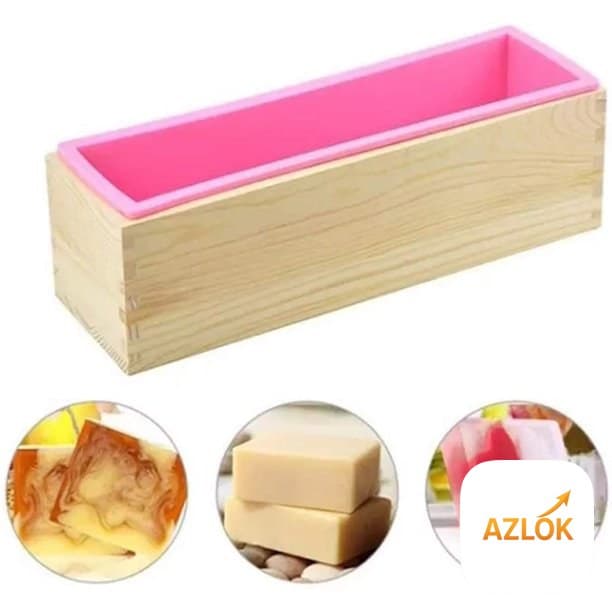
The Azlok Wooden Rectangle Silicone Soap Mould is a loaf-style mould that holds roughly 1 kg to 1.5 kg of soap batter, giving you a neat rectangular block you can slice into several bars. The soft silicone liner sits inside a sturdy wooden box, so you get easy release without the mould bowing or losing its shape while your soap sets.
What this mould is good for
This is a classic tool for anyone making cold process or melt-and-pour soap at home or for a small business. The silicone insert measures 25 x 6 x 7.1 cm, and the wooden frame around it (27 x 7.5 x 7.5 cm) adds the support that flexible moulds alone lack. That combination is what makes it easy to lift a full, heavy loaf out cleanly.
- Cold process and hot process soap — the wooden box insulates the batter, which helps the saponification process along.
- Melt-and-pour bases — pour, let it firm up, and pop the whole loaf out.
- Bath and craft blocks — bath melts, wax test loaves and similar rectangular pours.
- Small-batch selling — a single 1–1.5 kg loaf slices into a tidy set of retail-sized bars.
How to use it, step by step
- Set up the mould. Place the silicone liner snugly inside the wooden box before you start. For melt-and-pour you usually need no extra lining; for cold process, the silicone releases well on its own once fully cured.
- Prepare your batter. Mix your soap to a light-to-medium trace (cold process) or melt your base to a pourable liquid (melt-and-pour).
- Pour steadily. Fill the mould, tap it gently on the counter to release air bubbles, and level the top with a spatula.
- Insulate and rest. Cover the top and leave cold process soap undisturbed for 24–48 hours. Melt-and-pour sets faster, often within a few hours.
- Unmould. Once firm, lift the wooden box away and gently peel the silicone back from the loaf. Flexing the silicone rather than pulling the soap gives the cleanest edges.
- Cut and cure. Slice into bars with a soap cutter or a straight knife. Cold process bars then need to cure for four to six weeks in a well-ventilated spot before use.
Tips for a professional finish
- Wipe the silicone with a little oil before pouring if you want an extra-easy release with sticky recipes.
- Don't rush unmoulding. Soft soap sticks and tears; a firmer loaf cuts smoothly.
- Use a ruler and mark your cuts to get bars of even thickness — buyers notice consistency.
- Keep the wooden box dry. Wipe, don't soak it, so it lasts across many batches.
Safety notes
The mould itself is simple to handle, but soap making involves lye (sodium hydroxide) in the cold and hot process methods. Always wear gloves and eye protection, work in a ventilated area, and keep lye and raw batter away from children and pets. Never pour fresh lye solution into a mould you are holding. If you are new, start with melt-and-pour bases, which skip the lye stage entirely. Do not use these moulds for food unless the product is clearly labelled food-grade.
Buying and storage
Azlok offers this mould at ₹799 for a single unit (a Today Deal), with multi-packs of 2, 5 and 10 for those making larger batches or running a soap business. Each unit includes the purple silicone liner and its wooden box, weighing about 200 grams together. Store the silicone flat or in its box so it keeps its shape, and keep the wood away from prolonged damp. Cleaned and dried after each use, a set like this handles many production runs.
FAQ
How much soap does this mould hold?
The mould takes roughly 1 kg to 1.5 kg of soap batter, which is enough for a full loaf that you can cut into several standard-sized bars.
Do I need to line the silicone mould before pouring?
Usually not. Silicone releases soap well on its own. For very sticky or high-oil recipes you can lightly grease the liner, but paper lining is generally unnecessary.
Can I use it for cold process soap with lye?
Yes. The wooden box insulates the batter and supports the silicone during setting. Just follow standard lye safety and let the loaf cure fully before cutting and using.
How do I clean the mould after use?
Peel out any soap residue, wash the silicone with warm water and mild detergent, and dry it completely. Wipe the wooden box with a damp cloth rather than soaking it.
Is the silicone liner reusable?
Yes. With gentle handling and proper drying, the silicone insert and wooden box can be reused for many batches over a long time.