

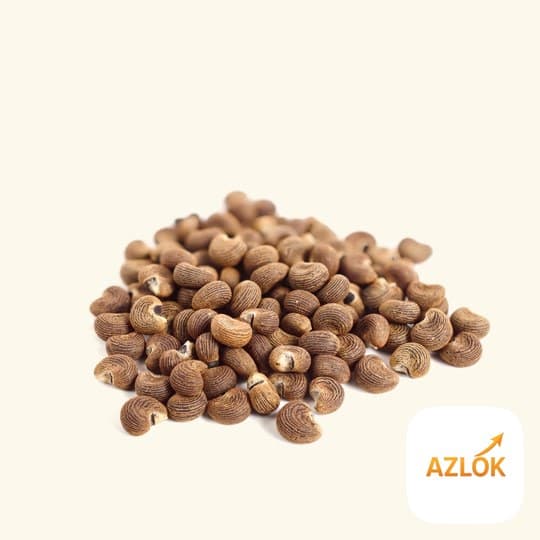

Ambrette Seed Essential Oil
Minimum Order: 1 units
Description
Ambrette Seed Essential Oil is steam-distilled from the dried seeds of Abelmoschus moschatus, yielding a light yellow, musky-floral liquid. With a specific gravity of 0.946 and flash point of 86.67°C, it is valued in luxury perfumery, skincare, and aromatherapy. Always dilute before topical use. Available from Azlok in sizes from 50 g to 10 kg.
History & Discovery
Ambrette seed, derived from Abelmoschus moschatus (also known as Hibiscus Abelmoschus or musk mallow), has been used for centuries across South and Southeast Asia, the Middle East, and parts of Europe. The plant is native to tropical Asia and is widely cultivated in India. Historically, the seeds were used as a substitute for animal musk in perfumery because of their warm, musky scent, and were also incorporated into traditional incense preparations. In Indian and Arabic fragrance traditions, ambrette seeds were often carried in sachets or blended into attars. The oil gained prominence in European perfumery from the 18th century onward, when natural musk alternatives were in high demand.
Scientific & Medicinal Importance
The essential oil is obtained by steam distillation of dried ambrette seeds. Its primary constituents are 2-trans,6-trans-farnesyl acetate, 2-cis,6-trans-farnesyl acetate, and ambrettolide — a macrocyclic musk lactone responsible for the characteristic musky odour. Ambrettolide is chemically significant because it is one of the few naturally occurring macrocyclic musks, making ambrette seed oil particularly valued as a natural alternative to synthetic musks in fine fragrance. The oil has a specific gravity of 0.946, a refractive index of 1.478, and a flash point of 86.67°C. It appears as a light yellow transparent liquid and has a shelf life of approximately two years when stored properly away from light and heat. The CAS number is 8015-62-1 and the FEMA number is 2051.
Ayurvedic and Traditional Uses
In traditional Indian medicine, the seeds of Abelmoschus moschatus have been used to address digestive discomfort and as a mild nervine. The seeds were occasionally referenced in classical texts under names such as Kasturi bhendi or Lata kasturi for their calming and digestive properties. However, the concentrated essential oil is a modern distillate and its use is primarily topical and aromatic — it does not directly correspond to the traditional seed preparations described in Ayurvedic texts. Consult a qualified Ayurvedic practitioner before using any essential oil therapeutically.
Modern-Day Applications & Benefits
Ambrette seed essential oil is widely used today in luxury and niche perfumery as a natural musk base note. It blends well with cedarwood, orange, mandarin, lavender, and other carrier oils. In skincare formulations, it is incorporated for its reported skin-conditioning and soothing properties, typically at concentrations of 0.5–2% in a suitable carrier oil such as jojoba or sweet almond oil. In aromatherapy, its calming, slightly earthy-floral scent is used to support relaxation. Azlok supplies the oil in bulk quantities (up to 10 kg), making it suitable for small perfume houses, cosmetic formulators, and soap and candle makers. Always conduct a patch test before use and keep the undiluted oil away from children. Avoid use during pregnancy without medical advice.
Why Azlok's Version is Trusted Today
Azlok
Frequently asked questions
What is ambrette seed essential oil used for?
Ambrette seed essential oil is primarily used as a natural musk note in perfumery and fragrance blending. It is also used in skincare formulations for its skin-conditioning properties and in aromatherapy for its calming, musky-floral scent.
How should I dilute ambrette seed essential oil before applying it to skin?
Dilute ambrette seed essential oil to 0.5–2% in a carrier oil such as jojoba, sweet almond, or coconut oil before applying to skin. Always do a patch test on a small area first and wait 24 hours to check for any reaction.
What essential oils blend well with ambrette seed oil?
Ambrette seed essential oil blends well with cedarwood, orange, mandarin, lavender, and most carrier oils. Its musky base note complements both citrus and woody fragrance families.
Is ambrette seed essential oil safe during pregnancy?
Pregnant women should consult a doctor before using ambrette seed essential oil. As a precaution, it is best avoided during pregnancy unless approved by a healthcare professional.
What quantity options are available for ambrette seed essential oil on Azlok?
Azlok offers ambrette seed essential oil in 50 g, 100 g, 500 g, 1 kg, 5 kg, and 10 kg sizes, making it suitable for individual buyers as well as cosmetic and fragrance businesses needing bulk quantities.
Specifications
How to use Ambrette Seed Essential Oil
Guides covering uses, dilution, safety and storage.