

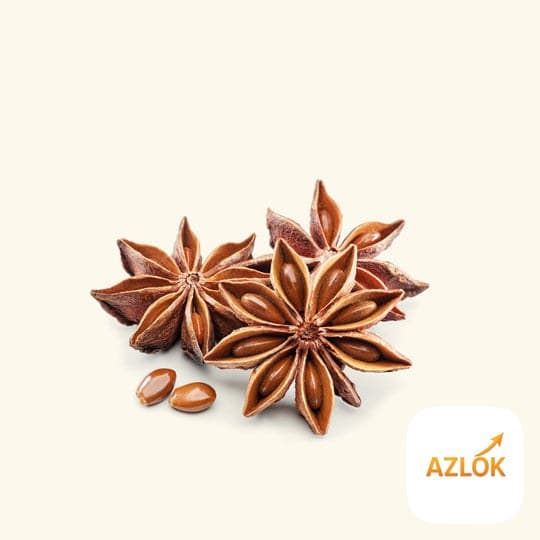

Aniseed Oil
Minimum Order: 1 units
Description
Aniseed Oil from Azlok is a cold-pressed, colorless essential oil extracted from the seeds of Pimpinella anisum, with a characteristic sweet, licorice-like aroma. It is widely used in cosmetics, soaps, creams, and fragrances for its soothing and cleansing properties. Key constituent trans-anethole gives it its distinctive scent and skin-conditioning qualities. Available in sizes from 50 g to 20 kg.
History & Discovery
Anise (Pimpinella anisum) has been cultivated for at least 4,000 years, with records of its use in ancient Egypt, Greece, and Rome. The Romans used anise seeds in spiced cakes called mustaceum, partly to aid digestion after heavy meals. Arab traders spread the plant across the Mediterranean and into South Asia. Oil distilled or pressed from the seeds has historically been used in folk medicine, flavouring, and perfumery across Europe and Asia. Star anise (Illicium verum), a botanically distinct plant from China, produces a very similar oil due to the same dominant compound, trans-anethole, and the two are sometimes used interchangeably in industry — both are referenced in this product's botanical name listing.
Scientific & Medicinal Importance
Aniseed oil's characteristic odour and most of its functional properties come from trans-anethole, which typically constitutes 80–90% of the oil. Other identified constituents include α-pinene, β-pinene, camphene, safrole, cis-anethole, linalool, anisaldehyde, and acetoanisole. The CAS number 8007-70-3 refers to the standardised anise seed oil. Its specific gravity is 0.986 g/ml and refractive index 1.559 — parameters used in quality verification. The flash point of 90°C means it is not classified as highly flammable under standard conditions but should still be stored away from open flames. The oil is soluble in alcohol but has limited solubility in water, which is why it is formulated into emulsions for cosmetic use. Optical rotation between -2.0 and +2.0 is consistent with high trans-anethole content.
Ayurvedic and Traditional Uses
In Ayurvedic tradition, anise seeds (known as shatapushpa or vilayati saunf) are considered to have deepana (digestive stimulant) and vata-kapha pacifying properties. The seeds are used in classical formulations to address digestive complaints, flatulence, and to freshen breath. The expressed or distilled oil is used in some traditional preparations, though its primary Ayurvedic application is the whole seed rather than isolated oil. Practitioners sometimes apply diluted anise oil externally for abdominal discomfort.
Modern-Day Applications & Benefits
Today, aniseed oil is used primarily in three industries: cosmetics and personal care, fragrance and perfumery, and food flavouring (at regulated, very low concentrations). In cosmetics, it appears in soaps, cleansers, face creams, and hair products for its scent and mild skin-conditioning effect attributed to anethole. It blends well with cardamom, caraway, cedarwood, coriander, and rosewood oils, making it a versatile base note or modifier in fragrance compositions. In soap making, it contributes a sweet, anise-forward scent that holds reasonably well in cold-process and melt-and-pour bases. Azlok supplies this oil in quantities from 50 g for hobbyists up to 20 kg for small manufacturers, with the oil packaged as per buyer requirement and a shelf life of two years from the date of manufacture when stored in a cool, dark place.
Why Azlok's Version is Trusted Today
Azlok
Frequently asked questions
Is Azlok Aniseed Oil safe to apply directly on skin?
No. Like most essential oils, aniseed oil should not be applied neat to the skin. Dilute it in a suitable carrier oil (e.g., coconut or jojoba) to 1–2% before topical use. Always perform a patch test first. Keep away from eyes and mucous membranes.
What is the main chemical component of Aniseed Oil?
The dominant compound is trans-anethole, which gives the oil its characteristic sweet, licorice-like aroma and accounts for approximately 80–90% of its composition. Other notable constituents include α-pinene, linalool, and anisaldehyde.
Can this oil be used in cold-process soap making?
Yes. Aniseed oil works in cold-process and melt-and-pour soap bases. It provides a sweet anise scent. Add it at the recommended fragrance usage rate for your soap recipe (typically 1–3% of oil weight) and test for acceleration before a full batch.
What sizes are available and what is the price?
Azlok offers Aniseed Oil starting at ₹200 in sizes of 50 g, 100 g, 500 g, 1 kg, 5 kg, 10 kg, and 20 kg. Larger pack sizes are suited for small manufacturers and businesses.
How should Aniseed Oil be stored?
Store aniseed oil in a tightly sealed, dark glass or opaque container away from direct sunlight, heat, and moisture. Keep it out of reach of children. Properly stored, the shelf life is two years from the date of manufacture.
Specifications
How to use Aniseed Oil
Guides covering uses, dilution, safety and storage.