

Frankincense Essential Oil
Minimum Order: 1 units
Description
Frankincense Essential Oil from Azlok is steam-distilled from Boswellia carterii resin and has a rich, woody, earthy aroma. It is widely used in aromatherapy, skincare, and meditation practices for its calming and grounding properties. Slightly yellow in colour, it blends well with cedarwood, myrrh, bergamot, and other essential oils.
History & Discovery
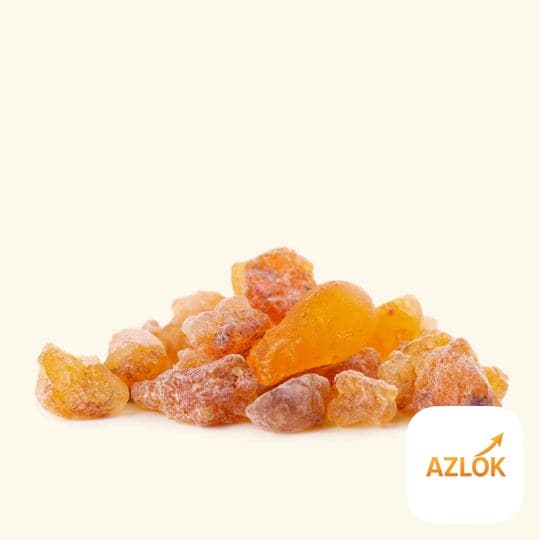
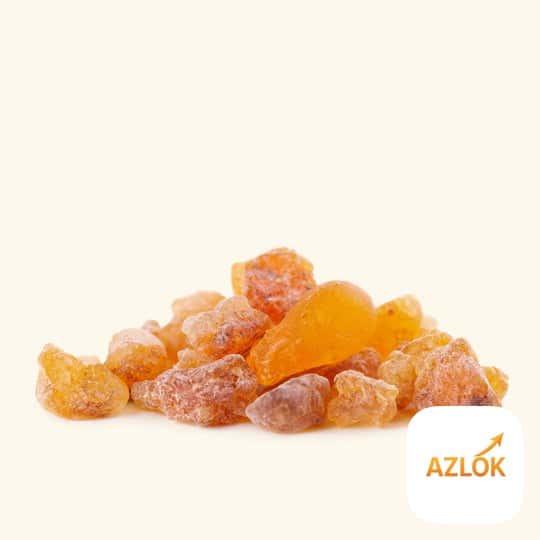
Frankincense resin has been traded and revered for over 5,000 years across ancient Egypt, the Arabian Peninsula, and the Indian subcontinent. It was burned as incense in religious ceremonies, used in embalming practices in Egypt, and carried along the famous Incense Route from Oman and Somalia to the Mediterranean. The name 'frankincense' derives from the Old French 'franc encens', meaning high-quality incense. Historically it was considered as valuable as gold in many trading civilisations. Boswellia carterii trees grow in arid, rocky regions of East Africa and the Arabian Peninsula. Harvesters make incisions in the bark; the sap that oozes out hardens into resin tears, which are then collected and steam-distilled to produce the essential oil. This traditional harvesting method has remained largely unchanged for millennia.
Scientific & Medicinal Importance
Frankincense essential oil is the volatile fraction of the gum resin of Boswellia carterii, often grouped with Boswellia sacra, and is obtained by steam distillation. Its make-up is dominated by monoterpenes. Alpha-pinene is usually the main component, alongside limonene, alpha-thujene, myrcene and sabinene, with smaller amounts of sesquiterpenes such as beta-caryophyllene. Exact proportions vary with the growing region, the harvest and the age of the resin. The heavier boswellic acids found in the resin are non-volatile, so they do not carry over into the distilled oil. The oil is a thin, clear to pale yellow liquid. It opens with a fresh, piney-citrus top note and settles into a warm, resinous base. It does not mix with water but dissolves readily in carrier oils and alcohol. Pinene and limonene oxidise when exposed to air and light, so the oil holds its character best in a tightly capped dark glass bottle.
Ayurvedic and Traditional Uses
In Ayurveda, the Boswellia genus is known as 'Shallaki' (Boswellia serrata), which is a well-documented medicinal plant used for joint support and inflammation. Boswellia carterii, the species used for frankincense essential oil, is closely related and shares some traditional usage. Frankincense resin has historically been used in Indian traditional medicine as a fumigant and in preparations for respiratory wellness. However, the steam-distilled essential oil is a modern concentrate and should not be equated directly with classical Ayurvedic formulations. In traditional contexts, frankincense fumigation (dhoop) has been used to purify spaces and support calm breathing. As with all essential oils, any use in an Ayurvedic context should be guided by a qualified practitioner.
Modern-Day Applications & Benefits
Today, frankincense essential oil is one of the most widely used oils in aromatherapy and wellness. It is diffused to promote a sense of calm and grounding, especially during meditation and yoga. In skincare, it is incorporated into serums and creams (always diluted in a carrier oil) for its reported toning and rejuvenating properties. It blends especially well with basil, bergamot, cardamom, cedarwood, chamomile, cinnamon, clary sage, coriander, geranium, ginger, myrrh, and vanilla essential oils. In the candle and soap-making industry, frankincense oil is valued for its deep, resinous, meditative scent. It is also used in perfumery as a base or middle note. Azlok supplies it in a range of pack sizes from 100 g up to 25 kg, catering to individual users and manufacturers alike. Shelf life is two years when stored in a cool, dark place in a tightly sealed container. Safety: Frankincense essential oil must always be diluted in a suitable carrier oil before skin application — a typical dilution is 1–2% (6–12 drops per 30 ml of carrier oil). Do a patch test before wider use. Keep out of reach of children. Avoid contact with eyes and mucous membranes. Not for internal use. Use in a well-ventilated area when diffusing. Pregnant or breastfeeding individuals should consult a healthcare professional before use.
Why Azlok's Version is Trusted Today
Azlok
Frequently asked questions
Is Azlok's frankincense essential oil pure and steam-distilled?
Yes. Azlok's Frankincense Essential Oil is steam-distilled from Boswellia carterii resin. Its technical parameters — specific gravity 1.523, refractive index 0.923, optical rotation -0.05 to 0 — are consistent with pure frankincense oil.
How should I dilute frankincense essential oil before applying it to my skin?
Dilute frankincense essential oil to 1–2% in a carrier oil such as jojoba, sweet almond, or coconut oil before skin application. This means approximately 6–12 drops per 30 ml of carrier oil. Always do a patch test first.
Can this frankincense oil be used in candle and soap making?
Yes. Frankincense essential oil is widely used in candle and soap making for its rich, woody, resinous scent. Follow standard usage rates for your formulation (typically 3–6% in candles and 1–3% in cold-process soap). Azlok offers bulk sizes up to 25 kg for manufacturers.
What is the shelf life of frankincense essential oil and how should I store it?
The shelf life of frankincense essential oil is two years from the date of manufacture. Store it in a tightly sealed, dark glass bottle away from direct sunlight, heat, and moisture. Refrigeration is not necessary but a cool, dark cupboard is ideal.
Is frankincense essential oil safe to ingest or use during pregnancy?
No, this essential oil is not for internal use. Pregnant or breastfeeding women should consult a qualified healthcare professional before using any essential oil, including frankincense, even aromatically or topically.
Specifications
How to use Frankincense Essential Oil
Guides covering uses, dilution, safety and storage.