

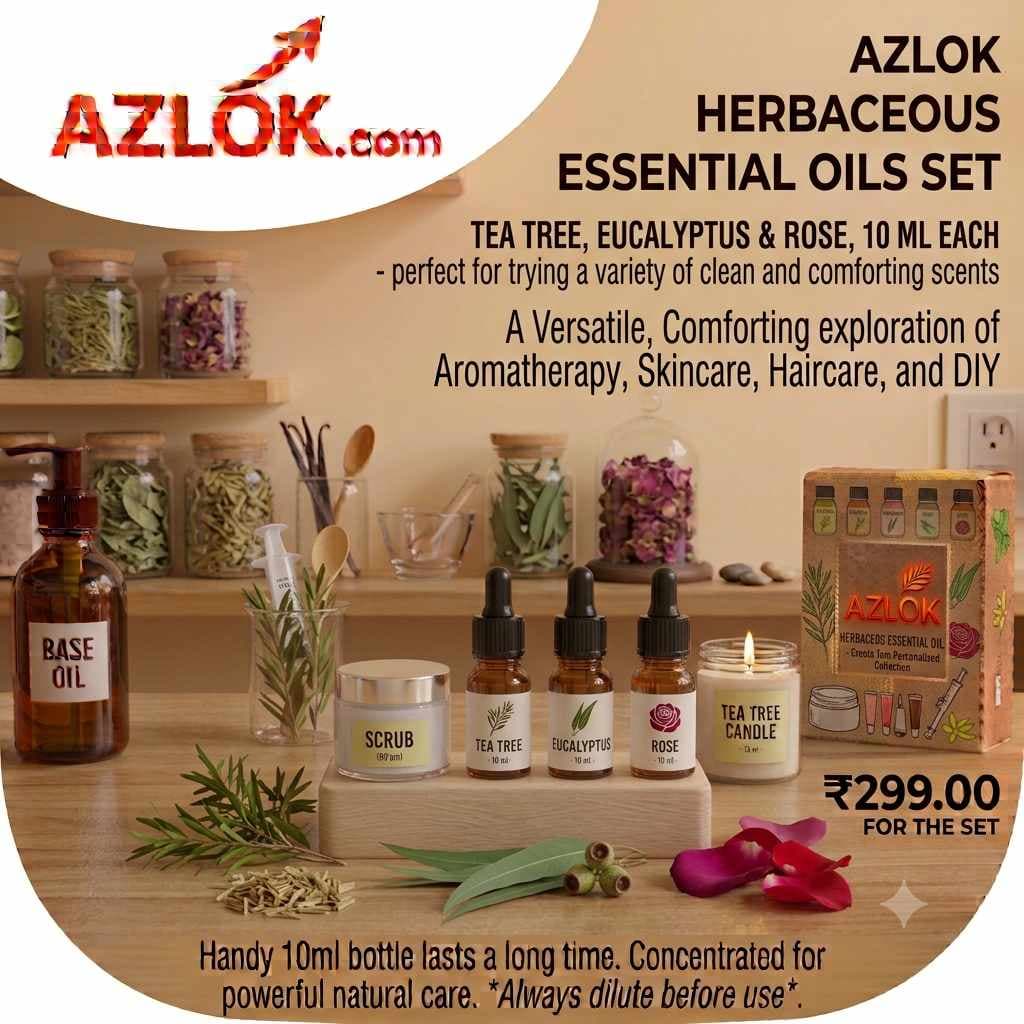

Herbaceous Essential Oils Set - Pack of 3 Oils
Minimum Order: 1 units
Description
Azlok's Herbaceous Essential Oils Set includes three 10 ml bottles — Tea Tree, Eucalyptus, and Rose Essential Oil — priced at ₹299. Suitable for skincare, haircare, aromatherapy, diffuser blends, and DIY soap or candle making. Always dilute with a carrier oil before skin use.
History & Discovery
All three oils in this set come from plants with long, well-recorded histories. Tea tree (Melaleuca alternifolia) grows wild in the swampy coastal regions of New South Wales, Australia, where the Bundjalung people used its leaves for generations. Commercial distillation of the oil began in the 1920s. Eucalyptus is also native to Australia. Its oil was being distilled on a commercial scale in Victoria by the 1850s, and eucalyptus trees were later planted in India's Nilgiri hills during the nineteenth century. Rose has the oldest story of the three. Persian scholars refined the distillation of rose water around the tenth and eleventh centuries, and rose attars became highly prized in Mughal India. Kannauj in Uttar Pradesh still makes rose attar by traditional methods. Bulgaria's Rose Valley later became a major source of rose oil.
Scientific & Medicinal Importance
Each bottle in this set holds a concentrated, volatile oil. Tea tree oil is usually steam-distilled from the leaves of Melaleuca alternifolia, and its main aroma compounds are terpinen-4-ol and gamma-terpinene, which give it a fresh, medicinal-green, slightly camphor-like smell. Eucalyptus oil, commonly from Eucalyptus globulus leaves, is rich in 1,8-cineole (eucalyptol), behind its sharp, cool, minty-woody note. Rose oils typically carry compounds such as citronellol, geraniol and phenylethyl alcohol, which give the soft, floral, sweet scent. All three oils are thin, light and do not mix with water; they need a carrier oil, emulsifier or wax to disperse properly. Because they evaporate quickly and react to light and heat, they are packed in small bottles and should be kept tightly capped.
Ayurvedic and Traditional Uses
Rose, known as gulab or shatapatri, has been part of Ayurvedic and Unani practice for centuries. It appears in classical texts and in everyday Indian preparations such as rose water, gulkand and attar. In Kannauj, rose petals are still distilled in copper degs using the deg-bhapka method, and the result is often captured in sandalwood oil. Rose fragrance also has a long place in Indian worship, weddings and hospitality. Eucalyptus and tea tree are not part of the classical Ayurvedic texts, because neither plant grew in India when those texts were written. Eucalyptus came to the Nilgiris in the nineteenth century, and Nilgiri eucalyptus oil soon became a familiar household oil across South India. Tea tree oil reached Indian homes much more recently, mainly through modern skincare and aromatherapy products.
Modern-Day Applications & Benefits
Today these three oils are mostly used for fragrance. In a diffuser, a few drops of eucalyptus or tea tree give a clean, sharp aroma, while rose adds a softer floral side; many people blend eucalyptus with rose for a balanced room scent. DIY makers add them to cold process or melt-and-pour soap, soy or paraffin candles, room sprays, reed diffusers and bath salts, adjusting the amount to the scent strength they want. In home skincare and haircare, small brands and formulators add them at low dilution to massage oils, hair oil blends, face packs, creams and lotions mainly for scent. Always dilute in a carrier oil such as coconut, almond or jojoba, do a patch test first, keep them for external use only and away from eyes and children, and consult a doctor before use if pregnant or on medication.
Why Azlok's Version is Trusted Today
Azlok
Frequently asked questions
Can I apply these essential oils directly on my skin?
No. All three oils in this set are highly concentrated and must be diluted in a carrier oil (such as coconut, almond, or jojoba oil) at 1–2% before skin application. Undiluted use can cause irritation or allergic reactions. Always do a patch test first.
Are these oils safe to use in a diffuser?
Yes, all three oils — tea tree, eucalyptus, and rose — can be used in an electric or ultrasonic diffuser. Add 3–5 drops per 100 ml of water. Ensure the room is ventilated and avoid prolonged exposure for children, pregnant women, or pets.
Can these oils be used for DIY soap and candle making?
Yes, these oils are suitable for adding fragrance to homemade soaps and candles. For candles, add at 3–6% of the wax weight. For cold-process soap, follow standard essential oil usage rates. Note that natural essential oils may fade in high-heat applications.
Are these essential oils edible or food-grade?
No. These are aromatic essential oils intended for external use, aromatherapy, and craft applications only. They are not food-grade and should not be ingested. Keep away from eyes and mouth.
How should I store these essential oils to extend their shelf life?
Store all three bottles in a cool, dark location — away from direct sunlight, heat, and humidity. Keep caps tightly closed after each use. Properly stored essential oils typically remain usable for 1–2 years. Keep out of reach of children.
Specifications
How to use Herbaceous Essential Oils Set - Pack of 3 Oils
Guides covering uses, dilution, safety and storage.