


Jamun Seed Powder
Minimum Order: 1 units
Description
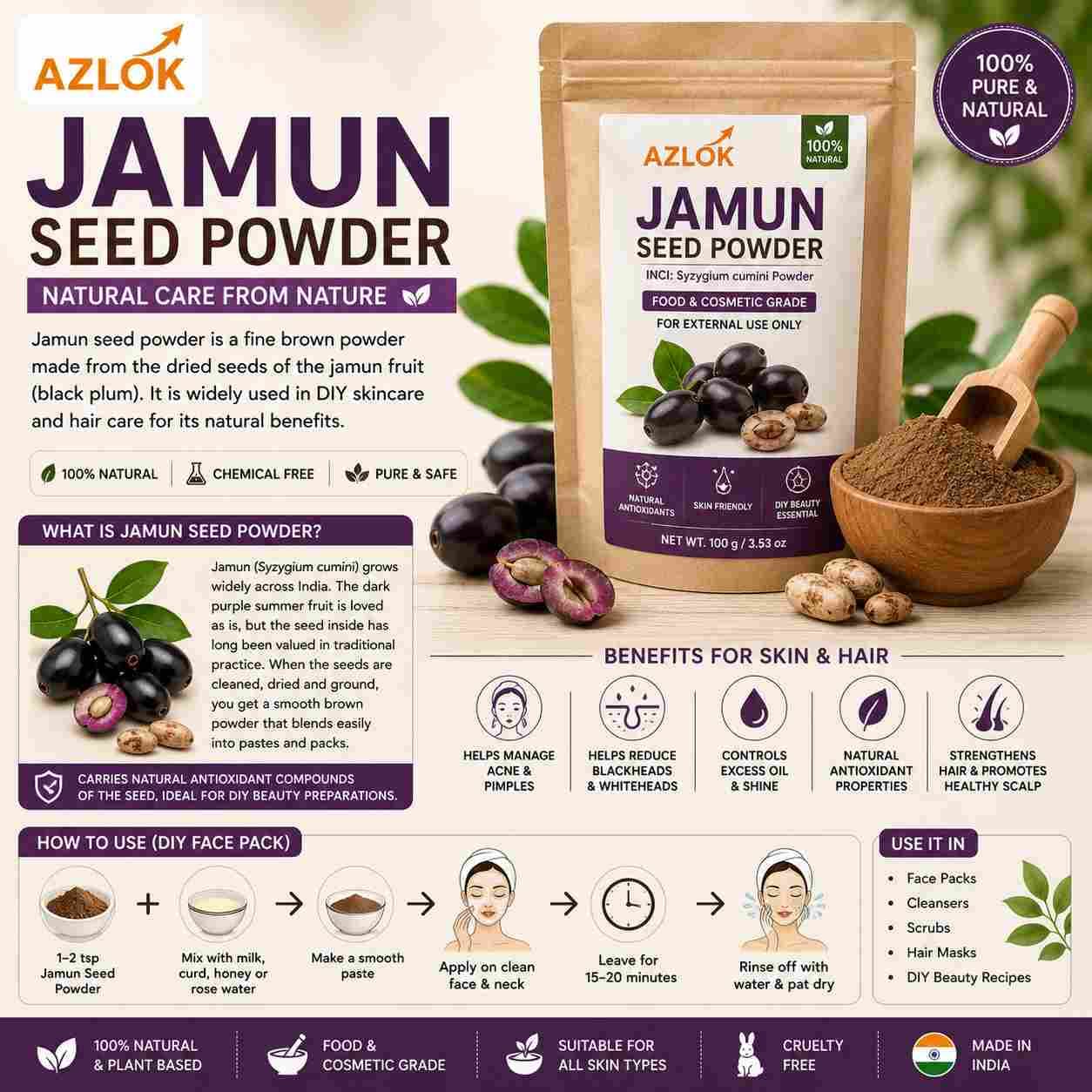
Jamun Seed Powder (Syzygium cumini) is made from dried seeds of the black plum fruit, native to India. It is used in skincare to fight acne, tighten pores, and brighten skin, and in haircare to strengthen roots and reduce scalp oiliness. Available in food & cosmetic grade from Azlok in packs from 100 g to 20 kg.
History & Discovery
Jamun (Syzygium cumini), commonly called black plum or Indian blackberry, has been cultivated across the Indian subcontinent for thousands of years. The fruit, bark, leaves, and seeds have all been used in traditional Indian medicine systems. Jamun trees are mentioned in ancient Sanskrit texts and are considered sacred in several Indian traditions. The seeds in particular were dried, powdered, and used by traditional healers long before modern herbal commerce began. Historically, jamun seed powder was prepared at home by drying the seeds in sunlight after the monsoon harvest and grinding them into a fine brown powder. Village practitioners recommended it for a range of conditions, and it remained a staple in household herbal kits across Maharashtra, Gujarat, Tamil Nadu, and Bengal. Today it is standardised and supplied commercially in food and cosmetic grades, as Azlok does, making it accessible to home users and formulators alike.
Scientific & Medicinal Importance
Jamun Seed Powder is made by drying and finely grinding the seeds (guthli) of the jamun fruit, Syzygium cumini, a tree of the Myrtaceae family. The powder is usually brown to greyish-brown, with an earthy smell and a distinctly bitter, astringent taste. Its colour and particle size can vary slightly between batches depending on the seeds and how finely they are milled. The seeds naturally contain tannins and other plant polyphenols, including ellagic acid and gallic acid, along with starch, fibre and small amounts of oil. The tannins give the powder its dry, astringent feel on the tongue and skin. In formulations it behaves as a fine, absorbent powder that mixes easily with water, rose water, milk or yoghurt to form a smooth paste, which is why it is used in face packs and hair masks.
Ayurvedic and Traditional Uses
The jamun tree, known in Sanskrit as Jambu, holds a long place in Indian tradition. Ancient texts refer to the Indian subcontinent as Jambudvipa, the land of the jamun tree. The fruit, bark, leaves and seeds have all been part of Ayurvedic practice for centuries, and the seed in particular, often called jambu beej or jamun guthli, has been dried and powdered at home for generations. In Ayurvedic descriptions, jamun is classed mainly under kashaya (astringent) rasa, matching the dry, puckering taste of the seed. Households in many parts of India still save the seeds during the summer jamun season, sun-dry them and grind them into powder for later use. Anyone wishing to use it in a traditional way should consult a qualified Ayurvedic practitioner or doctor, especially if pregnant or on medication.
Modern-Day Applications & Benefits
Jamun seed powder is widely used today in DIY skincare, including face packs, scrubs, and masks. A common home recipe is mixing one teaspoon of the powder with raw milk or rose water to form a paste, applying it to the face for 15–20 minutes, and washing off. For hair, it can be blended into hair masks with yogurt or coconut oil to address scalp oiliness and strengthen follicles. Cosmetic formulators use jamun seed powder as an active botanical ingredient in natural face washes, clay masks, and anti-acne creams. Small businesses sourcing bulk quantities (500 g to 20 kg) from Azlok use it in private-label herbal product lines. Always do a patch test before applying any new ingredient to a larger skin area. Store the powder in a cool, dry place away from moisture to preserve its 2-year shelf life. This product is for external use only — do not ingest it.
Why Azlok's Version is Trusted Today
Azlok
Frequently asked questions
How do I make a face pack using Jamun Seed Powder for acne?
Mix 1 teaspoon of jamun seed powder with enough raw milk or rose water to make a smooth paste. Apply to the face, leave for 15–20 minutes, then rinse with lukewarm water. Use 2–3 times a week. Always do a patch test on your inner arm first, especially if you have sensitive skin.
What is the shelf life and how should I store Jamun Seed Powder?
Jamun Seed Powder from Azlok has a shelf life of 2 years from the date of manufacture. Store it in a cool, dry place away from direct sunlight and moisture. Once opened, keep it in an airtight container to prevent clumping and preserve potency.
Is Azlok Jamun Seed Powder suitable for bulk purchase by small businesses?
Yes. Azlok offers jamun seed powder in 100 g, 500 g, 1 kg, 5 kg, 10 kg, and 20 kg packs, making it suitable for individual buyers as well as small cosmetic and herbal product manufacturers who need bulk quantities at consistent quality.
Can Jamun Seed Powder be used for hair care?
Yes. Jamun seed powder can be mixed with yogurt or coconut oil and applied to the scalp as a hair mask to help reduce excess oiliness and strengthen hair roots. Leave on for 20–30 minutes and rinse thoroughly. It is not a treatment for any diagnosed hair condition.
What does Jamun Seed Powder look and smell like, and will it tint my face pack?
It is a fine brown to greyish-brown powder with an earthy smell and a bitter, astringent taste. When mixed with rose water, milk or curd it gives a brownish paste, which washes off easily with water. Colour may vary slightly between batches. Always do a patch test before applying it to skin, and use externally only.
Specifications
How to use Jamun Seed Powder
Guides covering uses, dilution, safety and storage.