

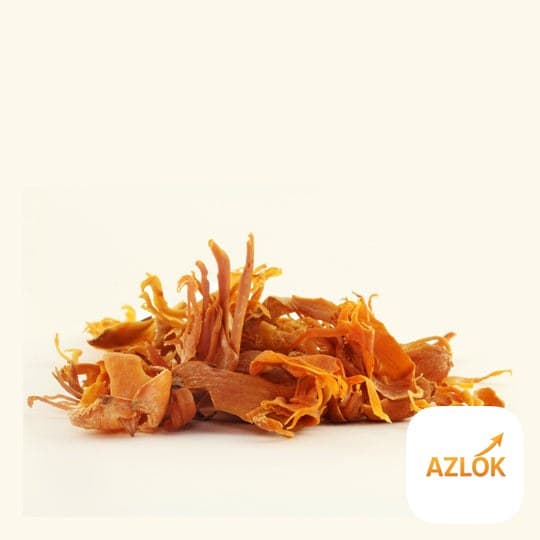

Mace Essential Oil
Minimum Order: 1 units
Description
Mace Essential Oil is steam-distilled from the dried arils (mace) of Myristica fragrans and has a warm, spicy, slightly sweet aroma. CAS# 8007-12-3. For external use only; always dilute before application.
History & Discovery
Mace is the lacy, bright-red aril that wraps around the nutmeg seed of Myristica fragrans, a tree native to the Banda Islands of Indonesia and also cultivated in Kerala and other parts of southern India. Both nutmeg and mace have been traded across the Indian Ocean since at least the 6th century CE, prized by Arab, Indian, and later European merchants. The spice reached medieval Europe through Arab traders and was considered so valuable that wars were fought over its supply routes during the colonial era. In India, mace has long been used in Mughal cuisine, Ayurvedic preparations, and traditional perfumery, making it one of the most historically significant spices of the subcontinent.
Scientific & Medicinal Importance
Mace essential oil is a pale yellow to almost colourless volatile liquid obtained by steam distillation of dried mace, the aril of Myristica fragrans. Its main components are monoterpenes such as sabinene, alpha-pinene, beta-pinene and limonene, along with terpinen-4-ol. It also contains aromatic compounds like myristicin, elemicin and small amounts of safrole, which give it a warm, spicy depth. The exact balance varies with the origin of the mace, its age and the distillation conditions. Like most essential oils, it does not mix with water but dissolves readily in alcohol and carrier oils such as jojoba, sweet almond or fractionated coconut oil. It is a middle note in perfumery and is quite concentrated, so only small amounts are needed. Store it in a tightly closed amber bottle, away from heat and sunlight, and out of reach of children.
Ayurvedic and Traditional Uses
In India, mace is known as javitri in Hindi and jatipatri in Sanskrit. It has been part of Ayurvedic practice for centuries, usually mentioned alongside nutmeg (jaiphal), since both come from the same fruit. Classical texts group it with other fragrant spices that were valued for their aroma and warming character, and it appears as an ingredient in a number of traditional preparations. Outside Ayurvedic practice, javitri has a long place in Indian kitchens. It is used in garam masala, biryani spice mixes and rich Mughlai and Awadhi dishes, and in some sweets for its delicate flavour. Its scent also found a place in traditional perfumery and attar blends. The essential oil captures this familiar spicy aroma in concentrated form, which is why it is mainly used today for fragrance rather than in food.
Modern-Day Applications & Benefits
Today, mace essential oil is used by aromatherapists, cosmetic formulators, and DIY soap and candle makers. In aromatherapy diffusers, a few drops blended with bergamot, rosemary, or clary sage can create a warming, mentally stimulating environment. Cosmetic manufacturers incorporate it into creams and serums targeting dull skin and in scalp oils aimed at thinning or weak hair. In the fragrance industry, it serves as a spicy-warm middle note in perfumes and colognes. Azlok supplies mace essential oil in sizes ranging from 100 g to 20 kg, making it suitable for both individual DIY users and small-to-medium businesses. The oil blends well with geranium, lime, rosemary, bergamot, and clary sage, as well as all common carrier oils.
Why Azlok's Version is Trusted Today
Azlok
Frequently asked questions
What is mace essential oil used for?
Mace essential oil is used in aromatherapy for stress relief and mental stimulation, in skincare for dull or oily skin, in scalp oils for weak or thinning hair, and as a spicy-warm note in perfumes and candles. It is for external use only.
How should I dilute mace essential oil before applying it to skin?
Always dilute mace essential oil in a carrier oil (such as coconut, jojoba, or sweet almond oil) at a concentration of 1–2% before applying to skin — approximately 6–12 drops per 30 ml of carrier oil. Perform a patch test on a small area first and wait 24 hours to check for any reaction.
Is mace essential oil safe during pregnancy?
Pregnant women should consult a doctor before using mace essential oil. The oil contains myristicin and other active compounds that may not be suitable during pregnancy without medical guidance.
What essential oils blend well with mace essential oil?
Mace essential oil blends well with geranium, lime, rosemary, bergamot, and clary sage essential oils. It also mixes readily with all common carrier oils including coconut, jojoba, and sweet almond oil.
What pack sizes are available for mace essential oil on Azlok?
Azlok offers mace essential oil in 100 g, 500 g, 1 kg, 5 kg, 10 kg, and 20 kg packs, with prices starting at ₹599, making it suitable for individual DIY users as well as small and medium businesses.
Specifications
How to use Mace Essential Oil
Guides covering uses, dilution, safety and storage.