

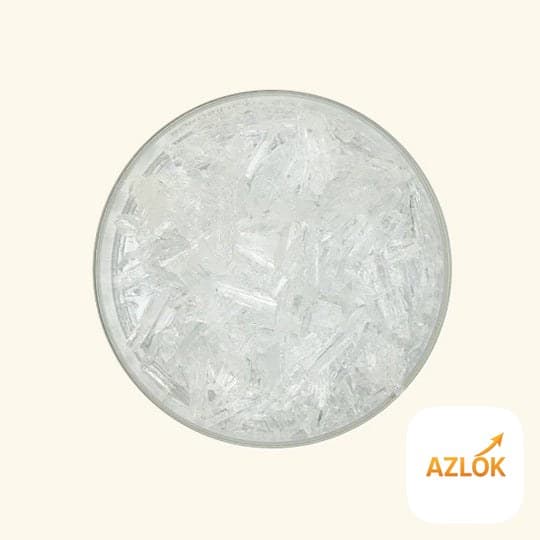

Menthol Crystal Bold (Edible Grade)
Minimum Order: 1 units
Description
Menthol Crystal Bold (Edible Grade) from Azlok consists of colourless-to-white hexagonal crystals derived from Mentha arvensis and peppermint oil. With 99% purity and edible-grade certification, these crystals deliver an intense cooling sensation and strong mint aroma. Available from 50 g to 20 kg, they suit cosmetic formulations, food flavouring, and pharmaceutical applications.
History & Discovery
Menthol has been used for thousands of years across Asia and Europe. Ancient Chinese and Japanese texts reference peppermint and mint plants as medicinal herbs, and menthol was identified as the primary active compound responsible for the characteristic cooling effect. In India, Mentha arvensis — commonly called corn mint or wild mint — has been cultivated in the Tarai belt of Uttar Pradesh since the 20th century, making India today one of the world's largest producers and exporters of natural menthol. The name 'menthol' derives from the Latin 'Mentha', the genus of the mint plant. Commercial crystallisation of menthol from mint oil was industrialised in the 19th century, and India's menthol industry grew substantially from the 1960s onward as global demand from confectionery, tobacco, and pharmaceutical sectors increased.
Scientific & Medicinal Importance
Menthol (chemical formula C10H20O, CAS 89-78-1, molecular weight 156.26 g/mol) is a cyclic terpene alcohol found naturally in mint oils. To produce menthol crystals, Mentha arvensis herb is steam-distilled to obtain mint oil. The oil is then subjected to slow cooling and refrigeration crystallisation, causing menthol to solidify into hexagonal crystals. The crystals are separated by centrifugation and dried to achieve a purity of 99%. The resulting crystals have a boiling point of 214.6°C, flash point of 93°C, specific gravity of 0.89 g/mL, and a pH range of 5–9 in solution. Menthol activates the TRPM8 receptor (a cold-sensitive ion channel) on nerve endings, producing the characteristic cooling sensation without any actual drop in temperature. It is soluble in alcohol, ether, and fixed oils, but only sparingly soluble in water.
Ayurvedic and Traditional Uses
In Ayurveda, Pudina (Mentha species) is classified as having cooling (sheeta), light, and pungent properties. It is traditionally used to pacify Pitta dosha and ease digestive discomfort, headaches, and nasal congestion. Menthol is the key bioactive responsible for these classical uses. Ayurvedic formulations such as peppermint-based arks, churnas, and herbal oils have employed mint and its extracts for centuries. However, concentrated menthol crystals are a modern refined product — the classical texts reference the whole plant or its crude oil rather than isolated crystals. When used in Ayurvedic topical preparations today, menthol crystal is valued for its analgesic and decongestant properties consistent with the traditional understanding of Pudina.
Modern-Day Applications & Benefits
Menthol crystal bold is widely used across several industries today. In cosmetics and personal care, it is incorporated into lotions, balms, cooling gels, scalp treatments, and lip products for its cooling and mild analgesic effect. In the food and confectionery industry, edible-grade menthol is used as a flavouring agent in candies, chewing gum, mouth fresheners, and beverages. The pharmaceutical sector uses it in cough drops, throat lozenges, nasal inhalers, and topical pain-relief ointments. In the fragrance industry it is used to impart a fresh, minty note. Azlok supplies edible-grade menthol crystals in bulk packs from 50 g to 20 kg, making them accessible for home formulators, small businesses, and industrial buyers. Safety note: Although edible grade, menthol crystals should not be ingested in concentrated crystalline form. Always dilute appropriately before use. Keep away from children. For topical formulations, recommended usage levels are typically 0.1–2%; higher concentrations may cause skin or mucous membrane irritation. Avoid contact with eyes. Work in a ventilated area as the vapour is intense.
Why Azlok's Version is Trusted Today
Azlok
Frequently asked questions
What is the difference between edible-grade and cosmetic-grade menthol crystal?
Edible-grade menthol meets food safety purity standards (99%+ purity) and can be used in food flavouring, oral care, and pharmaceutical products in addition to cosmetic applications. Cosmetic-grade menthol may not meet the stricter food safety specifications. Azlok's Menthol Crystal Bold is edible grade, making it suitable for both food and cosmetic formulations.
How do I dissolve menthol crystals in a formulation?
Menthol crystals are sparingly soluble in water but dissolve well in alcohol, carrier oils, and waxes. For oil-based products like balms or ointments, melt the crystals into warm oil or wax. For water-based products, first dissolve in a small quantity of ethanol (around 3–5 times the weight of menthol) and then blend into the formulation. Start with 0.1–2% concentration and adjust based on desired cooling intensity.
Can menthol crystals be added directly to food or beverages?
Edible-grade menthol crystals can be used as a food flavouring agent, but they must always be properly diluted before use — never consumed as raw crystals. Typical food flavouring usage is at very low levels (a few ppm). For home use, dissolve a small amount in a food-grade carrier like sugar syrup or alcohol before adding to recipes. Consult food formulation guidelines for exact dosage.
What is the shelf life and how should menthol crystals be stored?
Azlok Menthol Crystal Bold has a shelf life of 24 months from the date of manufacture. Store in a cool, dry place away from direct sunlight and heat, in a tightly sealed container. Menthol has a low melting point (around 42–43°C), so it can soften or clump in hot conditions. Keep away from open flames as the flash point is 93°C.
Is the 'Bold' variant different from regular menthol crystals?
'Bold' typically refers to larger crystal size compared to standard or fine-grade menthol crystals. The chemical composition and purity (99%) remain the same. Larger crystals are preferred by industrial and bulk buyers as they are easier to handle, produce less dust, and dissolve at a controlled rate. Fine or regular crystals dissolve faster and are often preferred for smaller-scale formulations.
Specifications
Documents
Safety data sheet not yet published for this product — request one below and we will email it.