

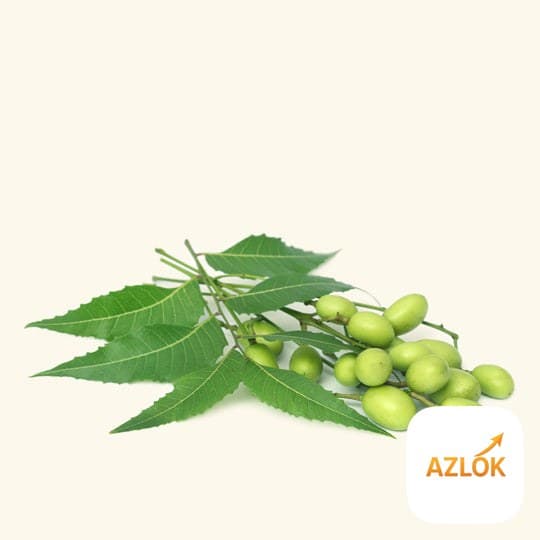

Neem Oil
Minimum Order: 1 units
Description
Azlok Neem Oil is cold-pressed from seeds of Azadirachta indica and retains its natural azadirachtin, fatty acids, and antioxidants. It has a characteristic strong odour and dark green to brown colour. Available in sizes from 500 g to 25 kg.
History & Discovery
The neem tree (Azadirachta indica) is native to the Indian subcontinent and has grown across India, Bangladesh, Pakistan and Myanmar for thousands of years. Its Sanskrit name, nimba, appears in old Indian texts, and the tree is still planted near homes, temples and along village roads for its shade. Neem twigs have long been used as datun, the traditional tooth-cleaning stick. The oil itself has been pressed from the seed kernels for generations, often in small wooden or stone ghanis. In rural homes it was burned in lamps and rubbed into wooden items and leather. Over the twentieth century, neem oil found its way into commercial soaps, hair oils and agricultural products in India, and later travelled to Africa, the Middle East and other regions where the tree was introduced.
Scientific & Medicinal Importance
Neem oil is a vegetable oil pressed from the seed kernels of the neem tree (Azadirachta indica). Like most seed oils, it is mainly made up of triglycerides. Oleic acid is usually the largest fatty acid, followed by significant amounts of stearic, palmitic and linoleic acids. Its fairly high share of saturated fats is why it turns thick or partly solid in cool weather. What sets neem oil apart is its non-fatty portion. It contains limonoids, a group of bitter compounds that includes azadirachtin, nimbin and salannin. It also contains sulphur-containing compounds, which give the oil its strong, garlic-like smell. Cold-pressed neem oil is dark green to brown, fairly viscous and very bitter. The exact composition varies with seed source, season and pressing method.
Ayurvedic and Traditional Uses
Neem, known as nimba, has been part of Ayurvedic practice for centuries. Classical texts describe it by its taste, and it is placed among herbs with a strongly bitter (tikta) quality. The leaves, bark, flowers and seed oil are all mentioned in traditional writings, and neem flowers are still eaten in some regional festival dishes, such as the bitter-sweet pachadi made for Ugadi. In traditional households, neem oil was mostly kept for external use. It was blended into herbal hair oils and body oils, often softened with sesame or coconut oil because of its sharp smell. Many families continue to use such blends today as part of their grooming routine. If you use it on skin or scalp, dilute it well, do a patch test first, and consult a doctor if pregnant or on medication.
Modern-Day Applications & Benefits
In modern cosmetic and personal care formulations, neem oil is used at concentrations typically between 0.5% and 5% in creams, lotions, shampoos, and scalp serums. At higher concentrations the characteristic strong odour can be overpowering, so it is usually blended with coconut oil, jojoba oil, or grapeseed oil. In agriculture, diluted neem oil sprays are an established biopesticide for controlling aphids, mites, whiteflies, and fungal issues on plants; it is approved for use in organic farming in several countries. Azlok supplies neem oil in bulk sizes up to 25 kg, making it suitable for small manufacturers, soap makers, cosmetic formulators, and nurseries. Always perform a patch test before topical use and dilute properly before applying to skin or plants.
Why Azlok's Version is Trusted Today
Azlok
Frequently asked questions
Is Azlok Neem Oil safe to apply directly on skin?
Undiluted neem oil can irritate sensitive skin. It is recommended to dilute it to 1–5% in a carrier oil such as coconut or jojoba oil before applying. Always do a patch test on a small area 24 hours before full use.
What is the shelf life of this neem oil and how should it be stored?
Azlok Neem Oil has a shelf life of 2 years from the date of manufacture. Store in a cool, dark place away from direct sunlight and heat. Keep the container tightly closed to prevent oxidation.
Does neem oil solidify in cold weather?
Yes, neem oil can become semi-solid or cloudy below around 25 °C because of its saturated fatty acid content. This is a natural characteristic and does not affect quality. Place the container in warm water for a few minutes to reliquefy before use.
Is this neem oil food-grade or edible?
No. Azlok Neem Oil is a cold-pressed carrier oil intended for external/topical, cosmetic, and agricultural use only. It is not food-grade and should not be ingested. Keep out of reach of children.
Can I use neem oil in handmade soap?
Yes. Neem oil can be used in cold-process and hot-process soap as a small part of the oil blend. Run your full recipe through a lye calculator, because neem oil has its own saponification value. Expect a darker bar, and note that its strong odour usually carries through to the finished soap. Strong essential oils in the recipe can help balance the smell.
Specifications
How to use Neem Oil
Guides covering uses, dilution, safety and storage.