

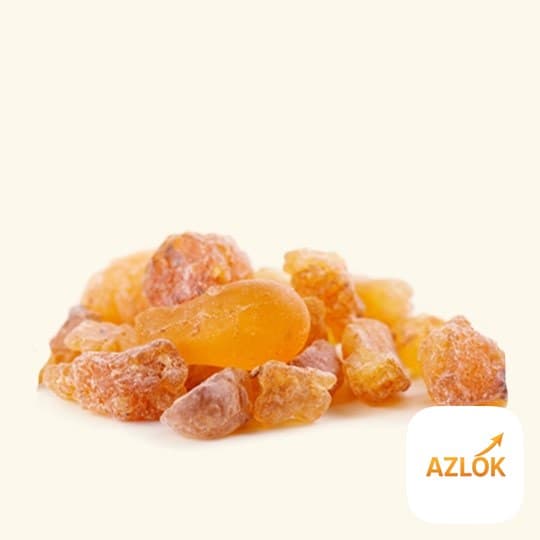

Olibanum Absolute Oil
Minimum Order: 1 units
Description
Olibanum Absolute Oil (Frankincense Absolute) is solvent-extracted from Boswellia serrata resin sourced in India. It has a woody, spicy scent and is used in perfumery, aromatherapy, candle and soap making, and skincare formulations. Azlok supplies it in sizes from 50 g to 20 kg. Flash point 40°C — handle with care.
History & Discovery
Olibanum, commonly called frankincense, has been traded and burned as incense for over 5,000 years across ancient Egypt, the Arabian Peninsula, and the Indian subcontinent. The resin is obtained by tapping the bark of Boswellia trees, which are native to arid regions of Africa, the Middle East, and India. Boswellia serrata, the Indian species, has been harvested for both religious and medicinal purposes for millennia and is mentioned in ancient Ayurvedic and Unani texts. The absolute form is a modern extraction developed for the fragrance and cosmetic industries, capturing the full aromatic profile of the resin in a liquid, easy-to-blend concentrate.
Scientific & Medicinal Importance
Olibanum absolute is produced by solvent extraction of Boswellia serrata resin, yielding a concentrated aromatic liquid with CAS number 8016-36-2 and FEMA number 2816. Its key physical properties include a specific gravity of 0.8775 at 20°C, refractive index of 1.4735 at 20°C, and a flash point of 40°C, which classifies it as a flammable liquid requiring careful storage away from heat and open flame. The oil is colourless to pale yellow and soluble in alcohols and fixed oils. The characteristic woody-spicy aroma comes from a complex mixture of terpenoids, including alpha-pinene, limonene, and boswellic acid derivatives present in the source resin. It blends well with ylang ylang, wild orange, peppermint, clary sage, rosemary, and most carrier oils.
Ayurvedic and Traditional Uses
In Ayurveda, Boswellia serrata is known by its Sanskrit name Shallaki, and its gum resin is often called salai guggul or kundur in Hindi-speaking regions. The resin collected from these trees in the dry forests of central and western India has been part of Ayurvedic practice for centuries. It also has a long place in daily ritual life, where it is burned in dhoop, havan and temple offerings for its warm, smoky aroma. It is worth noting that olibanum absolute is a modern product. Traditional practice used the raw resin or simple preparations made from it, not solvent-extracted absolutes. Today the absolute is valued mainly for its fragrance in perfumery, incense blends, candles and soaps. Any skin use should be well diluted, limited to external use and patch tested first. If you are pregnant or on medication, consult a doctor.
Modern-Day Applications & Benefits
In modern applications, olibanum absolute is a valued ingredient in high-end perfumery as a base note that adds depth, warmth, and a resinous character to fragrance compositions. It is used by candle and soap makers to impart a long-lasting woody-spicy scent. In skincare, formulators incorporate it into creams and serums for its reported skin-conditioning properties; however, it must always be properly diluted in a carrier oil or formulation base before skin application — do not apply undiluted. For aromatherapy diffusion, a few drops in a diffuser or blended with a carrier oil for massage is the standard practice. Always perform a patch test before topical use. Keep away from children, eyes, and mucous membranes. Store in a cool, dark place, tightly sealed, away from flames given its 40°C flash point. Shelf life is two years from manufacture.
Why Azlok's Version is Trusted Today
Azlok
Frequently asked questions
What is olibanum absolute oil and how is it different from frankincense essential oil?
Olibanum absolute and frankincense essential oil both come from Boswellia serrata resin, but are made differently. Essential oil is steam-distilled; absolute is solvent-extracted, giving a richer, more complete aroma with a thicker consistency. The absolute is preferred in perfumery for its fuller scent profile.
Can olibanum absolute oil be applied directly to the skin?
No. Olibanum absolute must be diluted in a carrier oil (such as jojoba or sweet almond oil) at a typical concentration of 1–2% before skin application. Undiluted application can cause irritation or sensitisation. Always do a patch test 24 hours before use.
What are the common uses of olibanum absolute oil in DIY crafts?
It is widely used in candle and soap making to add a woody-spicy fragrance, in perfume blending as a base note, and in skincare formulations such as creams and face serums. It blends well with ylang ylang, wild orange, peppermint, clary sage, and rosemary.
How should olibanum absolute oil be stored?
Store in a tightly sealed, dark glass container in a cool, dry place away from direct sunlight and heat sources. Its flash point is 40°C, so keep it away from open flames and sparks. Properly stored, shelf life is two years from the manufacturing date.
Is olibanum absolute oil edible or food-grade?
No. Olibanum absolute oil sold by Azlok is not a food-grade or edible product. It is intended for external cosmetic, perfumery, and craft use only. Do not ingest.
Specifications
How to use Olibanum Absolute Oil
Guides covering uses, dilution, safety and storage.