

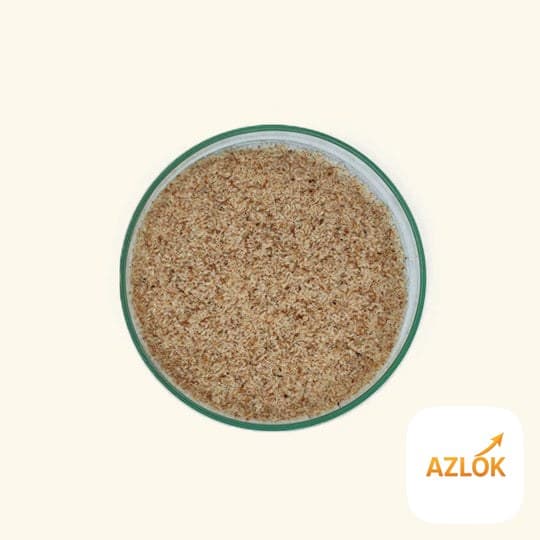

Psyllium Husk Powder
Minimum Order: 1 units
Description
Psyllium husk powder is a fine, natural powder made from the husks of Plantago ovata seeds grown in India. It forms a thick gel when mixed with water, making it useful as a dietary fibre supplement, a texture agent in food, and a water-binding ingredient in cosmetics and haircare formulations.
History & Discovery
Psyllium comes from Plantago ovata, a short annual herb that grows well in dry, sandy soil and cool winters. Its Hindi name, isabgol, is generally traced to the Persian words 'asp' and 'ghol', meaning horse's ear, a reference to the boat-shaped seed. The plant is thought to have reached India through trade with Persia and West Asia, and the husk has been part of Ayurvedic and Unani practice for centuries. Today India is the world's main grower and exporter of psyllium. Most of the crop is sown after the monsoon and harvested in early spring, largely in north Gujarat and western Rajasthan. Unjha in Gujarat has long been a key trading and processing centre, where the seed is cleaned, de-husked and milled into husk and fine powder for buyers in India and abroad.
Scientific & Medicinal Importance
Psyllium husk is the thin outer coating (seed coat) of Plantago ovata seeds. It is separated from the seed by milling and then ground into a fine powder. Most of the husk is fibre, and a large share of that fibre is mucilage, a water-loving polysaccharide made mainly of arabinoxylan: a chain of xylose sugars with arabinose side branches. The powder is off-white to light beige, with a mild, fairly neutral smell and taste. When stirred into water, the mucilage absorbs many times its own weight and swells into a smooth, slippery gel within minutes. This is why it thickens liquids, holds moisture in dough and adds slip to cosmetic gels. The powder also draws moisture from the air and can clump if left open, so store it in an airtight container in a cool, dry place.
Ayurvedic and Traditional Uses
In Ayurveda, isabgol (psyllium) is classified broadly under herbs that support Vata and Pitta pacification in the digestive tract. Classical Ayurvedic texts reference it as a cooling, mucilaginous herb used to ease constipation, soothe intestinal inflammation, and support healthy bowel movement. It is considered snigdha (unctuous) and guru (heavy) in guna, making it a gentle bulk laxative when taken with water or warm milk. Ayurvedic practitioners have traditionally recommended soaking the whole husk in water overnight before consumption. Psyllium husk powder in its finely milled form is also used in some Ayurvedic formulations for its binding and thickening properties.
Modern-Day Applications & Benefits
Psyllium husk powder is widely used today in three domains. In functional foods and nutraceuticals, it is added to high-fibre breads, breakfast cereals, gluten-free baked goods (where it helps bind dough), and dietary supplements. In the pharmaceutical industry, it serves as an excipient and as the active ingredient in over-the-counter bulk-forming laxatives. In cosmetics and personal care, formulators use it as a natural thickener and water-binding agent in face masks, hair gels, skin creams, and soothing lotions. Azlok supplies this powder in pack sizes from 100 g for home and small-batch use up to 20 kg for manufacturers and bulk buyers, at an edible and cosmetic grade suitable for both applications.
Why Azlok's Version is Trusted Today
Azlok
Frequently asked questions
What is the difference between psyllium husk and psyllium husk powder?
Psyllium husk is the whole or coarsely ground outer shell of Plantago ovata seeds, while psyllium husk powder is more finely milled. The powder disperses faster in liquids and is preferred for cosmetic formulations and smooth food applications, whereas the coarser husk is commonly taken as a fibre supplement.
Can I use this psyllium husk powder for baking gluten-free bread?
Yes. Psyllium husk powder is a popular binding and moisture-retention agent in gluten-free baking. It mimics some structural properties of gluten, helping dough hold together and giving bread a less crumbly texture. Typical usage is around 1–2 teaspoons per cup of gluten-free flour, but follow your specific recipe.
How do I use psyllium husk powder in a face mask or hair gel?
For a simple face mask, mix 1 teaspoon of psyllium husk powder with 3–4 tablespoons of water or aloe vera gel and stir until a smooth gel forms; apply to clean skin and rinse after 10–15 minutes. For hair gel, disperse 0.5–2% psyllium husk powder in water with gentle stirring. Always do a patch test before first use to check for any skin sensitivity.
What is the recommended daily intake if I take this as a fibre supplement?
A commonly cited serving for adults is 5–10 g (roughly 1–2 teaspoons) mixed in a full glass of water (at least 200–250 ml), taken once or twice daily. Always drink adequate water when consuming psyllium to prevent it from swelling in the throat. Consult a doctor before use if you have any digestive condition, difficulty swallowing, or are on prescription medication, as psyllium can affect drug absorption timing.
What pack size should I choose for home use versus manufacturing?
For personal or household use, the 100 g or 500 g pack is practical and stays fresh within the 2-year shelf life. Home bakers or small DIY cosmetic makers may prefer 1 kg. Businesses, nutraceutical manufacturers, and bulk buyers can order the 5 kg, 10 kg, or 20 kg packs available on Azlok for better unit economics.
Specifications
How to use Psyllium Husk Powder
Guides covering uses, dilution, safety and storage.