

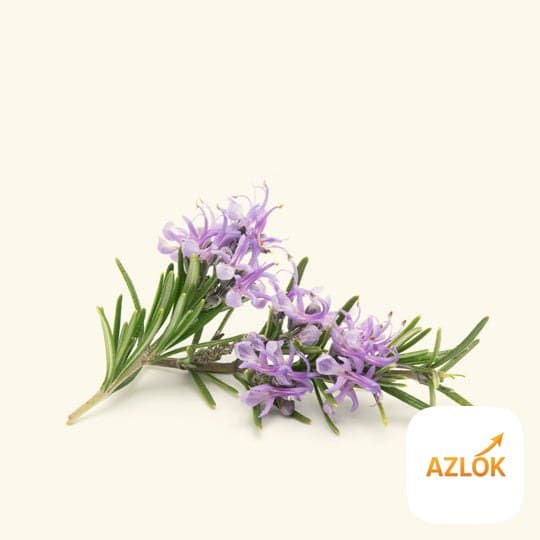

Rosemary Hydrosol Water
Minimum Order: 1 units
Description
Rosemary Hydrosol Water is a colourless, lightly herbaceous floral water obtained by steam distillation of Rosmarinus officinalis leaves. It carries a soft, fresh, slightly green aroma and is used in hair care, skin formulations, and DIY cosmetics. Water-soluble and gentle enough for direct skin application. Available in sizes from 100 g to 25 kg on Azlok.
History & Discovery
Rosemary (Rosmarinus officinalis, now often classified as Salvia rosmarinus) is native to the dry, rocky coasts of the Mediterranean. Its name is usually traced to the Latin ros marinus, meaning 'dew of the sea'. The ancient Greeks and Romans burned it as an aromatic herb and linked it with remembrance, a connection that later carried into European weddings and funerals. Steam distillation of rosemary grew alongside European perfumery. Hungary water, one of the early alcohol-based toilet waters, is traditionally described as rosemary-based. Hydrosols such as rosemary water came about as the water layer left after distilling the essential oil, and distillers kept them as mild aromatic waters. In India, rosemary is a relatively recent introduction, grown on a small scale in cooler hill regions. Its hydrosol has become popular with DIY formulators and small cosmetic brands.
Scientific & Medicinal Importance
Rosemary hydrosol is produced by passing steam through rosemary leaves and stems; the steam carries volatile aromatic compounds, and when condensed, separates into essential oil (the top layer) and hydrosol (the water layer). The hydrosol retains water-soluble aromatic molecules—including small amounts of camphor, 1,8-cineole, and rosmarinic acid—at much lower concentrations than the essential oil, making it gentler on skin. Its CAS number is 84604-14-8 and its INCI name is Rosmarinus Officinalis (Rosemary) Flower Water. It is colourless, has a soft, slightly green, fresh, faintly anise-like aroma, and is soluble in water and alcohol but insoluble in fixed oils. Its mild pH makes it suitable as a formulation base for toners, mists, creams, and shampoos.
Ayurvedic and Traditional Uses
Rosemary is not a traditional Ayurvedic herb and does not appear in classical Ayurvedic texts such as Charaka Samhita or Ashtanga Hridayam. Some modern Indian herbal practitioners include it in hair-care formulations, but any such use is contemporary rather than rooted in classical Ayurveda.
Modern-Day Applications & Benefits
In modern cosmetic formulation, rosemary hydrosol is widely used as a water phase ingredient in toners, facial mists, shampoos, conditioners, and scalp sprays. It can be used as a direct spray on the scalp to support scalp health, or blended into creams and lotions in place of plain water to add a mild herbal character. Some studies on rosemary extract and essential oil suggest potential to support hair follicle activity, though research specifically on the hydrosol at typical cosmetic concentrations is limited. Azlok supplies it in bulk sizes (up to 25 kg) suitable for small cosmetic manufacturers, and in a 100 g retail pack with a free dropper for home DIY users. Store in a cool, dry place away from direct sunlight; shelf life is 2 years from manufacture.
Why Azlok's Version is Trusted Today
Azlok
Frequently asked questions
Can rosemary hydrosol be applied directly to the scalp and hair?
Yes. Rosemary hydrosol is gentle enough to spray directly onto the scalp or use as a final hair rinse. It does not need dilution for typical scalp-spray use. For sensitive skin, a patch test on the inner arm 24 hours before first use is advisable.
Is rosemary hydrosol the same as rosemary essential oil?
No. Rosemary hydrosol is the water-based co-product of steam distillation; it contains water-soluble aromatic compounds at very low concentrations. Rosemary essential oil is the concentrated oil layer and requires dilution before skin contact. Hydrosol is ready to use as-is in most applications.
Can rosemary hydrosol be used in lotions and creams as a water phase ingredient?
Yes. Replace some or all of the distilled water in your formulation with rosemary hydrosol. It blends fully with the water phase and adds a mild herbal aroma to the finished product. It is insoluble in fixed oils, so it must be added to the water phase, not the oil phase.
Is rosemary hydrosol safe to use on the face?
Generally yes, for most adults. Spray onto a cotton pad and apply, or use as a facial mist. Avoid direct contact with eyes. If you have a known allergy to rosemary or related Lamiaceae plants, do not use. Always patch-test before applying to the face.
What pack size should I order if I am a small cosmetic manufacturer?
Azlok offers rosemary hydrosol in 500 g, 1 kg, 5 kg, 10 kg, 20 kg, and 25 kg packs, making it practical for small-batch cosmetic production. For home DIY use, the 100 g pack with a free 3 ml dropper is a convenient starting point.
Specifications
How to use Rosemary Hydrosol Water
Guides covering uses, dilution, safety and storage.