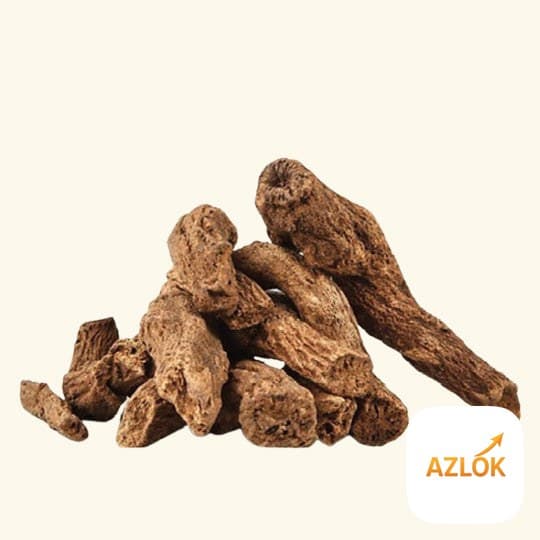
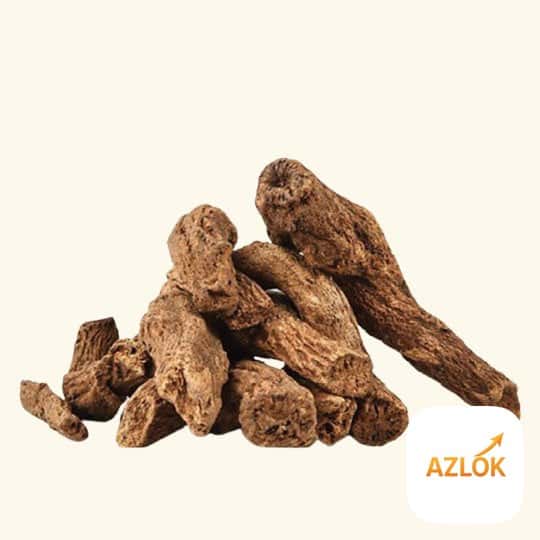
Costus essential oil is a thick, warm oil steam-distilled from the roots of the Costus plant (Saussurea costus), prized for its deep, woody, musky aroma. It is used mainly as a base note in perfumery and in diluted skincare and respiratory blends. Like all essential oils, it is meant only for external use and must be diluted before it touches the skin.
What is Costus essential oil?
This oil comes from the roots of a Himalayan herb long recorded in Ayurvedic tradition. Extraction is by steam distillation, giving a yellowish to brown liquid with a characteristic earthy, animalic scent that many perfumers describe as leathery and lingering. Its heavy, tenacious profile makes it a natural fixative that helps hold lighter aromas together in a blend.
A few useful technical points for makers: the botanical name is Saussurea costus, CAS 8023-88-9, FEMA 2336, specific gravity around 0.921, refractive index near 1.513, and a flash point of about 120 °C. It is soluble in alcohol and blends readily with carrier oils. Typical shelf life is around two years when stored well.
Common uses
- Perfumery: As a base and fixative note, it adds warmth and depth to woody, oriental and chypre-style accords.
- Skincare blends: Traditionally valued for soothing, calming properties; used well-diluted in facial and body oil formulations.
- Respiratory and grounding blends: A small amount lends a rich, earthy backbone to diffuser or massage blends meant to relax the mind.
- Aromatherapy: The musky, woody character is often used to create a calm, settled mood.
How to use it
Costus is powerful and long-lasting, so a little goes a long way. Always dilute before applying to skin.
- Patch test first. Mix one drop into a teaspoon of carrier oil, apply to the inner forearm, and wait 24 hours to check for any reaction.
- Dilute for skin: Keep concentrations low—generally around 0.5–1% in a carrier oil such as jojoba, sweet almond or coconut. That is roughly 1–2 drops per 10 ml of carrier.
- For perfumery: Blend with alcohol or a carrier, using it sparingly as a base note alongside brighter top and middle notes.
- For diffusing: Add just a drop or two to your usual blend, as its scent can dominate quickly.
It pairs beautifully with ylang ylang, opopanax and patchouli, and works with all types of carrier oils.
Safety notes
Please treat this as a concentrated botanical, not a casual product.
- For external use only. Do not ingest.
- Always dilute before topical application and do a patch test.
- Avoid direct exposure to sunlight after applying to skin.
- Keep out of reach of children and away from eyes.
- Pregnant or breastfeeding women, and anyone with a medical condition, should consult a doctor before use.
- Store away from open flames; the oil is combustible.
Buying and storage tips
Look for clear labelling of the botanical name, extraction method and batch details, and ask for a COA and MSDS when buying in larger quantities. Azlok offers Costus essential oil in sizes from 10 Gm up to 5 KG, so you can buy a small quantity to test a blend before committing to bulk for production.
To protect the oil, keep it in a tightly closed amber glass bottle, away from heat, light and humidity. Stored properly, it holds well for about two years. Because it is thick, gentle warming of the bottle in your hands helps it pour and blend more easily.
FAQ
Can I apply Costus essential oil directly to my skin?
No. It should always be diluted in a carrier oil to around 0.5–1% and patch-tested first. Direct, undiluted application can irritate the skin.
What does Costus essential oil smell like?
It has a deep, woody, musky and slightly leathery aroma that is long-lasting. This makes it a favourite base note and fixative in perfumery.
Which oils blend well with Costus?
It combines well with ylang ylang, opopanax and patchouli, and mixes easily with all common carrier oils for skincare and massage blends.
How should I store it and how long does it last?
Keep it in a sealed amber glass bottle away from sunlight, heat and moisture. Under these conditions it typically stays usable for about two years.
Is Costus essential oil safe during pregnancy?
Pregnant and breastfeeding women should consult a doctor before using it. As a precaution, avoid self-use without professional guidance.