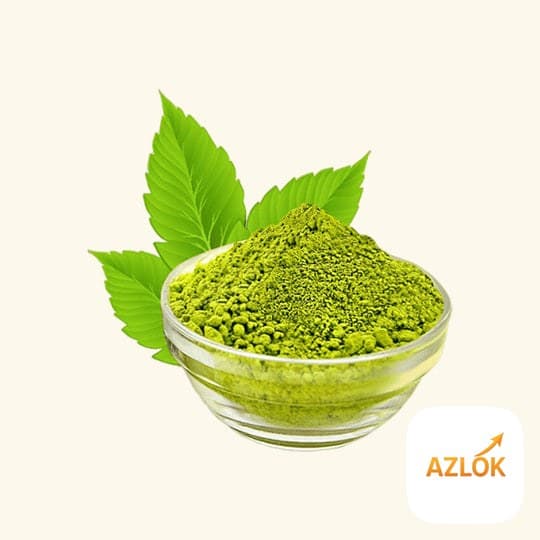

Heena Liquid Extract is a concentrated liquid drawn from the leaves, bark and flowers of the henna plant (Lawsonia inermis), meant to be added to hair and skin formulations at around 1–2%. Azlok offers it as a 4:1 extract, meaning roughly 4 kg of herb yields 1 kg of extract, so a little goes a long way in your recipes.
Henna — known across India and South-East Asia as mehndi — is best known for the reddish-brown dye used in temporary body art. This liquid extract, however, is a formulator's ingredient rather than a body-art paste. It is tasteless, has no noticeable odour, and comes in both water-soluble and oil-soluble versions to suit different products.
What Heena Liquid Extract is
Here are the key details at a glance:
- Botanical name: Lawsonia inermis
- CAS number: 84988-66-9
- Other names: henna, mehndi, cypress shrub
- Strength: 4:1 herb-to-extract ratio
- Water-soluble version: alcohol-free, extracted using vegetable palm glycerin (glycerol)
- Oil-soluble version: extracted using soy oil
- Preservative: BHT (butylated hydroxytoluene)
- Free from: gluten, artificial colour, heavy metals and fertilisers
- Country of origin: India
Common uses
Because it comes in two solubilities, this extract slots neatly into a range of homemade and small-batch products:
- Hair care: shampoos, conditioners, hair oils, serums and rinse-off masks, where henna has long been a traditional favourite.
- Skin care: creams, lotions, gels and toners as a botanical addition.
- Bath and body: body washes and soaps where a plant extract is desired.
Choose the water-soluble (glycerin-based) extract for water-phase products like toners, gels and shampoos. Pick the oil-soluble (soy oil-based) extract for anhydrous products such as hair oils, balms and oil serums.
How to use it
The recommended usage is 1–2% of your total formulation. That means for every 100 g of product, you would add roughly 1–2 g of extract.
- Decide whether your base is water-based or oil-based, then pick the matching version.
- Add the extract to the cool-down phase once your mixture has dropped below about 40°C, which helps protect delicate plant compounds.
- Stir thoroughly until fully blended.
- Always keep a proper broad-spectrum preservative in any water-containing product — the small amount of BHT in the extract preserves the extract itself, not your whole formula.
If you are new to formulating, start at 1% and adjust upwards only after testing a small batch.
Safety and honest notes
A few sensible precautions:
- This is a cosmetic raw material for external use. Do not ingest it.
- Avoid direct contact with the eyes; rinse with clean water if contact occurs.
- Keep it out of the reach of children.
- Patch-test any new finished product on a small area of skin before wider use.
- The oil-soluble version uses soy oil, so keep that in mind if you or your customers have soy sensitivities.
We do not make medical claims for this extract. Treat it as a botanical ingredient that adds tradition and character to your formulations.
Buying and storage
Azlok stocks Heena Liquid Extract from 100 g right up to 25 kg, so hobbyists making a single batch and small businesses running production runs are both covered. The 100 g pack starts at ₹299, which makes it easy to trial before committing to bulk sizes.
For storage, keep the bottle in a cool, dry place, away from direct sunlight and heat. Close the cap tightly after each use. Under good conditions the shelf life is around two years. If you buy larger packs, decant smaller working quantities to reduce how often the main container is opened. Documentation such as COA and MSDS is available for both the oil-soluble and water-soluble grades if you need it for compliance.
FAQ
Can I use Heena Liquid Extract for mehndi body art?
No. This is a liquid extract designed to be added to cosmetic formulations at 1–2%, not a dye paste for temporary tattoos. For mehndi designs you would need a traditional henna powder or ready paste.
What is the difference between the water-soluble and oil-soluble versions?
The water-soluble version is alcohol-free and made using vegetable glycerin, ideal for water-based products like toners and shampoos. The oil-soluble version uses soy oil and suits oil-based products such as hair oils and balms.
How much should I add to my formulation?
Use 1–2% of the total weight of your product. For 100 g of finished product, that is about 1–2 g of extract. Begin at the lower end and adjust after testing.
Does the extract preserve my whole product?
No. The BHT in the extract preserves the extract itself. Any finished product that contains water still needs its own suitable broad-spectrum preservative.
How long does it last and how should I store it?
The shelf life is about two years when stored in a cool, dry place away from sunlight, with the cap kept tightly closed.