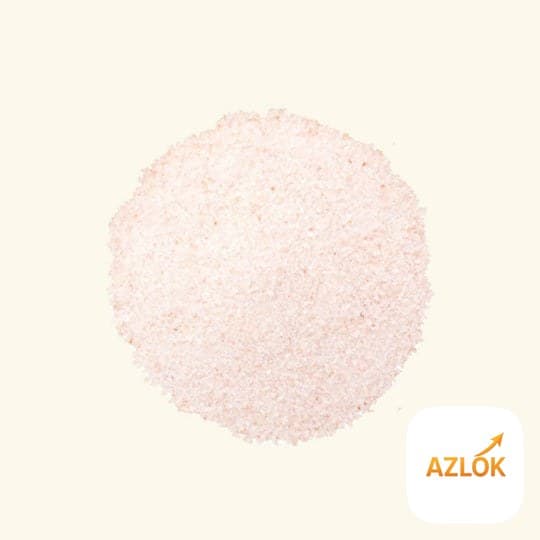

Himalayan salt, often sold as pink Himalayan salt, is a naturally coloured rock salt mined from ancient sea beds in the Himalayan region. In cosmetics it works mainly as a gentle physical exfoliant and a mineral-rich addition to scrubs, bath soaks and hair rinses. Azlok stocks cosmetic-grade Himalayan salt in a powder form, priced from around ₹249, in packs from 500 g right up to 25 kg for makers and small businesses.
What is Himalayan salt?
Chemically, Himalayan salt is largely sodium chloride (NaCl) along with trace elements such as potassium, magnesium and iron. That iron content is what gives it the familiar light-to-dark peach colour. Its INCI name is Himalayan Salt, its CAS number is 7647-14-5, and the cosmetic grade Azlok supplies is meant for topical and personal-care use rather than as a table seasoning.
Why it is used in skincare
The appeal of Himalayan salt in beauty products is practical, not magical. The fine crystals lift away dull, flaky skin, while the mineral content is a marketing and formulation point that many DIY makers appreciate. Common uses include:
- Body and foot scrubs — mixed with a carrier oil to slough off rough skin.
- Bath soaks — dissolved in warm water for a relaxing soak after a long day.
- Face scrubs — very finely ground salt, used sparingly, for oily or congested skin.
- Hair and scalp rinses — used gently to help clear product build-up.
- Cold-process soap and bath products — added to salt bars and bath melts.
How to use it: simple DIY recipes
A basic body scrub is the easiest place to start. Combine one part Himalayan salt with roughly one part carrier oil such as coconut, almond or olive oil. Add a few drops of an essential oil like lavender or peppermint if you like, stir well, and store in a clean, dry jar.
- Body scrub: Take a handful, massage over damp skin in circular motions, then rinse. Use once or twice a week.
- Foot soak: Dissolve two to three tablespoons in a basin of warm water and soak for 10–15 minutes.
- Bath soak: Add a small cupful to a warm bath and stir until dissolved.
For facial use, choose only the finest particles and go gently — coarse crystals can scratch delicate skin.
Safety notes worth reading
Himalayan salt is easy to work with, but a little care keeps things pleasant:
- Always patch-test a new scrub on your inner arm before wider use.
- Avoid scrubbing on broken skin, active acne, sunburn or freshly shaved skin, as salt will sting.
- Do not over-exfoliate. Once or twice a week is plenty for most skin types.
- This is a cosmetic-grade product for topical use — do not treat it as food-grade table salt.
- Oil-and-salt scrubs make surfaces slippery, so rinse the tub or floor afterwards.
- Keep the packet away from children and moisture.
Buying and storage tips
For occasional home projects, a 500 g or 1 kg pack is sensible. If you make and sell scrubs, soaps or bath products, the 5 kg to 25 kg packs bring the cost per gram down. Check the grade before buying: kitchen salt and cosmetic salt are not always the same fineness or specification.
Salt is naturally stable, so storage is straightforward. Keep it in an airtight container in a cool, dry place away from direct sunlight. Because salt attracts moisture, a tightly sealed jar prevents clumping. Azlok lists a shelf life of around 12 months, though well-stored salt tends to keep its quality if it stays fully dry.
FAQ
Is Himalayan salt the same as sea salt?
Both are largely sodium chloride, but Himalayan salt is mined as rock crystal from ancient sea beds and carries trace minerals that give it a pink to peach tone. Sea salt is evaporated from present-day seawater.
Can I use cosmetic-grade Himalayan salt for cooking?
No. Cosmetic-grade salt is intended for topical and personal-care use. For eating, buy salt clearly labelled as food-grade.
How often should I use a Himalayan salt scrub?
For most people, once or twice a week is enough. Over-scrubbing can leave skin dry and irritated, so listen to how your skin responds.
Why is my Himalayan salt darker in some batches?
The colour depends on natural iron and mineral content, so shades range from light peach to deeper peach. Slight variation between batches is normal for a naturally sourced material.
Which pack size should I choose?
A 500 g or 1 kg pack suits home use, while 5 kg and larger packs are more economical for regular DIY makers and small businesses.