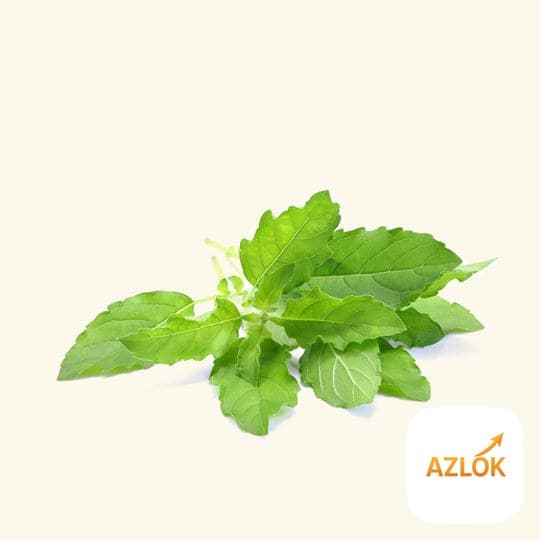

Holy Basil essential oil, better known in India as tulsi oil, is a steam-distilled oil pressed from the leaves of Ocimum sanctum. It carries a strong, warm, spicy-herbal aroma and is used mainly in aromatherapy, natural skincare and haircare formulations — always diluted, never neat on the skin.
What is Holy Basil essential oil?
Tulsi has been part of Indian homes and traditional beauty rituals for centuries. Azlok's Holy Basil Essential Oil is extracted by steam distillation from the leaves, which keeps its natural aromatic compounds intact. Its major constituents include eugenol, 1,8-cineole and estragole, and the colour ranges from pale yellow to brown. Because it is a concentrated oil, a little goes a long way.
Common uses
This is a versatile oil for hobbyists and small businesses building their own natural product lines.
- Aromatherapy and diffusing: A few drops in a diffuser fill the room with an uplifting, clarifying scent that many find helpful during study or work.
- Skincare formulations: Added in tiny amounts to creams, serums and face oils by makers who want a herbal note and its cosmetic properties.
- Haircare: Blended into carrier oils for a scalp massage oil or added to shampoos and hair oils.
- Soaps and candles: Used as a fragrance component in cold-process soaps, melts and candles, often blended with brighter oils.
- Room and linen sprays: Combined with a solubiliser and water for a natural home fragrance.
Holy Basil oil blends beautifully with lemon, rosemary and bergamot essential oils if you want to soften its intensity.
How to use it
Essential oils are highly concentrated, so dilution is the golden rule.
- Dilute for the skin: Mix into a carrier oil such as coconut, jojoba or sweet almond. A safe general guideline for body use is around 1–2% — roughly 6–12 drops per 30 ml of carrier oil.
- Patch test first: Apply a small diluted amount to your inner forearm and wait 24 hours before wider use.
- For diffusing: Add 3–5 drops to your diffuser as directed by the device.
- For hair: Blend a few drops into a warm carrier oil and massage into the scalp, then wash out after some time.
- In products: Follow your formulation's fragrance load and any IFRA guidance for the product type.
Safety notes
Because this oil is potent and contains eugenol and estragole, treat it with respect.
- Never apply undiluted oil directly to skin.
- Do not ingest it.
- Keep away from children and pets.
- Avoid contact with eyes and mucous membranes.
- If you are pregnant, breastfeeding, or managing a medical condition, consult a qualified practitioner before use.
- Use in a well-ventilated space and stop use if irritation occurs.
This oil is intended for cosmetic, aromatherapy and formulation use, not as a medicine.
Buying and storage tips
Azlok offers Holy Basil Essential Oil in sizes from 50 Gm up to bulk 20 KG packs, so it suits both home makers and larger production needs, starting at ₹299. When it arrives, store it well to protect its quality.
- Keep it in a tightly closed bottle, away from heat and direct sunlight.
- Store in a cool, dark place; a dark glass bottle is ideal.
- Shelf life is around 2 years when stored properly.
- Buy quantities you can realistically use, since oxidation increases once the bottle is opened repeatedly.
- Ask for the COA and MSDS if you are formulating commercially.
FAQ
Is Holy Basil essential oil the same as tulsi oil?
Yes. Holy Basil is the English name for tulsi (Ocimum sanctum), so the two names refer to the same essential oil.
Can I apply Holy Basil oil directly on my skin?
No. It should always be diluted in a carrier oil, usually at about 1–2%, and patch-tested before regular use.
What does Holy Basil essential oil smell like?
It has a strong, warm, spicy and herbal aroma. Many people find it uplifting, and it pairs well with lemon, rosemary and bergamot.
How should I store it to make it last?
Keep it tightly sealed in a cool, dark place away from sunlight and heat. Stored well, it stays good for around two years.
Can it be used in soap and candle making?
Yes, it works as a fragrance component in soaps, candles and melts. Follow the recommended fragrance load for each product type.