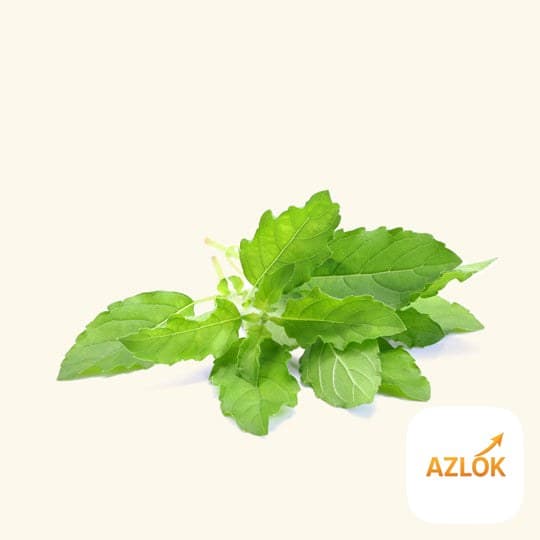
Holy Basil (Tulsi) Liquid Extract: Uses, Dosage and How to Formulate With It

Holy Basil (Tulsi) Liquid Extract is a concentrated herbal extract made from the Tulsi plant (Ocimum basilicum), meant to be added at 1–2% into skincare, haircare and wellness formulations rather than used neat. Azlok offers it as a 4:1 extract, meaning 4 kg of Tulsi herb yields 1 kg of finished extract, so a little goes a long way.
Tulsi is native to the Indian subcontinent and has been valued here for generations. It is often called the ‘Queen of Herbs’ and is considered an adaptogen — a natural substance traditionally used to help the body cope with everyday stress. This extract captures those plant compounds in an easy-to-blend liquid form.
What is Holy Basil (Tulsi) Liquid Extract?
It is a liquid extract drawn from the Tulsi plant. Azlok supplies it in two versions to suit different formulations:
- Water soluble (alcohol-free): extracted using vegetable palm glycerin (vegetable glycerol). Ideal for water-based products.
- Oil soluble: extracted using soy oil, suitable for oil-based blends and balms.
Key specifications: Botanical name Ocimum basilicum, CAS number 84775-71-3, extract strength 4:1, and BHT (butylated hydroxytoluene) used as a preservative note. It is free from gluten, artificial colour, heavy metals and fertilizers, with a shelf life of about 2 years.
Common uses
Because it is a formulation-grade ingredient, Tulsi extract is blended into finished products rather than used on its own. Makers commonly add it to:
- Face and body serums, creams and lotions
- Toners, mists and cleansers
- Hair oils, shampoos and scalp treatments
- Soaps, balms and other bath products
- Wellness and aromatherapy-style blends
Choose the water-soluble grade for lotions, toners and shampoos, and the oil-soluble grade for face oils, balms and anhydrous products.
How to use it
The recommended usage is 1–2% of your total formulation. For example, in 100 g of a cream, that works out to roughly 1–2 g of extract.
- Decide whether your base is water-based or oil-based, and pick the matching grade.
- Weigh your extract accurately rather than estimating by drops.
- Add it into the correct phase — water phase for the glycerin extract, oil phase for the soy-oil extract.
- Blend thoroughly until fully incorporated.
- If you are selling products, always use a suitable broad-spectrum preservative in water-containing formulas and test stability before scaling up.
Safety and precautions
This is a cosmetic and formulation raw material. Please use it responsibly:
- Keep it away from the reach of children.
- Avoid direct contact with the eyes.
- Do a small patch test on skin before using any new finished product.
- Observe caution with external applications, especially on sensitive or broken skin.
- No herb-drug interactions are known, but if you are pregnant, nursing or under medical care, consult a qualified professional before use.
- Do not treat this article as medical advice — we make no claims to cure or treat any condition.
Buying and storage tips
Azlok stocks the extract in a wide range of pack sizes — 100 g, 500 g, 1 kg, 5 kg, 10 kg and 20 kg — so hobbyists and small businesses can both find a suitable quantity. Pricing starts at ₹299. For bulk buyers, Certificates of Analysis (COA) and Material Safety Data Sheets (MSDS) are available for both the water-soluble and oil-soluble grades.
To keep it fresh through its 2-year shelf life:
- Store in a cool, dry place, away from direct sunlight and heat.
- Keep the container tightly closed to limit air exposure.
- Use clean, dry tools when measuring to avoid contamination.
- Label your batch with the date opened so you can track freshness.
FAQ
How much Tulsi extract should I add to my product?
The recommended usage is 1–2% of the total formulation. In 100 g of product, that is about 1–2 g of extract.
What does the 4:1 ratio mean?
It means 4 kg of Tulsi herb is used to produce 1 kg of extract, so the extract is concentrated. That is why only a small percentage is needed in formulations.
Is there an alcohol-free version?
Yes. The water-soluble grade is alcohol-free and is extracted using vegetable palm glycerin (vegetable glycerol). An oil-soluble grade extracted with soy oil is also available.
Can I take this extract internally?
This product is intended as a formulation raw material for external cosmetic use. Do not ingest it. Consult a qualified professional for any internal or medicinal use.
How long does it last and how should I store it?
It has a shelf life of about 2 years when stored in a cool, dry place away from sunlight, with the container kept tightly closed.