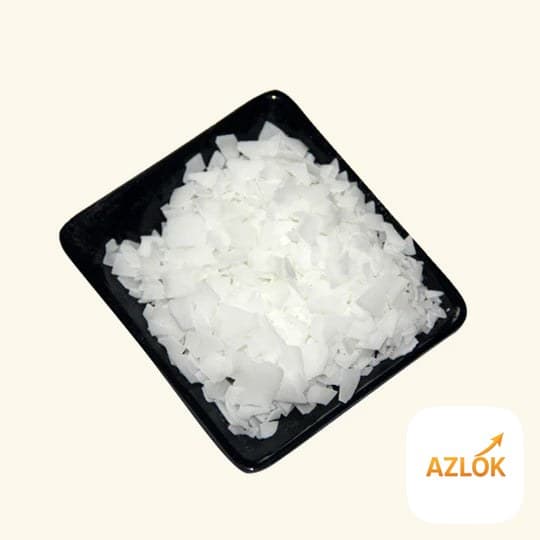

Hydrogenated Castor Oil Flakes, often called castor wax, are a hard, white vegetable wax made by adding hydrogen to ordinary castor oil. Makers use these flakes to thicken and set balms, lipsticks, deodorant sticks, creams and industrial greases, because the wax is non-toxic, resistant to both water and oil, and melts into a clear liquid. In short, it turns liquid oils into firm, stable structures without changing their smell or colour much.
What exactly is castor wax?
Castor wax comes from castor beans (Ricinus communis), grown widely in India. Regular castor oil is a thick liquid, but hydrogenation converts it into a brittle solid with a high melting point (roughly 85–88°C). The result is a plant-based wax with the chemical name reflected in the formula C57H110O9 and CAS number 8001-78-3. Azlok supplies it in flake form, which is easier to weigh and melt than large blocks.
Common uses
- Cosmetics and personal care: a hardening agent in lipsticks, lip balms, deodorant sticks, solid lotions and stick foundations. It adds structure and a smooth glide.
- Skin balms and salves: gives body to oil-heavy formulas without the greasy slip of some soft waxes.
- Candle and soap making: used in small amounts to raise melting point or add opacity and hardness.
- Pharmaceuticals: as a stabiliser and consistency agent in ointments and topical preparations.
- Industrial applications: lubricants and greases, mould-release agent in plastic and rubber processing, and food-grade paper coatings.
How to use it in formulations
Castor wax is used as part of the oil (heated) phase of a recipe. A little goes a long way because of its high melting point.
- Weigh accurately. Start with a small percentage of your total oils — around 3–8% for balms and sticks — and adjust for the firmness you want.
- Melt gently. Combine the flakes with your carrier oils and other waxes in a double boiler (a heatproof bowl over simmering water). Heat until fully clear and liquid.
- Blend, then pour. Once everything is melted and mixed, remove from heat, add any heat-sensitive extras like essential oils, and pour into moulds or tins before it sets.
- Test small batches. Because the wax sets hard, make a tiny trial first and check the feel on your skin before scaling up.
Tips and safety notes
- Keep the flakes away from open flame; wax vapours and hot oil can be a fire and burn hazard. Never leave a melting pot unattended.
- Work in a ventilated space and use heat-resistant gloves when handling hot liquid wax.
- This is a raw cosmetic and industrial ingredient, not a food or medicine. Do not eat it, and keep it out of reach of children and pets.
- For any new skin formula, patch-test the finished product on your inner arm before regular use.
- For industrial or pharmaceutical work, always request and read the COA and MSDS for the batch you buy.
Buying and storage
Azlok offers Hydrogenated Castor Oil Flakes starting at ₹249, with pack sizes from 250 g and 500 g for hobbyists up to 1 kg, 5 kg, 10 kg, 20 kg and 25 kg for small businesses and bulk buyers. Choose a smaller pack first if you are still testing recipes.
Store the flakes in a cool, dry place, tightly sealed against moisture and dust. Kept properly, the product has a shelf life of about 24 months. Because it is a hard wax, it resists going rancid better than many liquid oils, but heat and humidity will still shorten its life. Keep it well away from strong-smelling substances so it does not pick up odours.
FAQ
Is hydrogenated castor oil the same as castor wax?
Yes. "Castor wax" is the common name for hydrogenated castor oil. It is the solid, waxy version of liquid castor oil.
Is it vegan and natural?
It is plant-derived, made from castor beans, so it is suitable for vegan and vegetarian formulations. It is chemically processed by hydrogenation, but the source material is a vegetable oil.
What melting point should I expect?
Castor wax has a high melting point, generally around 85–88°C, which is why it makes cosmetics firmer and more heat-stable than softer waxes.
How much should I add to a balm?
As a rough starting point, use about 3–8% of your total oils for balms and sticks, then adjust up for a harder set or down for a softer one. Always trial a small batch first.
Can I use it in candles?
It can be added in small amounts to raise the melting point and add hardness or opacity, but it is not usually a standalone candle wax. Blend it with your main candle wax and test the burn.