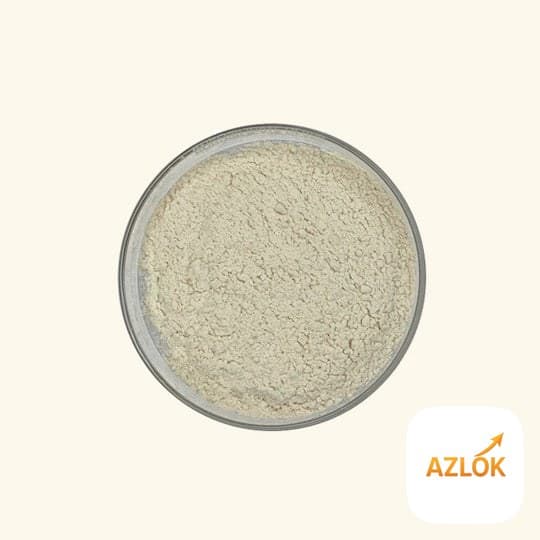

Kojic acid is a naturally derived skin-brightening ingredient made by fermenting rice or corn starch with Aspergillus oryzae fungus. It works by slowing down the enzyme that helps your skin produce melanin, which is why formulators use it in creams, serums and soaps to fade dark spots and even out skin tone. Azlok supplies it as a 99% pure, off-white powder that is odourless and water-soluble.
What is kojic acid?
Kojic acid is a by-product of the same fermentation used to make sake, soy sauce and miso. Chemically it is 5-hydroxy-2-(hydroxymethyl)-4H-pyran-4-one, with the formula C6H6O4, a molecular weight of 142.11 g/mol and CAS number 501-30-4. It occurs as a fine white to off-white powder that dissolves in water.
Its main claim to fame is that it interferes with tyrosinase, the enzyme responsible for converting the amino acid tyrosine into melanin. Less melanin production means gradual lightening of pigmentation over regular use. It also acts as a mild chelating agent, which can help stabilise certain formulations.
Common uses
- Brightening creams and lotions for uneven tone, tanning and dullness.
- Spot-treatment serums aimed at post-acne marks and dark patches.
- Handmade soaps, where it is a popular addition to melt-and-pour and cold-process bases.
- Face masks and toners as part of a small-batch cosmetic blend.
It is often paired with humectants and soothing ingredients, and sometimes with vitamin C or niacinamide, though seasoned makers add such combinations carefully after testing for stability.
How to use it in formulations
Kojic acid is water-soluble, so it is added to the water phase of a cream or dissolved in a hydrosol or water base for a serum.
- Start low. In cosmetics, kojic acid is generally used at around 1% to 2% of the total formula. Beginners should stay at the lower end.
- Weigh accurately. Use a digital scale that reads in grams. For a 100 g batch, 1 g gives roughly a 1% concentration.
- Dissolve fully in the water portion before combining with your emulsifier or base.
- Mind the pH. Kojic acid performs best in slightly acidic formulas; check your finished product with pH strips.
- Add a preservative. Any water-based product needs a broad-spectrum preservative to stay safe.
Safety and precautions
Kojic acid is for external use only. Please read these points before you use it.
- Do not ingest. This is a cosmetic raw material, not a food.
- Patch-test first. Apply a small amount to the inner forearm and wait 24 hours before regular use, as some people are sensitive to it.
- Use sunscreen. Brightened skin can be more sensitive to sun, so daytime SPF matters.
- Avoid broken or irritated skin and do not use if you have an active skin ailment.
- Keep away from children and store the powder out of reach.
- Handle the raw powder in a clean, dust-free area and avoid inhaling it.
Buying and storage tips
Azlok offers kojic acid in packs from 50 g up to 10 kg, so hobbyists and small businesses can both find a suitable size. The 50 g and 100 g packs are ideal if you are trialling a new recipe, while bulk buyers formulating regularly may prefer 1 kg or larger.
- Kojic acid can darken or discolour when exposed to light, heat and air, so store it in an airtight container.
- Keep it in a cool, dry place away from direct sunlight.
- Shelf life is around 24 months when stored properly; note the colour, as significant darkening can indicate degradation.
- Always keep the batch details and MSDS handy if you are making products to sell.
FAQ
What is kojic acid used for?
It is used in skincare to reduce the appearance of dark spots, sun tan and uneven skin tone by slowing melanin production. It also appears in handmade soaps and serums.
What percentage of kojic acid is safe in skincare?
Cosmetic formulations typically use around 1% to 2%. Beginners should start at the lower end and patch-test before regular use.
Is kojic acid natural?
Yes, it is derived through fungal fermentation of rice or corn starch using Aspergillus species, so it comes from a natural, plant-based source.
Can I mix kojic acid with vitamin C?
Some formulators do combine them, but both are pH-sensitive and can oxidise, so stability testing is important. If you are new to formulating, use them separately first.
Why does kojic acid turn brown?
It is prone to oxidation and can discolour when exposed to light, heat and air. Airtight, cool, dark storage helps keep it stable for its full shelf life.