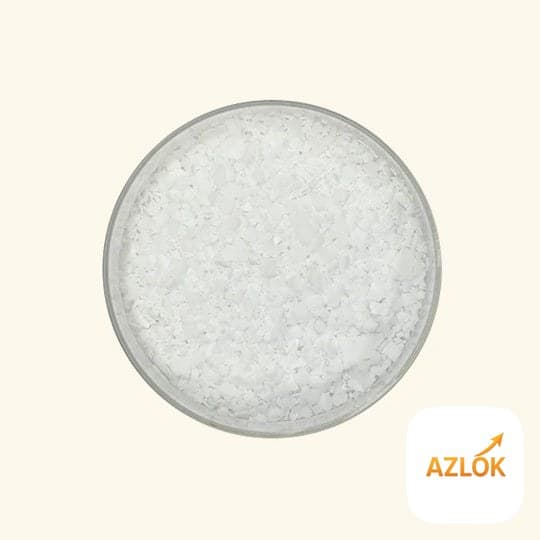

Myristic acid is a natural fatty acid, usually sourced from coconut or palm oil, that soap and cosmetic makers use to create a rich, fluffy lather and to thicken and stabilise creams, cleansers and shaving products. Azlok supplies it as a white powder of 99% purity (INCI name: Myristic Acid; CAS 544-63-8), ready to add to your recipes.
What is myristic acid?
Chemically, myristic acid is 1-tetradecanoic acid (formula C14H28O2, molecular weight around 228.37 g/mol). It occurs naturally in coconut oil, palm oil and butter, and is separated out through fractional distillation of mixed fatty acids. In its pure form it is a white, waxy solid with a mild characteristic odour and a high melting behaviour, which is why you receive it as a fine powder.
In formulations it wears several hats: surfactant, emulsifier and thickener. That combination is exactly why it turns up in so many everyday products, from bar soaps to face washes.
Common uses in cosmetics and soap
- Soap bars and liquid soap — contributes to a dense, bubbly lather and good cleansing.
- Shaving creams and foams — myristic acid is a classic ingredient for the cushiony, stable foam a good shave needs.
- Face washes and body cleansers — helps build foam and lift away oil and grime.
- Shampoos and hair conditioners — adds body and conditioning feel.
- Lotions and creams — works as a co-emulsifier and thickener, keeping the oil and water phases from separating.
Because it helps other actives absorb into the skin and gives formulas a stable, uniform texture, small amounts go a long way.
How to use it in your formulations
Myristic acid melts into the oil phase of a recipe. A simple approach:
- Weigh your ingredients accurately with a digital scale — cosmetic work is done by weight, not volume.
- Add the myristic acid powder to your oil or fat phase and heat gently until it fully melts and disperses.
- In cold-process soap, include it as part of your total oils and adjust your lye calculation using a reliable saponification (SAP) calculator, since it consumes alkali like any other fatty acid.
- In creams and cleansers, combine the hot oil phase with the water phase and mix until emulsified.
Typical usage levels are modest — often a few percent of the total recipe. Start low, make a small test batch, and scale up once you are happy with the lather and feel. It is highly cleansing, so pairing it with conditioning oils and humectants helps keep the final product from feeling stripping.
Safety and handling
This is an industrial-grade cosmetic raw material, not a food product, so treat it with care.
- Do not ingest. Keep out of reach of children and pets.
- Work in a well-ventilated space and avoid inhaling the fine powder; a dust mask and gloves are sensible.
- Avoid eye contact; rinse thoroughly with water if it happens.
- The flash point is around 110 °C, so heat gently and never leave melting oils unattended near open flames.
- Always patch-test your finished product on a small area of skin before regular use, and follow standard good manufacturing practice.
- Consult the COA and MSDS for full technical and safety details before large-scale use.
Buying and storage
Azlok offers myristic acid in packs from 100 g right up to 20 kg, so hobbyists making a few bars and small businesses running production batches can both find a suitable size. Pricing starts at ₹149, and the country of origin is India.
Store it in a cool, dry place in a tightly closed container, away from direct sunlight and moisture. Kept well, it has a shelf life of about 24 months. Because it is a powder, protecting it from humidity keeps it free-flowing and easy to weigh.
FAQ
Is myristic acid natural?
Yes. It is a naturally occurring fatty acid found in coconut oil, palm oil and butter, and is separated from these vegetable oils by fractional distillation.
What does myristic acid do in soap?
It acts as a surfactant and helps produce a rich, fluffy and stable lather while contributing to cleansing. It also adds hardness and structure to bars.
Is myristic acid safe for skin?
In the small percentages used in finished cosmetics it is widely considered suitable for most skin types. As it is very cleansing, balance it with conditioning ingredients and always patch-test your final product.
Can I use it in creams and lotions?
Yes. It works as a co-emulsifier and thickener, helping keep the oil and water phases blended and giving the product a stable, smooth texture.
How should I store myristic acid?
Keep it in an airtight container in a cool, dry, shaded place. Under these conditions it stays good for roughly 24 months.