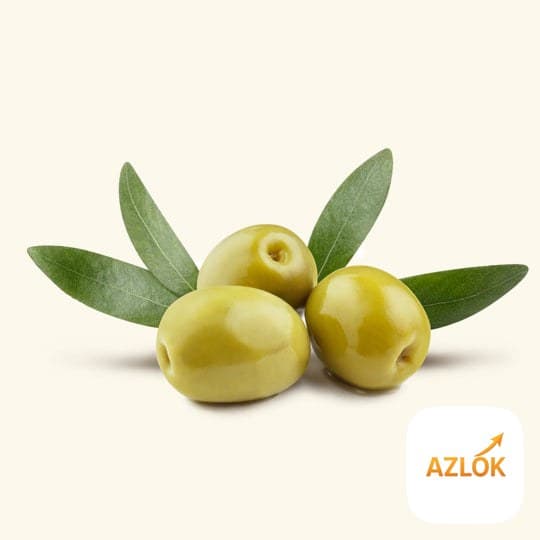

Olive Leaf Extract is a liquid herbal extract made from the leaves of the olive plant (Olea Europaea), and in DIY personal care it is mostly used as a botanical add-in for soaps, creams, lotions, serums, shampoos and face washes at around 1–2% of your formula. It is tasteless, has no odour, and Azlok offers it in both water-soluble and oil-soluble versions so you can match it to whatever base you are working with.
What Olive Leaf Extract Actually Is
Olive leaves have long been part of the Mediterranean diet and traditional home remedies. While most people know olives for eating and for olive oil, the leaves themselves are extracted separately. This product is a 4:1 extract, which means roughly 4 kg of dried olive leaf yields 1 kg of finished extract — a concentrated form that goes a long way in formulations.
A few useful specifics for makers:
- Botanical name: Olea Europaea (also called Jaitoon)
- CAS number: 8001-25-0
- Physical form: liquid
- Water-soluble version: alcohol-free, extracted using vegetable palm glycerin / vegetable glycerol
- Oil-soluble version: extracted using soy oil as the solvent
- Preservative note: contains BHT (Butylated Hydroxytoluene)
- Free from: gluten, artificial colour, heavy metals and fertilisers
Where Makers Use It
Because it carries no smell or taste of its own, Olive Leaf Extract slots into a wide range of recipes without changing your fragrance or feel. Common applications include:
- Cold-process and melt-and-pour soaps
- Shampoos and hair rinses
- Face and body creams and lotions
- Serums, face washes and toners
- General DIY personal care for face, hair, skin and body
The rule of thumb here is to choose the right solubility. If your base is water-based — a toner, gel or shampoo — reach for the water-soluble (glycerin) type. If you are building an oil serum, balm or oil-heavy cream, the oil-soluble (soy oil) version blends in cleanly.
How to Use It
Keep it simple and stay within the recommended range:
- Decide your batch size and calculate 1–2% of the total weight of the formula.
- Pick the matching version — water-soluble for water phases, oil-soluble for oil phases.
- Add it during the cool-down stage of your recipe rather than at high heat, and stir gently until fully combined.
- Note it clearly in your batch records so you can repeat successful formulas.
Because the extract is 4:1 concentrated, there is no benefit to overloading your product. More is not better, and staying in range keeps the final feel and stability predictable.
Safety and Honest Notes
This is a cosmetic and DIY ingredient. A few sensible precautions:
- No herb–drug interactions are known, but caution should still be observed with external applications.
- Always run a patch test when introducing any new ingredient into skin or hair care.
- The oil-soluble version is extracted with soy oil, so keep that in mind if you or your customers have soy sensitivities.
- The product contains BHT as a preservative — declare all ingredients honestly on your labels.
- Keep away from children and store safely. Treat it as a formulation ingredient, not a food supplement, and follow the prescribed dosage.
Buying and Storage
Azlok stocks Olive Leaf Extract from 100 Gm bottles for hobby batches right up to 25 Kg for small businesses and workshops, with pricing starting at ₹299. Choose your size based on how quickly you go through it — buying a smaller pack first lets you test both the water- and oil-soluble types before committing to bulk.
For storage, keep it in a cool, dry place away from direct sunlight and heat, with the cap tightly closed. Stored well, it has a shelf life of about 2 years. Each grade comes with its own COA and MSDS documentation, which is worth requesting if you are formulating for sale.
FAQ
What is the difference between water-soluble and oil-soluble Olive Leaf Extract?
The water-soluble version is alcohol-free and extracted using vegetable glycerin, so it mixes into water-based products like toners and shampoos. The oil-soluble version uses soy oil as the solvent and blends into oil-based products such as serums and balms.
How much Olive Leaf Extract should I add to my formula?
The recommended usage is 1–2% of the total weight of your formulation. Add it during the cool-down phase and stir until fully incorporated.
Does Olive Leaf Extract have a smell or taste?
No. It is tasteless and odourless, which makes it easy to add without affecting the fragrance or scent profile of your product.
What does a 4:1 extract ratio mean?
It means roughly 4 kg of olive leaf herb is used to produce 1 kg of finished extract, making this a concentrated form. A little goes a long way, so there is no need to exceed the recommended dosage.
How long does it last and how should I store it?
It has a shelf life of about 2 years when stored in a cool, dry place away from sunlight, with the container kept tightly sealed.