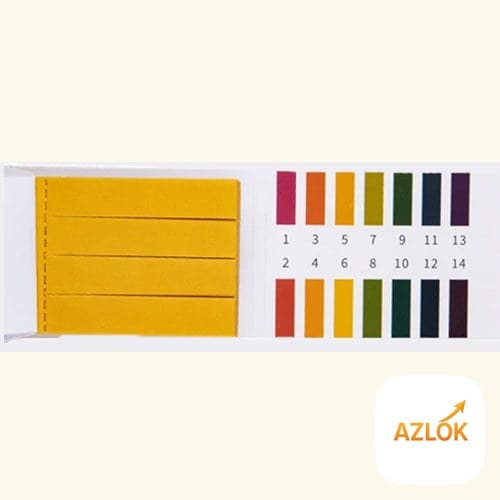

pH test strips are small strips of treated litmus paper that tell you whether a liquid is acidic or alkaline. You dip a strip into your sample, wait a few seconds, and match the colour that appears to the reference chart. Azlok's 1-14 pH test strips read the full scale, so a value near 1 means strongly acidic, 7 is neutral, and readings towards 14 mean strongly alkaline.
Each book contains 80 strips, and you can buy anything from a single book to a pack of 20, depending on how often you test. At ₹99 for a book, it is one of the cheapest quality-check tools you can keep on your workbench.
What you can test with pH strips
These strips are handy across the kitchen, the soap studio and the home lab. Common uses include:
- Soap and cold-process batches: checking that cured soap is not too alkaline before use.
- Water testing: a quick reading for drinking water, aquarium water or RO output.
- Milk and dairy: a rough freshness indicator, since souring milk becomes more acidic.
- Cosmetic products: confirming that creams, toners and shampoos sit in a skin-friendly range.
- Chemicals and cleaning solutions: verifying dilutions and mixed solutions.
How to use pH test strips correctly
The method is simple, but small habits make your readings more reliable.
- Pour a little of the liquid into a clean, dry container rather than dipping into the whole batch.
- Take one strip and dip it in for one to two seconds, making sure the coated section is fully wetted.
- Remove it and hold it flat. Do not shake or wipe it.
- Wait about 10-15 seconds for the colour to develop.
- Hold the strip against the reference chart on the pack, in good daylight, and pick the closest matching band.
For solid or semi-solid samples like soap or cream, dissolve a small amount in distilled water first, then test that solution.
Tips for accurate results
- Use distilled or clean water when you need a baseline; tap water can shift the reading slightly.
- Compare colours under natural light. Yellow bulbs and screens can throw off your judgement.
- Read within the recommended time. Leaving a strip too long can make the colour drift.
- Handle strips with dry fingers, or the sweat and oils on your skin can contaminate them.
- Remember these are estimation strips. They give you a band, not a decimal-precise number like a digital meter. For most home and small-business checks, that band is enough.
Safety notes
pH strips themselves are safe to handle, but the liquids you test may not be. When checking chemicals, acids or strong cleaners, work in a ventilated area, wear gloves, and avoid splashes. Never taste a sample to judge it. Keep the strips and any test solutions away from children. Used strips can go in normal waste unless the tested chemical requires special disposal.
Buying and storage
Buy a pack size that matches your usage. A single book of 80 strips suits occasional home testing, while soap makers, small cosmetic brands and labs often prefer the 5, 10 or 20 book packs to avoid running out mid-project. Azlok stocks all these options.
Store the strips in their original container with the lid closed. Keep them somewhere cool and dry, away from direct sunlight, steam and strong fumes, since moisture and vapours can spoil the reactive coating before you even use them. Do not touch the coated pads with wet hands. Stored well, an unopened book stays usable for a long time.
FAQ
What does the 1-14 range mean?
It covers the full pH scale. Values from 1 to below 7 are acidic, 7 is neutral, and above 7 up to 14 is alkaline. The further from 7, the stronger the acidity or alkalinity.
Are pH strips as accurate as a digital meter?
No. Strips give you an approximate band by colour matching, which is fine for soap, water, milk and cosmetic checks. If you need precise decimal readings, use a calibrated digital pH meter.
Can I test soap with these strips?
Yes. Dissolve a small shaving of soap in distilled water and dip a strip into that solution. Good finished soap usually reads in the mildly alkaline range rather than harshly high.
How many tests does one book give?
Each book has 80 strips, so you get 80 single tests. You cannot reuse a strip once it has reacted.
How should I store the strips?
Keep them in the sealed container in a cool, dry place, away from sunlight and moisture. Use dry hands and close the lid immediately after taking a strip.