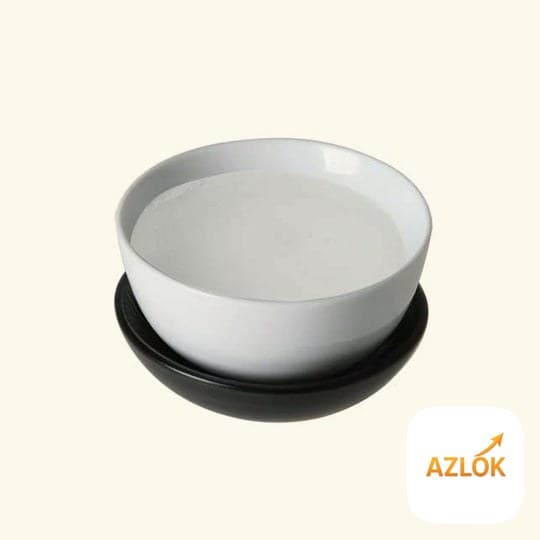
Sodium Lauryl Ether Sulphate (SLES): The Foaming Agent Behind Your Shampoo and Face Wash

Sodium Lauryl Ether Sulphate (SLES) is an anionic surfactant and foaming agent used in shampoos, face washes, shower gels, hand washes and liquid cleansers. It cuts grease, lifts dirt and produces a thick, uniform lather that dissolves easily in both hard and soft water, which is why it appears in so many personal care formulas. Azlok stocks SLES in an easy-pour liquid form for makers and small businesses.
What is SLES and why is it used?
SLES is short for sodium laureth sulfate (also written as sodium lauryl ether sulphate or sodium alkyl ether sulphate). It is made by ethoxylating sodium lauryl sulfate, which gives it a gentler feel while keeping its strong cleaning power. Its INCI name is Sodium Laureth Sulfate and its CAS number is 9004-82-4.
In simple terms, SLES is a detergent that helps water mix with oil and grime. When you rub it between wet hands it foams up, traps dirt and sebum, and rinses away cleanly. Because it is inexpensive and highly effective, it remains one of the most common primary surfactants in the cosmetics industry.
- Form: Colourless liquid with a characteristic odour
- Active strength: around 28% (SLES 28%)
- pH: roughly 6.86
- Solubility: dissolves readily in water
- Grade: Industrial grade, made in India
- Shelf life: 24 months
Common uses and applications
SLES is the workhorse behind a wide range of rinse-off and emulsion-based products. You will find it in:
- Shampoos and hair conditioners
- Face washes, body washes and shower gels
- Liquid hand wash and dishwash
- Foaming cleansers and bubble baths
- Creams, gels, lotions, foundations and some sunscreen bases
It works well as the main foaming base, and is often paired with milder secondary surfactants and additives to balance the final feel of a product.
How to use SLES in a formulation
SLES comes as a concentrated liquid, so it is diluted with water and blended with other ingredients rather than used neat. A basic approach for a simple cleanser looks like this:
- Weigh your water phase and gently warm it if needed.
- Add SLES slowly and stir without whipping air in — over-stirring creates stubborn foam that is hard to work with.
- Blend in secondary surfactants, humectants or conditioning agents as your recipe requires.
- Adjust thickness (commonly with salt) and check the pH; most skin and hair cleansers sit in the mildly acidic to neutral range.
- Add preservative, fragrance and colour last, then bottle.
Always follow a tested recipe and start with small batches. Exact percentages depend on whether you are making a shampoo, hand wash or body wash, so refer to reliable formulation guidance for your specific product.
Safety and handling
SLES is meant for external use in properly formulated products. Handle the concentrate with care:
- Avoid direct contact with the eyes; the concentrate can be irritating.
- Wear gloves and work in a ventilated space when measuring and mixing.
- Do not ingest, and keep it out of the reach of children.
- Patch-test any finished product before regular use, especially on sensitive skin.
- Rinse thoroughly with water if the concentrate contacts skin or eyes.
Refer to the COA and MSDS for detailed handling information before working with larger quantities.
Buying and storage tips
Azlok offers SLES in a range of pack sizes to suit hobbyists and businesses — 500 GM, 1 KG, 5 KG, 10 KG, 20 KG and 25 KG — starting at ₹249. Smaller packs are ideal for testing recipes, while bulk drums make sense for regular production.
- Store in a cool, dry place away from direct sunlight and heat.
- Keep the container tightly closed to prevent contamination and moisture pick-up.
- Use within the 24-month shelf life for best performance.
- Label diluted batches clearly, especially if children are around.
FAQ
Is SLES the same as SLS?
No. SLS (sodium lauryl sulfate) is the parent compound. SLES is made by ethoxylating SLS, which makes it milder and better tolerated in rinse-off products while still foaming strongly.
Can I use SLES directly on my skin or hair?
No. SLES is a concentrated surfactant meant to be diluted and blended into a finished formula. Using it neat can irritate the skin and eyes.
Does SLES work in hard water?
Yes. SLES 28% dissolves quickly in both hard and soft water and produces a uniform, stable foam, which is one reason it is so widely used.
How much SLES should I add to my recipe?
It depends on the product. Different cleansers use different active levels, so follow a tested recipe, start with a small batch and adjust foam and thickness before scaling up.
What pack size should a beginner buy?
The 500 GM or 1 KG pack is a sensible starting point for trials and small batches. Move to larger sizes once your recipe is finalised and you are producing regularly.