Stearic Acid: The Everyday Ingredient Behind Creamy Lotions and Firm Candles

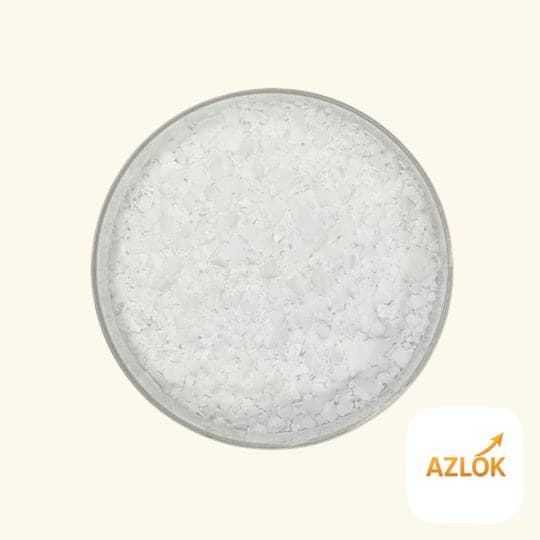
Stearic acid is a plant-derived fatty acid used to thicken, harden and stabilise homemade cosmetics, soaps and candles. In creams and lotions it acts as an emollient and co-emulsifier that gives a smooth, non-greasy finish; in candles it raises the melting point so the wax burns slower and holds its shape. It is a white, waxy solid with a faint characteristic odour and a chemical formula of C18H36O2.
What stearic acid actually does
Chemically, stearic acid (IUPAC name octadecanoic acid, CAS 57-11-4) occurs naturally in many vegetable oils and animal fats. On its own it does not dissolve in water, but it blends completely into oils. That property is exactly why formulators reach for it. It sits at the boundary between the oil and water phases of a product and helps hold them together, while adding body and a pleasant slip.
- Emollient: softens and conditions the skin's surface.
- Co-emulsifier and thickener: stabilises lotions and creams and makes them richer.
- Hardening agent: firms up soap bars and candle wax.
- Opacifier: gives products a creamy, opaque look rather than a watery one.
Common uses
You will find stearic acid across a wide range of everyday products. Azlok's stearic acid is an industrial-grade powder at 99% purity, suited to hobby and small-batch work in these areas:
- Lotions and creams: paired with an emulsifier to build thickness and a velvety texture.
- Soaps: harder, longer-lasting bars with a stable lather.
- Candles: added to paraffin or blended waxes to improve hardness and burn time.
- Foundations and colour cosmetics: as a base that carries pigments smoothly.
- After-shave and skin-protection products: for a protective, conditioning feel.
How to use it
Stearic acid is oil-soluble, so it always goes into the oil phase of your formula. Because it melts fully around 60-70°C, heat is part of the process.
- Weigh your ingredients. Stearic acid works best measured by weight, not volume.
- Add it to your oils and heat gently in a double boiler until it melts and turns clear.
- For emulsions, combine the heated oil phase with the heated water phase and stir or blend until it thickens and cools.
- For candles, stir the melted stearic acid into your molten wax before pouring.
As a general starting point, many lotion formulas use around 1-5% stearic acid, while candles may use a few percent by weight of wax. Treat these as rough guides and always follow a tested recipe, then adjust in small batches.
Safety and handling
Stearic acid is widely regarded as a low-hazard cosmetic ingredient, but sensible handling still matters, especially with an industrial-grade powder.
- Work in a ventilated area and avoid breathing in the fine powder; a dust mask is a good idea when weighing large quantities.
- It melts at high temperatures, so treat hot melted material with care to avoid burns.
- Keep away from children and pets, and store away from open flames.
- This is a cosmetic and industrial raw ingredient, not a food product. Do not ingest it.
- New to a formula? Patch-test any finished product on a small area of skin before regular use.
- Refer to the product's COA and MSDS for detailed specifications and safe handling.
Buying and storage
Azlok offers stearic acid in 500 g, 1 kg, 5 kg, 10 kg and 20 kg packs, so you can start small for testing and scale up once a recipe works. The 500 g pack is priced at ₹299, which suits hobby makers, while the larger packs make sense for regular soap, candle or skincare batches.
Store it in a cool, dry place in a tightly closed container, away from direct sunlight and moisture. Kept properly, it has a shelf life of about 24 months. Because it is a stable solid, it does not need refrigeration; just protect it from heat and humidity so it stays free-flowing.
FAQ
Is stearic acid vegan?
Stearic acid can come from either plant or animal sources. It occurs naturally in vegetable oils, and this grade is described as derived from plant sources. If a fully vegan supply chain is essential for your business, confirm the source with the supplier documentation.
Does stearic acid dissolve in water?
No. It does not dissolve in the water part of a formula, but it dissolves completely in oils. That is why it is added to the oil phase and melted before combining with water.
What is the difference between stearic acid as a thickener and an emulsifier?
Stearic acid mainly thickens and adds body. It supports emulsification but usually works alongside a dedicated emulsifier to keep oil and water phases stable in a lotion or cream.
Can I use stearic acid in candles?
Yes. Adding a small percentage to paraffin or blended wax raises the melting point, hardens the candle and can improve burn time. Stir it into the molten wax before pouring.
How much stearic acid should I add to a lotion?
Many lotion recipes use roughly 1-5% by weight. Start at the lower end, test the texture, and adjust in small batches until you get the thickness you want.