

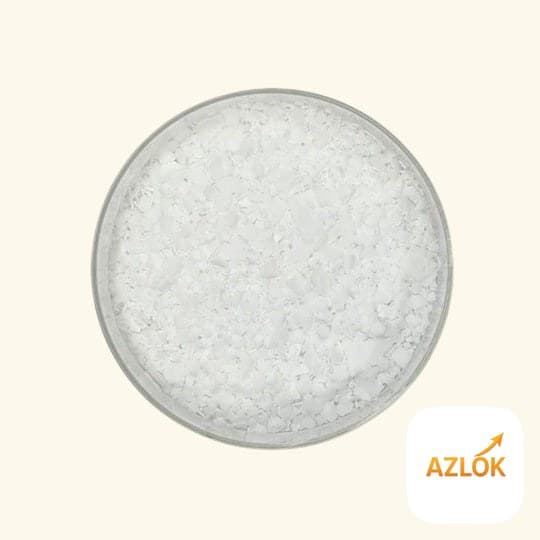

Stearic Acid
Minimum Order: 1 units
Description
Stearic Acid (C18H36O2, CAS 57-11-4) is a saturated fatty acid that appears as a white waxy powder. It is widely used in cosmetics and personal care as an emulsifier, surfactant, and emollient in soaps, lotions, candles, and shaving products. Azlok supplies 99% pure industrial-grade stearic acid in packs from 500 g to 20 kg.
History & Discovery
Stearic acid was first isolated in the early 19th century by French chemists Michel Eugène Chevreul and Joseph Louis Gay-Lussac, who derived it from animal fat. The name comes from the Greek word 'stear', meaning tallow or solid fat. Historically it was obtained by saponification of animal tallow, and the isolation of this compound helped establish modern fat chemistry and laid the groundwork for the soap-making industry. Over time, plant-derived sources such as palm oil and shea butter became common alternatives, making stearic acid production more versatile and widely available.
Scientific & Medicinal Importance
Stearic acid (octadecanoic acid) is an 18-carbon saturated fatty acid with the molecular formula C18H36O2 and a molecular weight of 284.48 g/mol. It melts at approximately 69–70 °C and boils at 361 °C, making it a solid at room temperature. Its HLB value of 15 indicates strong hydrophilic character, which is why it functions effectively as an emulsifier — helping water and oil phases blend uniformly in creams and lotions. In soap making, stearic acid reacts with alkalis (saponification) to produce solid, long-lasting soap bars. It also acts as a thickener and hardener, giving candles their opacity and increasing the melting point so candles burn longer and more evenly. At 99% purity with a pH of approximately 6, the Azlok grade is suitable for both industrial and cosmetic formulations.
Modern-Day Applications & Benefits
Stearic acid is one of the most widely used raw materials in personal care manufacturing. In lotions and creams it provides a smooth, non-greasy feel and helps stabilise emulsions. In solid soaps it contributes hardness and a creamy lather. Candle makers use it to harden paraffin wax, improve opacity, and raise the melting point, resulting in candles that are firmer and burn more evenly. It also appears in shaving creams, foundations, and lipsticks as a texture agent. For DIY soap and candle makers and small cosmetic businesses in India, Azlok offers stearic acid in multiple pack sizes (500 g to 20 kg) so both hobbyists and bulk buyers can source it conveniently. Safety: Stearic acid is considered low-hazard in its solid powder form, but inhalation of fine dust should be avoided — work in a ventilated area and use a dust mask when handling large quantities. It is not intended for ingestion in its industrial form. Keep away from children. Store in a cool, dry place away from moisture and strong oxidising agents.
Why Azlok's Version is Trusted Today
Azlok
Frequently asked questions
What is stearic acid used for in soap making?
In soap making, stearic acid reacts with lye (NaOH or KOH) through saponification to produce a hard, long-lasting bar with a stable, creamy lather. It also increases the hardness of the final bar.
How much stearic acid should I add to candle wax?
A common usage rate is 5–10% stearic acid by weight of the paraffin wax. This hardens the candle, increases opacity, and raises the melting point for a longer, more even burn. Adjust based on your desired hardness.
Is this stearic acid food grade or cosmetic/industrial grade?
The Azlok stearic acid listed here is industrial grade (99% purity, CAS 57-11-4) intended for cosmetic, soap, and candle applications. It is not certified food grade and should not be used in food products.
What is the recommended usage rate for stearic acid in lotions and creams?
In emulsified creams and lotions, stearic acid is typically used at 2–8% of the total formulation. It thickens the product, stabilises the emulsion, and gives a smooth skin feel. Always test in a small batch first.
How should I store stearic acid and what is its shelf life?
Store stearic acid in a sealed container in a cool, dry place away from moisture, direct sunlight, and strong oxidising agents. The shelf life is 24 months from the date of manufacture when stored correctly.
Specifications
Documents
Safety data sheet not yet published for this product — request one below and we will email it.
How to use Stearic Acid
Guides covering uses, dilution, safety and storage.