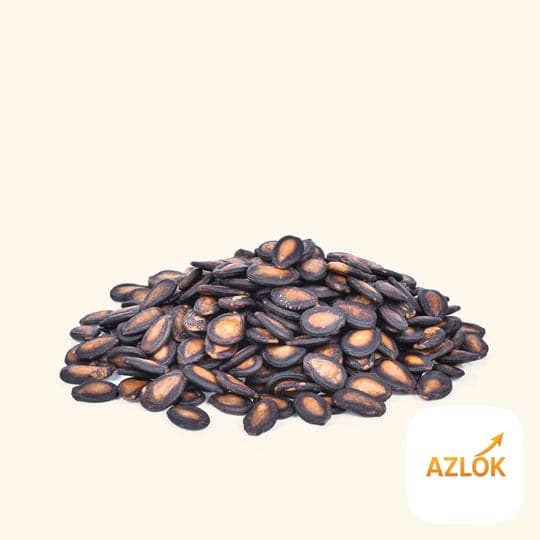

Watermelon Seed Oil is a light, cold-pressed carrier oil made from the seeds of Citrullus lanatus. It absorbs quickly, feels non-greasy, and is a good choice for oily and combination skin, while its fatty acids and antioxidants also help nourish dry skin. Because it is a carrier oil, you can use it on its own or blend it with essential oils and other fixed oils.
What is Watermelon Seed Oil?
Also known in some regions as Kalahari oil, this oil is pressed from watermelon seeds and is prized for feeling remarkably light on the skin. Azlok's version is cold-pressed in India, which helps retain the natural fatty acid profile. It is dark yellow to brownish in colour, liquid at room temperature, and carries a mild, characteristic odour rather than a strong scent.
Its major constituents are linoleic acid, oleic acid, stearic acid and palmitic acid. The high linoleic acid content is one reason it sits so well on oily skin without clogging the feel of the surface.
Common uses
Watermelon Seed Oil is versatile enough for both personal care and DIY formulation. Popular ways to use it include:
- Facial oil for oily skin: A few drops smoothed over cleansed skin, thanks to its light, fast-absorbing texture.
- Nourishing dry skin: Its fatty acids and antioxidants help condition skin that feels tight or flaky.
- Massage oil: A good base that spreads easily and does not leave a heavy residue.
- Under-eye creams and lotions: Often added to formulations for its light slip.
- Lip care products: Blends into balms and butters.
- Soap and candle making: Works as a carrier in melt-and-pour or cold-process projects, and in scented candles.
- Aromatherapy: Add it to diffuser blends or combine with essential oils for topical use.
How to use it
As a face or body oil, apply a small amount to clean skin and massage gently until absorbed. For a diluted blend, mix your chosen essential oil into the Watermelon Seed Oil before applying, since essential oils should never go directly onto skin undiluted. A common guideline for adults is roughly 6 to 12 drops of essential oil per 30 ml of carrier oil, adjusted lower for sensitive skin.
It blends particularly well with argan, almond and castor oils, so you can mix it into a custom face oil or hair treatment. In soap and candle work, treat it like other liquid fixed oils and follow your recipe's oil ratios.
Safety and patch testing
This oil is meant for external use only. A few sensible precautions:
- Do a patch test on your inner forearm and wait 24 hours before wider use.
- Keep it away from direct contact with the eyes.
- Avoid direct exposure to sunlight during storage.
- Do not ingest it, and keep it out of the reach of children.
These are general good-practice notes for any carrier oil rather than a claim that the oil treats any condition. If you have a known allergy or a skin concern, check with a professional first.
Buying and storage tips
Azlok offers Watermelon Seed Oil starting at ₹249, with pack sizes ranging from 100 GM for home users up to 5 KG, 10 KG, 20 KG and 25 KG for small businesses and bulk formulators. Choose a smaller size if you are trying it for the first time, and scale up once you know it suits your recipes.
To keep it fresh through its two-year shelf life:
- Store in a cool, dark place away from heat and sunlight.
- Keep the cap tightly closed to limit exposure to air.
- Use clean, dry tools or droppers to avoid contamination.
- Watch for any change in smell, which can signal that an oil is past its best.
FAQ
Is Watermelon Seed Oil good for oily skin?
Yes. It is light and absorbs quickly, which is why it is often recommended for oily and combination skin. Its high linoleic acid content is part of the reason it feels non-greasy.
Can it be used on dry skin too?
It can. The oil contains essential fatty acids and antioxidants that help nourish and condition dry skin, so it works across skin types.
Can I put Watermelon Seed Oil directly on my face?
As a carrier oil, yes, after a patch test. If you are adding essential oils, dilute them into the Watermelon Seed Oil first rather than applying them neat.
What oils does it blend well with?
It blends nicely with argan, almond and castor oils, and is soluble in alcohol and most fixed oils, making it easy to use in custom formulations.
How should I store it and how long does it last?
Keep it in a cool, dark place with the lid closed. Stored well, it has a shelf life of about two years.