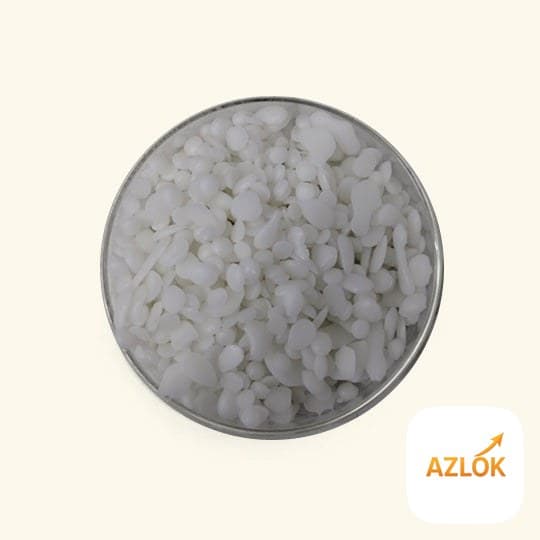

White beeswax pellets are refined, filtered beeswax shaped into small beads that melt quickly and evenly, making them ideal for candle making, lip balms, salves, lotions and creams. Because they are odourless and neutral in colour, they suit almost any recipe where you want the structure of natural wax without adding a strong scent or tint.
What are white beeswax pellets?
Beeswax is produced by honeybees to build the honeycomb, and it is collected during honey harvesting. In its raw state it carries a golden colour and a faint honey aroma. Azlok's white beeswax pellets (INCI name Cera Alba, CAS 8012-89-3) have been filtered so the natural pigments are removed, leaving a light, near-neutral wax. The pellet form is the practical part: instead of chipping away at a hard block, you simply scoop out what you need and it melts fast.
Quick specifications to know before you start:
- Form: solid pellets, white to pale yellow
- Melting point: roughly 144 to 147 °F (about 62 to 64 °C)
- Saponification value: around 88.96
- Shelf life: about 2 years when stored well
Common uses
Beeswax is one of the oldest candle waxes in the world, and it remains a favourite for good reason. Here is where these pellets earn their keep:
- Candle making: beeswax burns slowly and holds its shape well; blend it with soy or coconut wax for softer texture.
- Lip balms and lip care: it gives balms their firmness and forms a protective, hydrating layer.
- Lotions, creams and salves: beeswax acts as a natural emulsifier and thickener, adding body to your formulations.
- Soap bars: a small amount adds hardness and a smooth finish.
- Hair and skincare products: used in moustache waxes, hair pomades, cuticle balms and barrier creams.
How to use white beeswax pellets
The golden rule is gentle, indirect heat. Beeswax is flammable if overheated, so never melt it directly on a flame or in a pan on high heat.
- Weigh your pellets on a kitchen scale rather than measuring by volume.
- Melt using a double boiler or a heatproof bowl set over simmering water. Keep the heat low and stir occasionally.
- For balms, a common starting ratio is 1 part beeswax to 3 to 4 parts carrier oil. Adjust for a firmer or softer feel.
- Once fully melted and combined with your oils or butters, remove from heat and add any essential oils or fragrance last, when the mix has cooled slightly.
- Pour into clean tins, jars or moulds and let it set undisturbed.
A simple lip balm: melt 10 g beeswax pellets with 30 g of a carrier oil like almond or coconut, stir well, then pour into small pots. Test the set balm on the back of your hand and re-melt with a little more oil if it feels too hard.
Tips and safety notes
- Wipe pots and utensils with kitchen paper while still warm; hardened beeswax is stubborn to clean.
- Work in a ventilated space and keep melted wax away from children and pets.
- For skincare, always do a patch test with your finished product before regular use.
- Beeswax adds structure but is not a preservative. If your recipe contains water (like a lotion), you must add a suitable preservative.
- These pellets are for making cosmetics and candles, not for eating.
- People with a known bee-product allergy should avoid it.
Buying and storage
Azlok offers white beeswax pellets from a 500 gm pack starting at ₹329 up to bulk 25 kg sizes, so hobbyists and small businesses can both buy sensibly. If you are testing a new recipe, start with the 500 gm pack; scale up to 5 kg or more once you settle on a formulation.
Store the pellets in a cool, dry place away from direct sunlight and strong odours, since wax can pick up ambient smells over time. Keep the pack sealed and it will stay usable for about two years.
FAQ
What is the difference between white and yellow beeswax?
Both come from the honeycomb. Yellow beeswax is unrefined and keeps its natural golden colour and honey scent, while white beeswax is filtered to remove the pigment, leaving it near-colourless and odourless. White is better when you want a neutral base for cosmetics or lightly coloured candles.
Is white beeswax good for candle making?
Yes. Beeswax is one of the oldest candle waxes and burns slowly with a clean flame. Many makers blend it with soy or coconut wax for an easier pour and softer texture.
Are these beeswax pellets edible?
No. Treat them as a cosmetic and candle-making ingredient. Do not ingest them, and keep them away from children.
How much beeswax do I use in a lip balm?
A common starting point is 1 part beeswax to 3 to 4 parts carrier oil. Increase the beeswax for a firmer balm and reduce it for a softer, glossier feel.
How should I melt beeswax pellets safely?
Use a double boiler over simmering water on low heat and stir occasionally. Never heat beeswax directly over a flame, as it is flammable when overheated.