

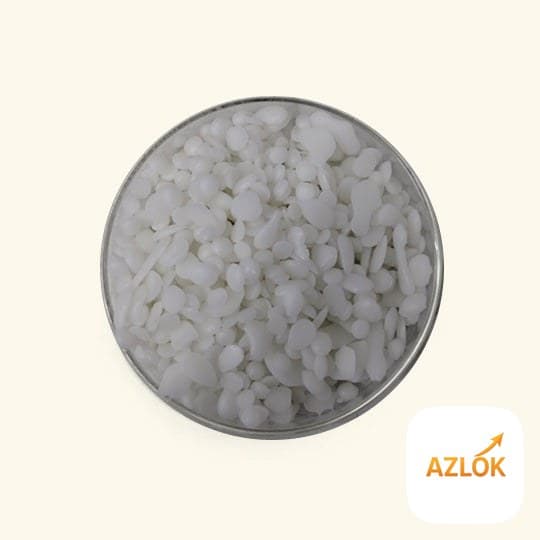

White Beeswax Pellets
Minimum Order: 1 units
Description
White Beeswax Pellets (INCI: Cera Alba, CAS 8012-89-3) are naturally filtered beeswax in easy-to-melt pellet form, refined to remove colour and odour. Melting point 144–147 °F. Suitable for candle making, lip balms, lotions, creams, soaps, and hair-care formulations. Available from 500 g to 25 kg on Azlok.
History & Discovery
Beeswax has been used by humans for thousands of years. Ancient Egyptians used it to seal mummies and waterproof ships, while Romans and Greeks used beeswax candles in religious ceremonies. It is one of the oldest known waxes, with records of its use dating back more than 9,000 years in archaeological sites across Europe and the Middle East. Beeswax was also historically used as a wood polish, a lubricant for threads and metal tools, and a base for early cosmetic preparations including lip salves and skin ointments. White beeswax specifically is produced by filtering and sometimes briefly exposing raw yellow beeswax to sunlight or by mechanical filtration, which removes the pollen, propolis, and pigments responsible for the yellow colour, leaving a paler, odour-reduced wax.
Scientific & Medicinal Importance
Beeswax is a complex mixture of esters, fatty acids, long-chain alcohols, and hydrocarbons secreted by worker honey bees (Apis mellifera and related species) from glands on their abdomen. Its CAS number is 8012-89-3. The saponification value of 88–96 indicates low ester content compared to vegetable fats, which is why it does not fully saponify under standard soap-making conditions and must be used in small proportions in cold-process soap. Its melting point of 62–64 °C (144–147 °F) makes it suitable as a thickener and hardener in cosmetic formulations. Beeswax forms a breathable, semi-occlusive film on the skin that helps retain moisture without completely blocking the skin's ability to exchange gases. It is insoluble in water but soluble in most organic solvents and fixed oils when heated. White beeswax has the same chemical composition as yellow beeswax; the difference is only in colour and slight reduction in natural scent due to the filtration process.
Ayurvedic and Traditional Uses
In Ayurvedic literature, beeswax is called Madhuchchhishta, a Sanskrit word usually explained as 'what remains of honey', meaning the comb left after the honey is drained. Classical texts mention it mainly as a base material. Melted together with ghee or plant oils, it gave traditional preparations a soft, spreadable consistency, much like a balm today. In Indian homes and crafts, beeswax, known simply as 'mom', has had practical uses for generations. It was used to wax thread, polish wood and make lamps. It is also central to Dhokra, the old lost-wax method of metal casting. Traditionally, the raw yellow wax was used straight from the comb. White pellets are a refined, bleached form of the same material. This context is shared as history only. For skin preparations, do a patch test, use externally, and consult a doctor if pregnant or on medication.
Modern-Day Applications & Benefits
White beeswax pellets are widely used in modern cosmetic and personal-care manufacturing. In lip balms and lipsticks, they provide structure, glide, and a smooth texture while forming a protective barrier on lips. In body lotions and creams, beeswax acts as a natural emulsifier and thickener, helping water and oil phases remain stable. In cold-process and melt-and-pour soap making, small quantities (2–5%) add hardness to bars. For candle making, pure beeswax candles burn longer and cleaner than many paraffin alternatives, producing minimal soot and a faint natural honey scent (less pronounced in white beeswax). The pellet form is preferred by DIY makers and small manufacturers because it melts quickly and uniformly compared to blocks. Azlok supplies white beeswax pellets in quantities from 500 g for home crafters to 25 kg for industrial buyers, making it accessible at multiple scales. When melting, always use a double boiler and avoid direct flame, as beeswax is flammable above its flash point (~204 °C).
Why Azlok's Version is Trusted Today
Azlok
Frequently asked questions
What is the melting point of these white beeswax pellets?
The melting point is 144–147 °F (approximately 62–64 °C). Use a double boiler to melt safely; avoid direct heat sources.
Are these beeswax pellets suitable for making lip balm?
Yes. White beeswax is a standard ingredient in lip balm formulations, typically used at 15–30% to provide structure and a protective barrier on the lips.
What is the difference between white and yellow beeswax?
White and yellow beeswax have the same chemical composition. White beeswax is filtered to remove pollen, propolis, and natural pigments, resulting in a lighter colour and a milder scent. Yellow beeswax retains its natural honey aroma.
Can I use white beeswax pellets in candle making?
Yes. Beeswax is one of the oldest candle waxes. It burns slowly with minimal soot. Use 100% beeswax or blend with other waxes. Note that beeswax has a higher melting point than paraffin, so adjust wick size accordingly.
How should I store white beeswax pellets and what is the shelf life?
Store in a cool, dry place away from direct sunlight and heat. Keep the container sealed to prevent dust contamination. Shelf life is up to 2 years under proper storage conditions.
Specifications
How to use White Beeswax Pellets
Guides covering uses, dilution, safety and storage.